Category Archives: Economy

VDT picks up private prison national article: the news is not good for CCA

The VDT, after following the local private prison story, picked up a national story about CCA’s offer to 48 state governors to buy their prisons. CCA is not getting any takers.

AP wrote 10 March 2012, Firm offers states cash for prisons,

Despite a need for cash, several states immediately slammed the door on the offer, a sign that privatizing prisons might not be as popular as it once was.
Doesn’t seem very popular around here. Most people still don’t seem to have heard about the proposed local private prison, but once they do, by far most say they are against it.
Prison departments in California, Texas and Georgia all dismissed the idea. Florida’s prison system said it doesn’t have the authority to make that kind of decision and officials in CCA’s home state of Tennessee said they aren’t reviewing the proposal. The states refused to say why they were rejecting the offer.
Good for Georgia and the other states! Georgia, where the prison population is already plummeting.
“Knowing the state government, it has to have something to do with the potential political backlash,” said Jeanne Stinchcomb, a criminal justice professor at Florida Atlantic University who has written two books on the corrections industry. “Privatization has reaped some negative publicity, so I can only assume that despite the possible benefits, there would be a price to pay for supporting it.”
Do tell….

-jsq

Farm bill would reauthorize USDA REAP grants

Sen. Richard Lugar (R-Ind.) and Rep. Marlin Stutzman (R-Ind.) wrote for The Hill 5 March 2012, REFRESH Act: Strengthen rural communities and U.S. energy security
Reauthorize and reform the popular REAP program to demonstrate opportunities for economically viable energy investments and encourage loans rather than grants.
Rep. Sanford Bishop (D-Ga.) has long been working with local farmers and USDA to help with agriculture and rural jobs.

The Indiana Congress members continued:

Real commitment to rural growth requires that we put money where our mouth — or authorization — is. We offer basic mandatory funding that is more than paid for through cutting waste.

Renewable energy production creates jobs. Rural communities see potential for real economic growth in the emerging biofuel sector. Advances in technologies and agricultural techniques could offer economic benefits from coast to coast. Using the REFRESH Act as the basis for the next Farm Bill would help galvanize private investment in the sector, bringing jobs to a ready economy.

Indeed it can.

Obviously I like REAP grants, since we got one for Okra Paradise Farms. That 25% REAP grant plus an 35% ARRA NREL plus 35% GEFA credits will add up to 90% covered by grants and tax credits, which is a pretty good deal.

Now that remaining 10% is still a significant amount; like the price of a small car. But in 7-15 years (how long it will take to pay off this system, depending on how you figure it), what would the value of a car be? Much less than when you bought it. Meanwhile, these solar panels will be generating almost as much power as they are now, and they will continue to generate for at least a decade more, probably much more.

The big missing piece is up-front financing. Local banks will do it, but only for collateral. By which they mean real estate. Nope, they won’t take the solar equipment as collateral, even though it would still be operational many years from now.

Local banks or credit unions could see this as an opportunity and start accepting solar equipment as collateral. Beyond that, with a few changes to Georgia law, to deal with the power utility territoriality clause, and maybe to ban boondoggle charges for more dangerous and less job-producing power sources, we could get a commodity market in solar power in this state. You could put up solar panels like this, or more, on your house or business roof, and sell your excess power to somebody in Atlanta with less roof space. That would produce widely distributed energy, reducing need for foreign oil or dirty coal, lowering your electric bills, maybe even producing you a profit, and generating local jobs right here in south Georgia.

Private investment is ready to come in for utility-scale solar projects.

And companies like SolarCity that already do everything from financing to installation could do that in Georgia. Or home-grown companies could do that. Or local banks could finance while local companies installed.

Anyway, we have here on our workshop roof a proof of concept, operational right now, purchased partly via a USDA REAP grant.

-jsq

How and why did New Hampshire ban CWIP?

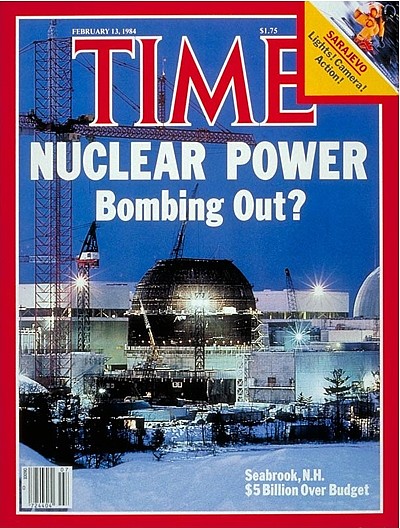
After years of protests and the Three Mile Island nuclear accident in Pennsylvania, the New Hampshire legislature passed a law that denied the Public Service Company of New Hampshire (PSNH) Construction Work in Progress (CWIP) charges before the Seabrook nuclear plant provided electricity to its customers. One of two planned Seabrook reactors did finally go into service in 1990, more than a decade late and far over budget. Meanwhile, the New Hampshire Supreme Court ruled the anti-CWIP law was constitutional, and PSNH went bankrupt in 1988:
the first investor-owned utility since the Great Depression to declare bankruptcy.
Seabrook was the last nuclear reactor built in the United States. Until now. In Georgia. Which has CWIP. Maybe we should change that.

Here’s an excerpt from a corporate history of Public Service Company of New Hampshire (PSNH):

By January 1972 PSNH had decided not only to build a nuclear plant at Seabrook but also to have it consist of two 1,150-megawatt units, to be completed in 1979. PSNH was to own 50 percent of the $1.3 billion project and share the remaining investment with other New England utilities. In January 1974 the New Hampshire Site Evaluation Committee, the Public Utilities Commission (PUC) and other regulatory bodies had issued the basic permits, but interveners in the case succeeded in having the New Hampshire Supreme Court overturn these permits. After repeated appeals and rehearings PSNH received its construction permit in July 1976—and experienced its first protest at the planned site.

There followed a decade of other protests at the site, inside regulatory chambers, and in New Hampshire and Washington courtrooms. The 1979 accident at the Three Mile Island nuclear-power plant in Pennsylvania—to name but one event that triggered concern

Continue reading

Who are the members of the Valdosta-Lowndes County Land Bank Authority?

Inquiring minds want to know who is on the board of the Valdosta-Lowndes County Land Bank Authority (VLCLBA)?

According to the Georgia Department of Community Affairs 2010 Directory of Registered Local Government Authorities:

Creation Date 6/24/1999
Method of Creation General Statute
Official Citation O.C.G.A. 48-4-61
Dependency Independent
Single or Multi Jurisdictional Multi-Jurisdictional
Members Lowndes County
City of Valdosta
Contact Mara S. Register, Assistant to the City Manager
Post Office Box 1125
216 E. Central Avenue
Valdosta, Georgia 31603
229-259-3571
Board Members Burke Sherwood, Frank Morman, James Wright, Joyce Evans,


Now we know.

How hard would it be for the City of Valdosta or the County of Lowndes to keep such information on their own web pages? They could include pictures better than the ones I found lying about on the web. Maybe even add agendas and minutes while they’re at it?

-jsq

Industrial Authority got wetlands easement from Lowndes County for private prison site

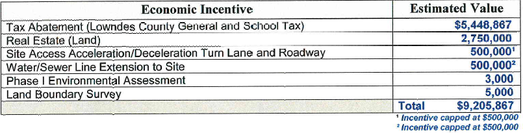
Before selling it off to a private landowner who who two years later got a contract with private prison company CCA to resell it for almost 100% profit, the Industrial Authority acquired a road easement through county-owned wetlands from Lowndes County:
Further, Grantor hereby conveys a Non-Exclusive Ingress and Egress Easement in that certain 0.685 acre tract or parcel of land situate, lying and being in Land Lot 153 of th 11th Land District of Lowndes County, Georgia. Said 0.685 acre tract being designated as “0.685 acres — Ingress/Egress Easement reserved for future right-of-way extension” as depicted on that certain map or survey “Valdosta-Lowndes County Industrial Authority” dated September 8, 2004 and recorded September 9, 2004 in Plat Cabinet A, Page 2659, Lowndes County records, to which map and survey is hereby referred in further aid of description.
An easement that a private landowner might have more difficulty getting from the county. Isn’t that convenient?

This is the wetland that has not yet been approved for that purpose by the Army Corps of Engineers, according to Ashley Paulk.

By the way, that wetland easement in 2004 was before Brad Lofton was hired in 2006 to be executive director of VLCIA, so the very peculiar history of this bit of land can’t all be blamed on him. The appointed Industrial Authority board and the elected Lowndes County Commission and Valdosta City Council are all also involved.

-jsq

Can Georgia ban Construction Work in Progress (CWIP)?

Georgia Power charges its customers Construction Work in Progress (CWIP) for the nuclear plants it is constructing at Plant Vogtle on the Savannah River. This while claiming a solar energy commodity market would raise rates for its customers. If nuclear is so great, why does it need to be pre-funded by customers? Can Georgia ban CWIP? Other states have.

This interesting survey by Wisconsin, courtesy of National Association of Regulatory Utility Commissioners (NARUC), says Illinois, Montana, New Hampshire, Ohio, and Oregon ban CWIP (except in certain cases for some of those states) and North Carolina and Washington in practice do not use it.

Appended below is the first question from the survey and the answers. The entire survey is on the LAKE website.

Here’s who in the Georgia state government you can contact about CWIP.

-jsq

CURRENT RETURN ON CWIP
VERSUS AFUDC [Allowance for Funds Used During Construction]
REGULATORY SURVEY RESULTS
March 2006

The Wisconsin Commission is relooking at its current practice for allowing a current return on construction work in progress (CWIP). We would appreciate it if you or someone else from your agency could respond to the following questions.
Continue reading

Crony capitalism corruption, a non-partisan enemy —Barbara Stratton

Received yesterday on VSU Health Sciences: much better than a private prison. -jsq
You know my main argument against the private prison is I don’t like public/private partnerships and the sweetheart deals they encourage. Also, when I requested CCA to provide me with information that supports private prisons so I could research both sides they did not respond. This led me to believe they have no concern for community opinion even when citizens are open minded and seeking honest information. They seem to prefer back room deals with local politicians that escape community detection unless citizens are aggressively observant like LAKE members.

However, we are not on the same page about what I consider simplistic solutions for reducing the prison population. Education and good drug treatment programs are definitely positives, but they are not the silver bullet liberals proclaim them to be. Criminals evolve from complex heredity and environmental mediums that don’t magically dissolve via education or intervention protocols. Certainly these are to be encouraged because they do help some, but they will never totally replace the need for legal intervention and penal institutions. In addition to educational and medical institutions not being a magical replacement solution for crime, these very institutions often encourage crony capitalism corruption, which we agree to be a non-partisan enemy.

In summary, I support our criminal justice system which includes prisons, but I do not support any mixing of government and business. Public/private partnerships are crony capitalism playgrounds that undermine free enterprise and citizen control. Unfortunately our trusted elected legislators have already filled our GA Codes and State Constitution with government consolidation and multi county regional partnership initiatives. At present, they are pushing SB 284, already passed by the senate, and in the house, which will further enhance Land Bank Authority powers and partnerships. As citizens we all need to remember that increasing unelected bureaucratic authorities equals minimized citizen control. We also need to ask our local, state and federal elected representatives why they are listening to special interest groups that encourage authorities and public/private partnerships instead of protecting their constituents.

-Barbara Stratton Commenter

We don’t have to agree on every point to oppose (private prison) or support (government transparency) the same things. Indeed, there will always be criminals, but we don’t need to lock up more than any other country on the planet. The big change in the environment that has produced seven times more criminals now than in the 1960s is the War on Drugs. Time to end that failed experiment in prohibition. Meanwhile, indeed crony capitalism corruption is our non-partisan enemy.

-jsq

A few questions I have… —Etta Mims

Received Monday. -jsq
John –

You have my permission to post this – these are the questions I have regarding the private prisons:

I believe research is one of my best friends! Thank you Wikipedia and Google!

I researched private prisons over the weekend, and here are some of my questions and “aha” statements:

  1. Please note: these Private Prisons are also called “For Profit Prison” – that right there should cause fear and trembling.
  2. If we as tax payers are funding these “Private/For Profit Prisons” are we allowed a percentage of the profits?
  3. “Private/For Profit Prisons” typically enter into contractual agreements with governments – again – fear and trembling.
  4. Why build a private prison? Why not add on to the current prison located to the west of I-75?
  5. If you look online, there are many Private/For Profit Prisons closing due to the recession:
  6. There are inadequately staffed Private/For Profit Prisons http://www.ccpoa.org/news/tags/tag/private+prisons This will lead to an increase in prisoners escaping.
  7. Prison employees typically live outside the county they work in, so how will this help our local economy?
I haven’t completed my research. I will continue to look into these questions and “ahas” until I understand the pros and cons completely.

Until then — I think March 13 is the deadline? Scary.

Heading out Drive Away CCA 2012 03 06

Yes, we drove about that slow the whole way: that was in the plan. We honked at Valdosta City Hall: the City Council could hear us inside.

They have Citizens to be Heard at their regular meeting tonight.

Here’s the video:


Heading out Drive Away CCA 2012 03 06
No private prison in Lowndes County,
Motorcade against Corrections Corporation of America, Drive Away CCA,
CCA, VLCIA, Corrections Corporation of America, Valdosta-Lowndes County Industrial Authority,
Valdosta City Council, Lowndes County Commission, incarceration, prison, private prison,
Valdosta, Lowndes County, Georgia, 6 March 2012.
Videos by Gretchen Quarterman for LAKE, the Lowndes Area Knowledge Exchange.

-jsq

Why private prison employees might not want to work too close to home —Barbara Stratton

Received yesterday on Video: Drive Away CCA radio. -jsq
Great interview John. The comment about employees not wanting to work at a facility in the same county they live in was an interesting thought relative to the proposed local employment benefits. When I worked for CCA in the inmate Mental Health unit at the Valdosta Correctional Institute we were always warned that keeping pictures of our families or anything personal on our desks was possibly dangerous and therefore not recommended. I loved my job there because being inside the prison meant we had to form close working relationships with each other and I love teamwork on the job and it was never boring. We had almost constant training hours warning us about the dangers of being in close contact with inmates and all the rules about interacting. Forheight=”1 instance we had one inmate who was a brilliant artist. He like to gift us with his artwork, which we were allowed to accept as a non-personal gift to be placed on the office walls. He was a very well behaved prisoner especially to females, but his beautiful artwork always consisted of some form of predator watching prey such as a cat watching a bird. We loved the artwork, but took note of the inuendos.

Prisoners were always given strict instructions that

Continue reading