Tag Archives: bankruptcy

Solar faster, cheaper, no cooling water, no leaks, no explosions

Way back in 2014 I calculated that half the right of way acreage of the Sabal Trail fracked methane pipeline could produce just as much electricity,
cheaper, faster, taking no land, using no cooling water, risking no leaks or explosions.
Solar is even cheaper now, doubling deployed capacity every two years,
and even Duke, FPL, and Georgia Power are building solar farms everywhere.
So why do utilities persist in building more pipelines?
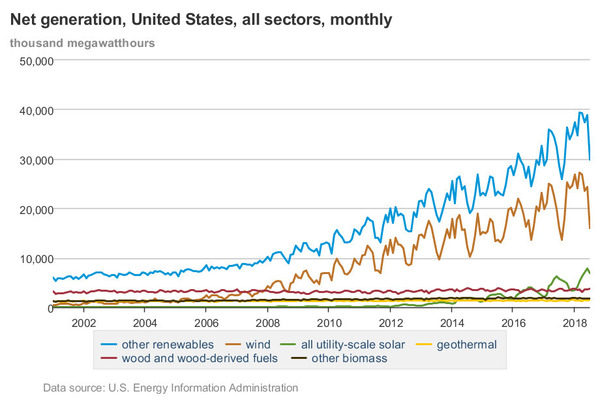

Net generation, United State, all sectors, monthly, Chart


Net generation, United States, all sectors, monthly, U.S. EIA.

Every electric utility can read that chart from the U.S. Energy Information Agency,
which shows wind (the middle orange line) and solar (the green line coming up from the bottom) adding up to almost all of “other renewables” (the top blue line),
with nothing else growing like that.
All the pipelines rammed through regulatorially captured agencies
don’t come close Continue reading

How to ban CWIP in Georgia

A one-paragraph law can do it; that’s all it took in New Hampshire
to ban

Construction Work in Progress (CWIP)


after

Three Mile Island.

OK, plus a state Supreme Court ruling, but that would be easier in Georgia
since the New Hampshire Supreme Court already set a precedent of upholding
the NH law.
After Fukushima,

Georgia could ban CWIP
and end the new Plant Vogtle construction.
The we could

get on with building solar
.

Here’s the text of the NH law, taken from

the NH Supreme Court ruling:

“378:30-a Public Utility Rate Base; Exclusions. Public utility rates or
charges shall not in any manner be based on the cost of construction
work in progress. At no time shall any rates or charges be based upon
any costs associated with construction work if said construction work is
not completed. All costs of construction work in progress, including,
but not limited to, any costs associated with constructing, owning,
maintaining or financing construction work in progress, shall not be
included in a utility’s rate base nor be allowed as an expense for rate
making purposes until, and not before, said construction project is
actually providing service to consumers.”

Simple enough.
The

Georgia legislature
could do it.
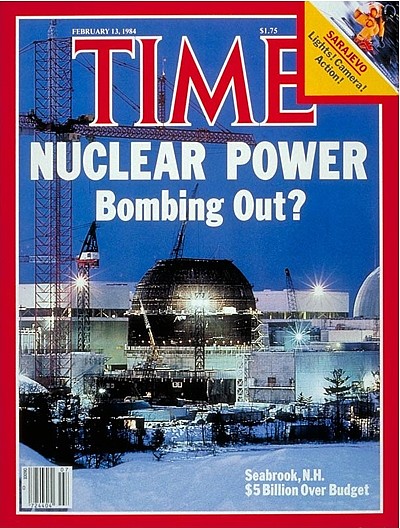
Knowing the NH CWIP ban caused PSNH

to go bankrupt on costs for the Seabrook nuclear plant
,
Georgia Power might back off on Plant Vogtle rather than have such a law passed.

-jsq

What we can learn from no nukes and solartopia of 30 years ago

Why were only 12% of the projected 1000 nuclear plants built in the U.S. by
the year 2000?
Because of the no nukes movement started in Seabrook, New Hampshire
in 1977.
And because New Hampshire banned CWIP.
Here in Georgia in 2012 we can cut to the chase and do what they
did that worked.

Harvey Wasserman wrote for The Free Press 13 May 2007,

How creative mass non-violence beat a nuke and launched the global green power movement
,

Thirty years ago this month, in the small seacoast town of Seabrook,
New Hampshire, a force of mass non-violent green advocacy collided


with the nuke establishment.

A definitive victory over corporate power was won. And the global
grassroots “No Nukes” movement emerged as one of the most important
and effective in human history.

It still writes the bottom line on atomic energy and global warming.
All today’s green energy battles can be dated to May, 13, 1977, when
550 Clamshell Alliance protestors walked victoriously free after
thirteen days of media-saturated imprisonment. Not a single US
reactor ordered since that day has been completed.

How effective?

Richard Nixon had pledged to build 1000 nukes in the US by the year
2000. But the industry peaked at less than 120. Today, just over a
hundred operate. No US reactor ordered since 1974 has been
completed. The Seabrook demonstrations—which extended to
civil disobedience actions on Wall Street—were key to keeping
nearly 880 US reactors unbuilt.

The only new nukes ordered since then are the ones Georgia Power
wants to build at Plant Vogtle on the Savannah River, for which

Georgia Power customers are already getting billed Construction
Work in Progress (CWIP).

Thirty years later, some things haven’t changed:

Continue reading

How and why did New Hampshire ban CWIP?

After years of protests and the Three Mile Island nuclear accident
in Pennsylvania,
the New Hampshire legislature passed a law that denied
the Public Service Company of New Hampshire (PSNH)

Construction Work in Progress (CWIP)
charges
before the Seabrook nuclear plant


provided electricity to its customers.
One of two planned Seabrook reactors did finally go into service in 1990,
more than a decade late and far over budget.
Meanwhile,
the New Hampshire Supreme Court ruled the anti-CWIP law was constitutional,
and PSNH went bankrupt in 1988:

the first
investor-owned utility since the Great Depression to declare
bankruptcy.

Seabrook was the last nuclear reactor built in the United States.
Until now.
In Georgia.
Which has CWIP.
Maybe we should
change that.

Here’s an excerpt from

a corporate history of

Public Service Company of New Hampshire (PSNH):

By January 1972 PSNH had decided not only to build a nuclear plant
at Seabrook but also to have it consist of two 1,150-megawatt units,
to be completed in 1979. PSNH was to own 50 percent of the $1.3 billion
project and share the remaining investment with other New
England utilities. In January 1974 the New Hampshire Site Evaluation
Committee, the Public Utilities Commission (PUC) and other
regulatory bodies had issued the basic permits, but interveners in
the case succeeded in having the New Hampshire Supreme Court
overturn these permits. After repeated appeals and rehearings PSNH
received its construction permit in July 1976—and experienced
its first protest at the planned site.

There followed a decade of other protests at the site, inside
regulatory chambers, and in New Hampshire and Washington courtrooms.
The 1979 accident at the Three Mile Island nuclear-power plant in
Pennsylvania—to name but one event that triggered concern

Continue reading