Category Archives: Economy

Valdosta rank in Georgia cities

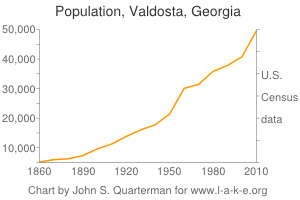
Increased population is using increasing resources Recently I saw someone speculating online that Valdosta’s rank among Georgia cities was rising because its population is growing. And its population is indeed growing, as you can see in the graph on the right or the Census Bureau data in the table below right. (Compare to similar information for Lowndes County.) But not as fast as some other Georgia cities, so Valdosta’s rank is not increasing. In fact, the opposite: Valdosta has been dropping in rank.

Census Pop.
1860 166
1870 1,199 622.3%
1880 1,515 26.4%
1890 2,854 88.4%
1900 5,613 96.7%
1910 7,656 36.4%
1920 10,783 40.8%
1930 13,482 25.0%
1940 15,595 15.7%
1950 20,046 28.5%
1960 30,652 52.9%
1970 32,303 5.4%
1980 37,671 16.6%
1990 40,135 6.5%
2000 43,724 8.9%
2010 54,518 24.7%

Here are city ranks for the censuses from 1980 to 2000:

1980 7 Atlanta, Columbus, Savannah, Macon, Albany, Warner Robins, VLD.
1990 11 passed by Augusta, Athens, Roswell, Marietta
(Augusta and Athens cheated by consolidating with their counties.)
2000 14 passed by Sandy Springs, Johns Creek, and Alpharetta
2010 14 Sandy Springs passed Macon and Marietta dropped two,
but Valdosta remained #14

So actually Valdosta has been decreasing in Georgia city rank over time, because cities in the Atlanta metro area have been growing faster.

Now I don’t consider that a bad thing: population growth isn’t the same thing as economic growth, and economic growth isn’t the same thing as prosperity or well-being. But it’s an interesting bit of history.

Rank1980199020002010
1 Atlanta Atlanta Atlanta Atlanta
2 Columbus Augusta Augusta Augusta
3 Savannah Columbus Columbus Columbus
4 Macon Savannah Savannah Savannah
5 Albany Macon Athens Athens
6 Warner Robins Athens Macon Sandy Springs
7 Valdosta Albany Sandy Springs Macon
8 Roswell Roswell Roswell
9 Marietta Albany Albany
10 Warner Robins Johns Creek Johns Creek
11 Valdosta Marietta Warner Robins
12 Warner Robins Alpharetta
13 Alpharetta Marietta
14 Valdosta Valdosta

-jsq

Vogtle circular firing squad delaying opening

Southern Company and the other owners of Plant Vogtle are blaming the contractors (who are suing them) for further delays in construction. How much money will they waste before they never open?

Kristi E. Swartz wrote for the AJC yesterday, Disputed costs at Vogtle rise,

Georgia Power and a group of municipal and cooperative electric companies are building twin 1,100-megawatt reactors, the first in the United States to win permits in 30 years. The total expected cost of the project is $14 billion, but potential cost overruns at Vogtle, located in Waynesboro in east Georgia, continue to grow, according to the recent Southern Co. regulatory filing.

Delays in getting federal licensing approvals for the new reactor design and then for the entire project have been cited as the chief culprit.

Because of the dispute with contractors over the additional costs, “the owners are evaluating whether maintaining the currently scheduled commercial operation dates of 2016 and 2017 remains in the best interest of their customers,” the filing said. The total amount of the cost overruns could be well over $900 million; Georgia Power owns 45.7 percent of the project, so its share is $425 million, the latest filing said. Originally the overrun was projected at $400 million when the issue was first made public in April.

Up another $25 million since April? How long until it gets into billions of cost overruns? Which will be paid by whom?

Continue reading

Video of stealth education panel at Lowndes High last night

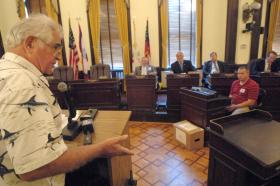
Here’s George Boston Rhynes’ first video from last night’s stealth education panel. The VDT covered it, but, presumably due to its bizarre policy of not covering candidates for office, the VDT didn’t even mention that J.C. Cunningham, Democrat running for Georgia House District 175, was present, even though the VDT posted pictures and quotes from the incumbent, Republican Amy Carter, who apparently organized the panel. Charter schools were discussed; see below after the video.

Video of stealth education panel at Lowndes High last night
Video by George Boston Rhynes for K.V.C.I and bostongbr on YouTube,
Valdosta, Lowndes County, Georgia, 14 August 2012.

On the panel, left to right:

Continue reading

“It’s almost like they are out to take advantage of the rubes,” —an economist

Do big box stores count as development? Are they worth millions in tax incentives and bond investments? Maybe we can find something better for local industry and jobs.

Rumors have been flying for years about a Bass Pro store coming to Valdosta, like this one on a Georgia Outdoor News forum:

01-22-2008, 09:05 PM, bear-229
ive heard the land has been bought. very close to the new toyota lot but it has not made it to the “new locations” on the web site

That’s on James Road, in that huge proposed development that Lowndes County approved around that time.

Scott Reeder wrote for The Atlantic 13 August 2012, Why Have So Many Cities and Towns Given Away So Much Money to Bass Pro Shops and Cabela’s?,

Both Bass Pro Shops and its archrival, Cabela’s, sell hunting and fishing gear in cathedral-like stores featuring taxidermied wildlife, gigantic fresh-water aquarium exhibits and elaborate outdoor reproductions within the stores. The stores are billed as job generators by both companies when they are fishing for development dollars. But the firms’ economic benefits are minimal and costs to taxpayers are great.

An exhaustive investigation conducted by the Franklin Center for Government and Public Integrity found that the two competing firms together have received or are promised more than $2.2 billion from American taxpayers over the past 15 years.

Where does all that money come from? Bonds, usually. Which is yet another reason why last legislature’s HB 475 to give unelected bodies bond issuing privatizing power would be a bad idea.

What does all that money go for?

Continue reading

Another home with wind power

When we arrived, the wind company was tuning the stay wires on the windmill at the home of Karl and Clare Kuntz in western New York State.

Another home with wind power
Karl and Clare Kuntz, Pavillion, Genesee County, New York
Videos by John S. Quarterman for Lowndes Area Knowledge Exchange (LAKE).

Clare said the wind company is Sustainable Energy Developments. She added,

Sign You can put your money in the mattress or in the bank, and get about the same appreciation. Or you can put it in wind or solar and feel good about it.

Karl said it would take about fifteen years to pay back the wind investment, and meanwhile they get more power than they use, and still will after it’s all paid for. He remarked that the wind company has also started doing solar energy, because solar now costs half as much as wind. And that’s in windy western New York, 1000 miles north of sunny south Georgia.

-jsq

There is something you can do

Anybody who has tried to do much of anything around here has run into this phrase:

There’s nothing you can do.

I was reminded of that when I read this, from the Economist 12 May 2012, Hope springs a trap,

This hopelessness manifests itself in many ways. One is a sort of pathological conservatism, where people forgo even feasible things with potentially large benefits for fear of losing the little they already possess.

The article expands on that idea:

Development economists have long surmised that some very poor people may remain trapped in poverty because even the largest investments they are able to make, whether eating a few more calories or working a bit harder on their minuscule businesses, are too small to make a big difference. So getting out of poverty seems to require a quantum leap—vastly more food, a modern machine, or an employee to mind the shop. As a result, they often forgo even the small incremental investments of which they are capable: a bit more fertiliser, some more schooling or a small amount of saving.

It may seem that the article is about the poorest of people, but that “pathological conservatism” could as easily apply to the hopelessness many people seem to have about ever getting solar panels on their own roofs, or to attracting enough business to our area to employ our high school and college graduates, or that businesses will ever come to the south side.

Yet the point of the article is that field studies by MIT economist Esther Duflo show Continue reading

Vermont protests against wind vs. nuclear

Compare 6 arrested of about 25 demonstrators against Green Mountain Power’s wind energy project on Lowell Mountain vs. 130 arrested of a thousand protesting in March against the Vermont Yankee nuclear plant.

Also notice what they were protesting. The location on Lowell Mountain, as damaging the mountain top and being unsightly, plus:

“I feel like they [GMP] only went through the public process to a point, and the process is flawed,” said Young, a self-employed logger and farmer from Westfield. “Community members don’t have the resources to have a strong voice. It’s complex, expensive, and lawyers don’t want to do it.”

At Vermont Yankee, the protests were against radioactive leaks, nuclear waste, and this:

Yankee’s initial 40-year license expired Wednesday. The plant is still running, under a 20-year extension from the federal Nuclear Regulatory Commission—despite a vote by the state senate not to allow the plant to continue operating in Vermont.

A common theme is lack of democratic oversight, although even that seems greater in degree for Vermont Yankee. We are familiar with that issue in Georgia, where there’s an election going on for Public Service Commissioners and legislators.

Another common theme is that it’s complex and expensive, which is indeed an issue for big wind projects. Power companies like them as big as they can build them because that fits their corporate bureaucracy. They can instead be smaller and distributed. Nuclear power plants, on the other hand, are always big, bureaucratic, and expensive.

While I thoroughly sympathize with the Lowell Mountain protesters about the mountain top issues, I don’t see anything about them protesting the risk of a wind spill. Risks of nuclear radioactive contamination are very real, and are among the Vermont Yankee protesters’ main issues. Wind off the coast of Georgia would not have that problem.

-jsq


Well loan and tap fees —Barbara Stratton @ Hahira 2012-08-02

Received yesterday on Hahira approved for water well loan by state. -jsq

It’s nice to know Hahira will get a break in interest, but tax payers will still have to pay back the loan. I missed the council meeting which is unusual for me. Does the video show anything about the fact some council members voted not to raise the tap fees for new construction which would certainly help pay back the loan instead of depending so much on tax monies? Developers should not be allowed to come in and make huge profits from new construction, then take their profits and let the citizens pay the price for increased water demands. Raising the one time tap fees would have distributed some of the costs to the developers who enjoy the profits from increased demands on the infrastructure and water usage.

-Barbara Stratton

Yes, we have video of the entire Hahira City Council meeting, which will be posted soon. LAKE is always happy to accept help in taking or labeling videos.

-jsq

The reality of the solar industry —Michael Noll

Received Friday on Plant Vogtle water use. -jsq

Please note a recent article in the New York Times about the best alternative to nuclear power in Georgia: The Secret to Solar Power By Jeff Himmelman, 9 August 2012.

To quote from the article:

“… the reality of the [solar] industry — as evidenced by the enormous investments that companies like Google and Bank of America are making in residential solar power — is that it has rapidly become a smart, practical and profitable investment.”
Michael G. Noll, President
Wiregrass Activists for Clean Energy (WACE)

When will Southern Company & Georgia Power finally wake up? —Michael G. Noll

Received today on Plant Vogtle water use. -jsq

Energy projects such as biomass plants, coal firing plants, and nuclear power plants waste enormous amounts of water. The once proposed 40MW biomass plant in Valdosta would have consumed 800,000 gallons of water DAILY. Considering that for years now we are experiencing record drought conditions and heat waves in the US, this should make everyone’s hair stand up on the back of their necks. (For more information see “Electricity’s Thirst on a Precious Resource”.)

Add to this scenario a recent decision by the US Nuclear Regulatory Continue reading