Category Archives: Climate change

This is what a mayor with vision sounds like

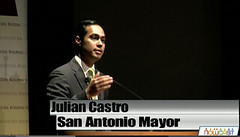
Mayor Julian Castro of San Antonio

speaks at 44:25

about


…the nexus between sustainability and job creation.
Every now and then, perhaps once in a generation,
there presents itself a moment, an opportunity,
for those cities that are willing to seize it,
to truly benefit the region for generations to come.

Here’s
the video:

Continue reading

San Antonio promises to shut down a coal plant

We could do something like this.
We’ve already made a start with Wiregrass Solar.


San Antonio, the Clean-Energy City?
Look out Austin, SA Mayor Julian Castro promises to shut-down a coal plant by 2018.


At an event this afternoon at UT-San Antonio, Mayor Julian Castro
announced a suite of green energy projects that he said would position
San Antonio as the nation’s “recognized leader in clean energy technology”
and help fulfill his aggressive environmental goals.

Most notably, Castro and leaders from CPS Energy, the city-owned utility,
pledged to shut down one of its coal-fired power plants 15 years ahead
of schedule. By 2018, the city would mothball the 871-megawatt J.T. Deely
Power Plant — a bold move in a growing state that’s seemingly addicted
to coal.

So what are they going to use for energy?

Continue reading

Detroit cuts power due to heat: too bad they didn’t have solar

AP reported 10 June 2011,

Half the country wilts under unrelenting heat
:


Detroit officials intentionally cut power to city hall and a convention
center Thursday to prevent the municipal power system from crashing from
high energy demand — even though temperatures had tapered to the 70s
after two days above 90. Equipment failures knocked out power to several
other government buildings and traffic lights in parts of the downtown.

“Because there was a short window of time, we had to make a decision
to take some of our customers off to prevent a blackout of the entire
city,” Detroit mayoral spokeswoman Karen Dumas said.

Too bad they didn’t have solar, which would have provided peak power
at peak load.

-jsq

Lowndes County is disaster area —Gov. Deal

Climate change makes Lowndes County a disaster area.

Amber Eady wrote for WALB,

Deal requests disaster designation for Lowndes County
:


Gov. Deal sent a letter to the U.S. Secretary of Agriculture Tom Vilsack
asking that 22 Georgia counties be declared disaster areas because of
Georgia’s ongoing drought.

Lowndes County was on that list of 22 counties that Deal wants to be
declared as disaster areas.

-gretchen

Southern Company “bullish” on solar

Colleen Kiernan, director of the Georgia chapter of the Sierra Club,
wrote in the Atlanta Business Chronicle 22 May 2011,

Wind energy a viable option for Southern Co.’s portfolio
:


Two years ago, Southern Co. claimed “Renewable energy sources like wind
and solar are not really an option for us in the Southeast.”

Now the new CEO, Thomas Fanning, says he’s “bullish” on solar. While
the new attitude on solar is refreshing,

I’ve seen this before.
AustinEnergy went in one year from solar isn’t an option to

Continue reading

VSU Faculty Senate passes anti-biomass resolution

Karen Noll reported on WACE’s facebook page that
the VSU Faculty Senate passed a resolution Thursday 19 May 2011 that
biomass will not be considered renewable for VSU’s climate commitment goal.

Why?

Because

leading medical associations have identified woody biomass
incineration as increasing risks of
“a variety of illnesses, some life-threatening”,
because biomass incineration
produces more CO2, NOX, and fine particulates than existing coal plants,
and because it
“may lead to
unsustainable forestry practices and a net increase in global greenhouse
gas emissions”.

Who proposed this?

Continue reading

What do “the indigenous” think about solar?

In a facebook conversation, someone said solar was useless because
we should all live like “the indigenous” used to.
Well, let’s see what some of “the indigenous” think about solar power.
Zachary Shahan wrote 13 January 2010 in CleanTechnical,
Native American Tribe Going for Solar, and Money:


The 3,000 members of the Jemez Pueblo tribe in New Mexico are looking
to build the first utility-scale solar power plant on tribal land. They
are also looking to make some money on it.

It is no secret that Native American tribes are more likely to be
poverty-stricken and they generally have more than twice the unemployment
rate of the United States. Former Jemez Pueblo governor James Roger
Magdalena says, “We don’t have any revenue coming in except for a
little convenience store.”

It is estimated this solar power plant could generate $25 million over the
next quarter century and help create a sustainable revenue for his tribe.

Mr. Magdalena sees the environmental changes

Continue reading

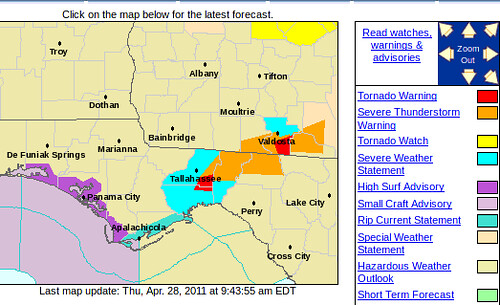
Tornado Warning in Lowndes County right now

The

National Weather Service map
right now shows a tornado warning for part
of Lowndes County:


This is at least the second time this month; here
another tornado warning for Lowndes County, from 5 April 2011:

Continue reading

Energy reliability: let’s do the study for Georgia

Which energy source is really more reliable?
Nuclear, coal, or wind, water, and sun?


As Plant Vogtle and others

have just demonstrated,

nuclear power isn’t as reliable as we might have thought.
Mark Z. Jacobson says we can generate reliable power from
wind, water, and sunlight alone.
Will that work in Georgia?

Elsevier’s policy of charging for peer-reviewed articles from
scientific journals is controversial, and some people find $19.95
prohibitive to access Mark Z. Jacobson and Mark A. Delucchi’s

Providing all global energy with wind, water, and solar power, Part I: Technologies, energy resources, quantities and areas of infrastructure, and materials

from Energy Policy
Volume 39, Issue 3, March 2011, Pages 1154-1169.
Fortunately, the same authors wrote an earlier version for
Scientific American, 26 October 2009,

A Plan to Power 100 Percent of the Planet with Renewables:
Wind, water and solar technologies can provide 100 percent of the world’s
energy, eliminating all fossil fuels. Here’s how

A new infrastructure must provide energy on demand at least as reliably
as the existing infrastructure. WWS technologies generally suffer less
downtime than traditional sources. The average U.S. coal plant is offline
12.5 percent of the year for scheduled and unscheduled maintenance. Modern
wind turbines have a down time of less than 2 percent on land and less
than 5 percent at sea. Photovoltaic systems are also at less than 2
percent. Moreover, when an individual wind, solar or wave device is down,
only a small fraction of production is affected; when a coal, nuclear
or natural gas plant goes offline, a large chunk of generation is lost.

Continue reading