In a statement, Wal-Mart representative Maggie Sans wrote, “Previously, we expressed our concerns about ALEC’s decision to weigh in on issues that stray from its core mission ‘to advance the Jeffersonian principles of free markets…We feel that the divide between these activities and our purpose as a business has become too wide. To that end, we are suspending our membership in ALEC.”
Wal-Mart claimed that ALEC was no longer as interested in Jeffersonian free market principles as they were other partisan political issues. Two of those unnamed political issues are most certainly voter ID and stand your ground laws.
When even Wal-Mart complains that ALEC isn’t “free market” enough, Wal-Mart, which
Continue reading →
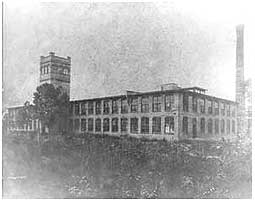
FYI: The Strickland Mill in Remerton is being threatened with demolition. Remerton City Council will meet to discuss this situation on Monday, June 4th at 5:30pm during their work session, and on Monday, June 11th at 5:30pm to vote on the matter. The public is invited to both of these meetings to express opinions on the possible demolition of the Mill. As you all are aware, this mill complex dates to 1899 and is one of the few surviving textile mills in our region. This is an important community landmark and was very influential to the development of Valdosta, not to mention integral to Remerton's existence.
Remember the Southern Company brags about “Our competitive generation business”. The important word there is “our”, as in the Southern Company and its subsidiary Georgia Power gets to compete, and you don’t. Unless you’re big enough.
Some retail competition has been present in Georgia since 1973 with the passage of the Georgia Territorial Electric Service Act. This Act enables customers with manufacturing or commercial loads of 900 kW or greater a one time choice in their electric supplier. It also provides eligible customers the opportunity to transfer from one electric supplier to another provided all parties agree.
Because of that law, you can’t you put up solar panels on your own land and sell your power to somebody somewhere else. And you can’t get a company like SolarCity or Lower Rates for Customers to put up solar panels on your property and sell you the power ( or can you?). Unless you’re generating at least 900 KW; then maybe you can get selected businesses to switch to your power once. Except you probably still won’t qualify, because
Continue reading →
I think of Georgia Power more as like IBM when minicomputers came out. IBM built bigger mainframes. The Internet started to spread, and IBM pushed its own proprietary SNA network. (Remember SNA? I didn’t think so.) Then PCs came out, and IBM layoffs started….
Everybody except for Georgia is jumping on the wind and solar bandwagon, but Georgia Power is side-lined in a nuclear jam like a horse-buggy manufacturer at the dawning of the Ford assembly line.
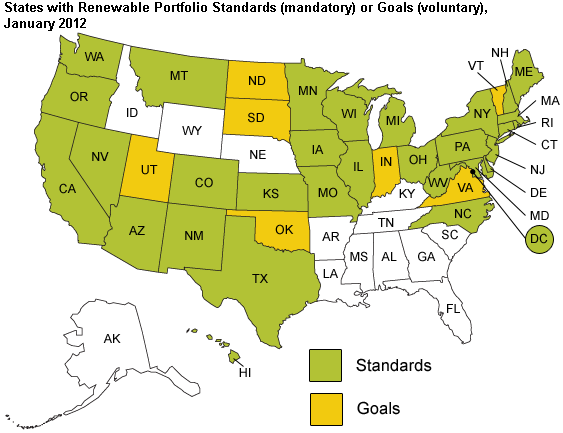
The white area on that map is for states that have no standards or goals for renewable energy.
Remember Georgia Power is the biggest part of its parent, The Southern Company, and the nuclear units at Plant Vogtle (operating and planned) are actually owned by another offshoot of The Southern Company. According to Southern Company’s webpage, Megawatts and Markets,
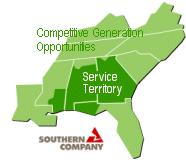
Southern Company regulated regional electric utilities serve a 120,000-square-mile territory in Alabama, Florida, Georgia, and Mississippi. Our competitive generation business extends to markets in six southeastern states.
It’s interesting how similar the Southern Company’s markets are to the states in that white southeast no-renewable-energy-portfolio area!
Nuclear is our only emissionless technology, said Southern Company (SO) CEO Thomas A. Fanning. That would indicate that solar and wind have emissions. I assume he just mis-spoke in his otherwise masterful responses (often not answers) to shareholder questions.
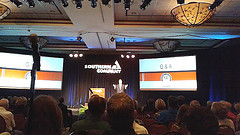
Slides and sound for CEO Fanning’s main presentation are available on SO’s website. He indicated SO is unmatched in a combination of financial aspects, including dividends that have steadily increased year after year, and especially investment stability. He neglected to mention that much of those dividends are made possible by Georgia Power’s guaranteed profit margins. He did find time to oppose big government regulation, which is ironic, since Southern Company is a big beneficiary of Georgia’s numerous regulations benefitting Georgia Power. He also bragged about the Georgia legislature passing the “Energy Rate Increases to Finance Nuclear Power Plant Construction”.
Market study advisory panel forming up! Chairman Roy Copeland asked whether “Industrial” in VLCIA’s name is positive or negative for PR? Executive Director Andrea Schruijer made sure to announce a date change for a board meeting a month in advance. All that and much more!
Here are videos of the entire 17 April 2012 regular meeting of the Valdosta-Lowndes County Industrial Authority (VLCIA). Here’s the agenda.
VLCIA Executive Director Andrea Schruijer said they had shown contractor Market Street Services the area so they could go back and start working up data for a market study. In May an advisory panel of 10-13 individuals plus focus groups will meet with Market Street.
I’ll answer: as long as VLCIA includes as “industry” boondoggles like a health-threatening biomass plant and a job-destroying private prison, why yes, “industrial” reflects negatively on VLCIA. But a mere name change through a D.B.A. won’t fix that problem. Only a change in behavior will fix that problem. Changes such as doing some due diligence so they know when a private prison company is playing them along by saying they’re the primary site. Changes such as weighing the community’s health when considering potential jobs. And especially changes such as listening to people outside the VLCIA and Chamber bubble when others do useful and important research. The community can be an asset for VLCIA, providing research and contacts VLCIA either does not have the resources to do or might not think of to do, if VLCIA will listen to the community.
Videos Regular Meeting, Valdosta-Lowndes County Industrial Authority (VLCIA), Norman Bennett, Tom Call, Roy Copeland chairman, Mary Gooding, Jerry Jennett, Tom Davis CPA, Allan Ricketts Project Manager, S. Meghan Duke Public Relations & Marketing Manager, Lu Williams Operations Manager, Valdosta, Lowndes County, Georgia, 17 April 2012. Videos by Gretchen Quarterman for Lowndes Area Knowledge Exchange (LAKE).
On the eve of Southern Company (NYSE: SO) holding its annual meeting
of stockholders in Pine Mountain, GA., the nonprofit Green America
released a report today ranking the major U.S. power producer as
“the United States’ most irresponsible utility.”
Titled “Leadership We Can Live Without: The Real Corporate Social
Responsibility Report for Southern Company,” the Green America
analysis assigns letter grades to seven major U.S. utilities on four
fronts: reliance on coal; pollution; reliance on and expansion of
nuclear power; and lobbying expenditures. Southern came in dead last
with straight “F” grades in all four of the categories.
The PR and the report have a lot more detail, such as this:
Clean Air Task Force data shows that Southern Company’s coal-fired
power plants cause 1,224 deaths, 1,710 heart attacks, 20,770 asthma
attacks, and 752 cases of chronic bronchitis per year. The total
annual cost of all of this damage is over $9 billion.
Hey, that’s more than the original projected cost of the new nukes!
Georgians, do you like trading your health for SO’s
coal plants
and its nuclear boondoggle?
Progress Energy announced Tuesday that it is hiking the estimated
cost of its proposed Levy County nuclear plant and pushing the
plant’s completion date back to 2024.
Progress Energy also said it plans to ask Florida regulators to
increase customers’ bills to upgrade Progress’ damaged Crystal River
nuclear plant.
Progress said in a press release that the new cost of the plant
could be as high as $24 billion. The previous estimate was about $2
billion less. The plant was originally slated to go online in 2016,
but that deadline continues to get pushed back.
Meanwhile, by
John Hanger’s estimates,
an extra $1 billion would buy about 450 MW of wind power or about 330
MW of solar power.
So that $2 billion expected cost rise would buy about
Continue reading →
Here are videos of the entire February meeting of the Greater Lowndes Planning Commission (GLPC). I would post their agenda, but they didn’t publish one.
Regular Session, Greater Lowndes Planning Commission (GLPC), Valdosta, Lowndes County, Georgia, 27 February 2012. Videos by Gretchen Quarterman for Lowndes Area Knowledge Exchange (LAKE).
How did conservation zoning get put on part of Robert Dinkins’ property at Lake Alapaha? County records conflict on that point. Was it important to keep that conservation zoning? Staff thought so, but the Planning Commission thought otherwise, and the Lowndes County Commission decided to agree.
The second county case in the 27 February 2012 Greater Lowndes Planning Commission (GLPC) meeting was
REZ-2012-02 Dinkins, Southern Shore, 0264 007 A&B, ~97 ac., R-21 & CON to R-A, well/septic. They spent 8 1/2 minutes on it, mainly listening to the requester, Robert Dinkins, wonder how any part of the subject property was zoned for conservation. Staff recommended the conservation zoning remain. GLPC voted to recommend removing it.
Here’s a video playlist of this rezoning item in all three meetings (GLPC, LCC Work Session, and LCC Regular Session):
Conservation at Lake Alapaha: REZ-2012-02 Dinkins Regular Session, Greater Lowndes Planning Commission (GLPC), Valdosta, Lowndes County, Georgia, 27 February 2012. Work Session, Lowndes County Commission (LCC), Valdosta, Lowndes County, Georgia, 12 March 2012. Regular Session, Lowndes County Commission (LCC), Valdosta, Lowndes County, Georgia, 13 March 2012. Videos by Gretchen Quarterman for Lowndes Area Knowledge Exchange (LAKE).