Tag Archives: Wind

Wind for 1/3 of Georgia electricity, plus solar

“Georgia has about 14.5 gigawatts of feasibly developed offshore wind energy potential–enough power to provide one-third of Georgia’s current electrical needs.”

And the wind blows at night when the sun doesn’t shine.
Add solar for the peak power day,
and there’s no excuse for coal, nuclear, or natural gas.


Georgia’s Offshore Wind Energy Potential Showcased at CoastFest
,
by Allie Brown
for SACE 15 October 2013.

Georgia Power and Southern Company know this.
When will they act on it?

PS: Owed to Danielle Jordan

-jsq

Actually, green solar power is winning

An article that dismisses without investigation the fastest
growing industry in the world, solar power, after solar has become

cheaper than any other energy source
, is not a serious article.


Richard Smith wrote for Truthout 9 January 2014,

Green Capitalism: The God That Failed
.
Sure,
there are lots of good points in there (such as we need a carbon tax,
but it’s not enough), but given that

only 90 companies account for 2/3 of GHG emissions

saying we can’t change that without crashing the world’s economy is
like saying we can’t deal with horse manure in cities in 1900 without
crashing the world’s economy, and

people did say things like that back then
.

Most of the world’s oil and gas is used to produce power,
so once we

convert to solar and wind
,
we’ll have plenty of remaining petroleum for other uses
such as lubrication.


Saying in 2014 that solar and wind can’t power the world is like
saying in 1994 that Continue reading

Solar is now competitive with … natural gas –Crossborder Energy study

Colorado, California, North Carolina: when will Georgia catch up in solar power?
What will it take to get the Georgia legislature to realize all Georgians
will benefit economically from much more solar power than

GA PSC in July required Georgia Power to buy
?
And why should we permit

a methane gas pipeline to gash through Georgia

to profit executives in Houston and Juno Beach, Florida
when we could be deploying solar everywhere in Georgia
for

local jobs, profit, lower electric bills, and clean air and water
?

Here’s
the study

that showed solar benefits outweigh costs in North Carolina,

The Benefits and Costs
of Solar Generation
for Electric Ratepayers
in North Carolina
,
by R. Thomas Beach and
Patrick G. McGuire for Crossborder Energy, 18 October 2013.

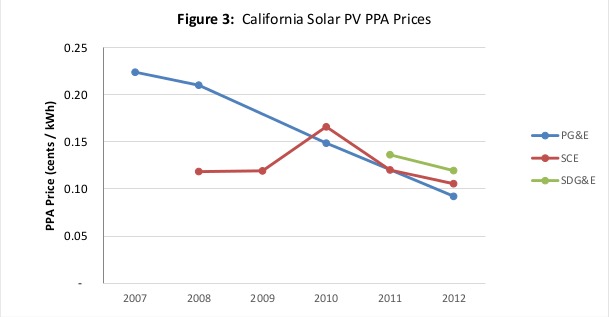
Wholesale solar PPA prices provide perhaps the most dramatic
evidence of the continued decline in solar PV costs. Solar PPA
prices have fallen dramatically over the past several years, to the
point that, in some regions of the U.S., solar is now competitive
with other generation resources, including wind and natural gas.
Xcel Energy in Colorado recently announced that it is proposing to
add 170 MW of utility-scale solar to its system, with its CEO
stating “[f]or the first time ever, we are adding cost
competitive utility scale solar to the system.”33
The
California electric utilities make public each year the average PPA
prices for renewable contracts approved by the CPUC in the prior
year. Figure 3 shows the trend in the prices for their solar PV
PPAs; CPUC contract approval can occur up to a year or more after
bids are received, so the figure is indicative of prices through
roughly 2011.34
2012 solicitations for solar PPAs in California in
the 3 MW to 20 MW size range through the Renewable Auction Mechanism
(RAM) have yielded market-clearing prices in the
8 to 9 cents
per
kWh range.3


The Lawrence Berkeley National Lab (LBNL) conducts and publishes
regular national surveys of the installed costs of solar PV; these
surveys include Continue reading

The nuclear renaissance is dead: somebody tell the Georgia legislature the wind is blowing towards the sun


Sombody should tell Georgia Power and Southern Company
they’re still pushing a dead power source.
It’s time to go from far-too-expensive nuclear directly
to solar onshore and wind offshore.

Remember in the last year or so

five U.S. nukes have been shut down and five more have been cancelled

while in Canada two more have been cancelled, plus maybe two more,

and maybe as many as six are to be shut down
.
Dr Jim Green wrote for Ecologist yesterday,

The nuclear renaissance is stone cold dead
,

Perhaps the most shocking developments have been in the United
States, where the industry is finding it increasingly difficult to
profitably operate existing reactors—especially ageing
reactors requiring refurbishments—let alone build new ones.

Almost half of the world’s reactors Continue reading

Warren Buffett moves from nuclear to wind


How to get Georgia Power and Southern Company off of

nuclear

and onto offshore wind and onshore solar power: stop approving

Construction Work in Progress (CWIP)

rate hikes for nukes that are already a billion dollars
over budget and more than a year late.
So far Mississippi is doing better about this than Georgia,
by

capping ratepayer and taxpayer costs for Kemper Coal
.
Iowa did, and look what happened.

SimplyInfo wrote 23 December 2013,

What Power Companies Do When Nuclear Is No Longer An Easy Option
, Continue reading

Buried under nine feet of manure: 19th century horse predictions


There is a big difference between the 19th century horse excrement
crisis and the current 21st century energy crisis,
similar as they may sound.
One was real.
The other is manufactured by the modern equivalent of stagecoach vendors.

Stephen Davies wrote for The Freeman 1 September 2004,

The Great Horse-Manure Crisis of 1894
,

In 1898 the first international urban-planning conference convened
in New York. It was abandoned after three days, instead of the
scheduled ten, because none of the delegates could see any solution
to the growing crisis posed by urban horses and their output.


The problem did indeed seem intractable. The larger and richer that
cities became, the more horses they needed to function. The more
horses, the more manure. Writing in the Times of London in 1894, one
writer estimated that in 50 years every street in London would be
buried under nine feet of manure. Moreover, all these horses had to
be stabled, which used up ever-larger areas of increasingly valuable
land. And as the number of horses grew, ever-more land had to be
devoted to producing hay to feed them (rather than producing food
for people), and this had to be brought into cities and
distributed—by horse-drawn vehicles. It seemed that urban
civilization was doomed.

Continue reading

Southern Company missed earnings: weather and Kemper Coal and nuclear Plant Vogtle


SO CEO Tom Fanning continued to blame slow sales and earnings on mild
weather (air conditioners running less), but the big boondoggle
going bad is Kemper Coal, which has slipped six months from May 2014 to Q4 2014,
and even the Wall Street Journal calls it “possibly the most expensive fossil-fuel power plant ever built in the U.S”.
How bad will SO’s stock tank when SO’s even more expensive
nuclear Plant Vogtle slips even more?

Dividends can’t prop up SO’s share price forever, not when PSCs are revolting against the rate hikes
and guaranteed profit hikes that prop up those dividends.
When will Southern Company and Georgia Power get out front and lead in solar and wind power?
Before or after the public, state public service commissions, and investors make them do it?

Justin Loiseau wrote for DailyFinance 4 November 2013,

Southern Company Earnings: A $5 Billion Blunder?
Continue reading

Fossil fuel divestment fastest


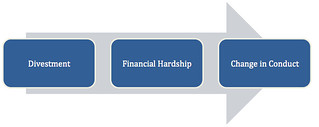
Divestment to Financial Hardship to Change in Conduct

Not just

faster than apartheid divestment
;
faster than divestment from tobacco, armaments, and others:
fossil fuel divestment.
It’s not about direct reduction of market capitalization;
it’s about making it socially unacceptable to buy from stigmatized
companies, and it works, and it’s working faster than ever for fossil fuels.
Oh, and fossil fuel companies are a tiny sliver of university endowments,
so ditching them is pain free,
especially now that

fossil fuel stock prices are not rising while solar stocks skyrocket

(and nuclear stocks don’t).
Go fossil free, go VSU.


Stranded Assets and the Fossil Fuel Divestment Campaign: What Does Divestment Mean for the Valuation of Fossil Fuel Assets?

8 October 2013 | Authors: Atif Ansar, Ben Caldecott, James Tilbury

Damian Carrington wrote for the Guardian Monday 7 October 2013

Campaign against fossil fuels growing, says study:
Investors being persuaded to take their money out of fossil fuel sector, according to University of Oxford study
,

A campaign to persuade investors to take their money out of the fossil fuel sector is growing faster than any previous divestment campaign and could cause significant damage to coal, oil and gas companies, according to a
study from the University of Oxford
.


The report compares the current
fossil fuel divestment campaign
, which has attracted 41 institutions since 2010, with those against tobacco, apartheid in South Africa, armaments, gambling and pornography. It concludes that the direct financial impact of such campaigns on share prices or the ability to raise funds is small but the reputational damage can still have major financial consequences.

Continue reading

Nukes have always been a government sponsored boondogle as cover for nuclear weapons production –John Pate


From Eisenhower’s Atoms for Peace and Matsutaro Shoriki founding
the Japanese nuclear industry
to Shinzo Abe’s international nuclear salesmanship,
nuclear power has always been a whitewash for nuclear weapons,
with “peaceful” nukes

a boondoggle for big corps subsidized by taxpayers and ratepayers
.
Yet the sun is rising around the world, on Japan as well as on the U.S.

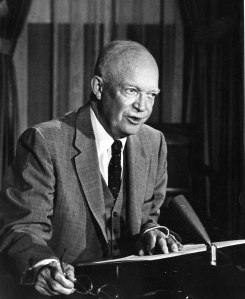
U.S. President Dwight Eisenhower kicked it off with his

“Atoms for Peace”

speech at the UN, 8 December 1953,


The Atomic Energy Agency could be made responsible for the
impounding, storage, and protection of the contributed fissionable
and other materials. The ingenuity of our scientists will provide
special safe conditions under which such a bank of fissionable
material can be made essentially immune to surprise seizure.

The more important responsibility of this Atomic Energy Agency would
be to devise methods whereby this fissionable material would be
allocated to serve the peaceful pursuits of mankind. Experts would
be mobilized to apply atomic energy to the needs of agriculture,
medicine, and other peaceful activities. A special purpose would be
to provide abundant electrical energy in the power-starved areas of
the world. Thus the contributing powers would be dedicating some of
their strength to serve the needs rather than the fears of mankind….

Against the dark background of the atomic bomb, the United States
does not wish merely to present strength, but also the desire and
the hope for peace.


And “Atoms for Peace” was part of an organized government PR campaign
(“Operation Candor”)
about Soviet nuclear weapons; see

http://www.eisenhower.archives.gov/research/online_documents/atoms_for_peace.html”>Dwight D. Eisenhower Presidential Library
for sources.
Operation Candor was replaced by Operation Soothing Syrup (I am not making this up),
according to Continue reading

Solar and wind cheaper than fossil fuels –more evidence

The most cost-effective power sources are solar and wind,
re-affirms a study that includes social costs,
such as the environmental costs of the climate
change caused by CO2 from fossil fuels
(the social cost of carbon, or SCC),
and the health damage caused by sulfur dioxide pollution.
It’s time to stop paying for utility executive profits with our health and dollars.
No fracking, no pipeline.

M Caulfield wrote for Exposing the Truth 24 September 2013,

Renewable Energy Now Cheaper Than Fossil Fuel
,

168292900_900x675[1]Renewable energy is becoming more and more
competitive. Alternative and renewable energy sources are increasingly
becoming more affordable. According to a new study published in the Journal
of Environmental Studies and Sciences
, it is now less costly in
America to get electricity from wind turbines and solar panels, than it
is to get it from coal-fired power plants. The study shows, when climate
change costs and other health impacts were factored in, that it is even
more cost effective to convert an existing coal-fired power plant with
a wind turbine, than it is to keep the old fossil fuel-burning plant.


Unsubsidized renewable energy is now cheaper than electricity from coal and
gas power stations in Australia as well. Wind farms in Australia
can produce energy at AU$80/MWh. Meanwhile, coal plants are
producing energy at AU$143/MWh and gas at AU$116/MWh. And the myth that alternative energy sources
were
enormously more costly than the typical
fossil fuels, is proving to be untrue. And after initial
investment costs are waged, making them now ameliorated, and the raw materials for solar and wind power are free, besides
costs of upkeep, and the harvesting of those sources doesn’t cause
mayhem to the environment. Making it an ever-more appealing alternative
energy source.

“The perception that fossil fuels are cheap and
renewables are expensive is now out of date… The
fact that wind power is now cheaper than coal and gas in a country with some of the world’s best fossil fuel
resources shows that clean energy is a game changer which promises to turn
the economics of power systems on its head,” – Michael Liebreich,
chief executive of Bloomberg New Energy Finance.

In lead author Laurie Johnson’s Blog 17 September 2013,

New Study: Clean Energy Least Costly to Power America’s Electricity Needs
, Continue reading