Tag Archives: Oil

Harvard excuses for not divesting from fossil fuels

Drew Faust wants us to believe Harvard can’t figure out how to power its
own campus and vehicles on renewable solar, wind, wave, and tidal energy?


Come on, pull the other one!

President Faust wrote that
divestment would make Harvard appear “as a political actor rather than an academic institution”,
that Harvard might not make enough money,
that “Universities own a very small fraction of the market capitalization of fossil fuel companies”, and that
“I also find a troubling inconsistency in the notion that, as an
investor, we should boycott a whole class of companies at the same
time that, as individuals and as a community, we are extensively
relying on those companies’ products and services for so much of
what we do every day.”
The first three excuses would have applied just as much back in the 1980s
when

Harvard finally divested from companies dealing in apartheid in South Africa
, a symbolic, and yes, political action that contributed markedly to the
release of Nelson Mandela, the downfall of the apartheid regime, and later
the election of Nelson Mandela as president of South Africa.

Harvard President Derek Bok, 18 May 1990,

in a letter to students

explaining the Unversity’s September 1989 decision
to divest from tobacco companies, since completed:


In reaching its decision, the corporation was motivated by a desire
not to be associated as a shareholder with companies engaged in
significant sales of products that create a substantial and
unjustified risk of harm to other human beings.

Harvard divestment was good enough for apartheid and tobacco.


In veritas, Harvard can have just as much or more influence by divesting
from fossil fuels, and that cause is even more important for the whole world.
In south Georgia truth, so can

Valdosta State University in its own region
.


Office of the President, Harvard,
3 October 2013,

Fossil Fuel Divestment Statement
;
I added the links and images, all directly related to Harvard.

Dear Members of the Harvard Community,

Continue reading

Bloomberg illustrates 63% solar growth in 2012

A graph Bloomberg New Energy Finance posted illustrates
the recent 60%+ growth deployed solar capacity, but
BNEF fails to project solar’s compound interest growth forward.


Look at the solar numbers in that graph:

2008 2009 2010 2011 2012
1.6 2.0 2.9 4.9 8.0
Change 25% 45% 69% 63%


Then look at that last row I added, which is each year’s
percentage increase over the previous year, as in
8.0 for 2012 divided by 4.9 for 2011 = 1.63 or 63%.
Slightly more for the previous year, and less in years before that.
In other words, the annual compound growth rate for solar is
around the 65% rate reported

by the solar industry
.

And slightly higher than the 60.9% FERC rate I used Continue reading

Pull out your phone, MacGyver, and take a picture of cars powered by rooftop solar


MacGyver needs to show an imprint on a floorboard to someone. Pull
out your phone and take a picture! No, in 1986

he MacGyvers a chisel
and hammer
and pries the floorboard up.


Even in 1996 the telcos and most of the public thought

dedicated copper and fiber connections were needed for reliable communications
.
(“Allison, can you explain what the Internet is?”)


But now you can pull out your phone and take a picture and post it over the packet-switched Internet to facebook for all the world to see.


In 2023 baseload nukes and coal plants and oil pipelines will be like
phone booths connected by dedicated copper, while rooftop solar charging
cars will be as common as phones in your pockets.
Solar power will win like the Internet did,
beating all other sources of power within a decade.


Meanwhile, Continue reading

Solar power will win like the Internet did

Remember BITNET, FidoNet, or UUCP?
Nope, the Internet overtook all of those.
And in 20 years that’s how young people will remember coal and natural gas plants,
although the waste-disposal costs of nukes will be with us for ten thousand years.
Solar power is going to overtake all other power sources within a decade.
Here’s why I think that.

Jerry Grillo quoted me in Georgia Trend July 2013,

Sun Dancing: As Georgia’s solar capacity shoots skyward, a new state utility is proposed
,


“Solar power is the fastest-growing industry in the world, and
it’s growing along in the same way the Internet did,” says
John S. Quarterman, a Harvard-educated author and Internet pioneer
who launched the first commercial online newsletter, among other
things, and who lives in rural Lowndes County.

“Think back 20 years to 1993. How many people had heard of the
Internet? And look at how far we’ve come. What I’m seeing with solar
energy is the same kind of exponential growth. It’s clean energy
that works, and it generates jobs.”

Here are 1992 ten-year graphs of Internet
growth from that newsletter, Matrix News,
using Continue reading

Local hospital opens 1950s-style diesel power plant

And still not a single solar panel at South Georgia Medical Center.
Yes, I know that won’t work for emergency power during the night,
but it would do fine for peak load during the afternoon.
Plus, did anybody see a request for bids for that new power plant?


Valdosta Electric always parked across the street from SGMC; google streetview

Eames Yates posted SGMC PR for WCTV Friday 19 July 2013 verbatim including
the title, plus a smoking smokestack image,

State-Of-The-Art Power Plant Opens At SGMC
, while
WALB posted a slightly shortened version,

S. GA Medical boasts brand new power plant
.
Here’s the SGMC PR;
I’ve added a few links: Continue reading

Floods cause oil spill in the tar sands capital of Calgary

Meanwhile, solar panels seldom flood and work again as soon as
the sun comes out.
And how much more flooding would we get here with a good hurricane
sitting still for a while?

John Upton write for Grist 25 June 2013,

Calgary floods trigger an oil spill and a mass evacuation
,


Epic floods forced more than 100,000 people to flee their homes last
week in Calgary, Alberta, the tar-sands mining capital of Canada.
More than seven inches of rain fell on the city over the course of
60 hours.

Now the floodwaters are Continue reading

Review of the misleading movie Pandora’s Promise

Here’s a trailer for the “documentary” pro-nuke film that comes out today,


Pandora’s Promise
.
The film discounts solar and wind energy because its makers
don’t understand the exponential decrease in solar prices or
the night backup power ability of wind connected with a smart grid.
The vast majority of the American people already are demanding
those real renewables instead of nuclear or coal,
and the economics of wind and solar are also rapidly beating natural gas.

Atom Ecology’s promotional writeup 7 June 2013,

Pandora’s Promise – Anti-Nuclear Mob Burns Environment In Coal Fired Forges Of Industry For 30 Years
begins,

A new documentary film that reveals how opposition to and voting
against nuclear power turned into massive increases in coal burning
power plants. The far worse outcome for the environment as coal has
filled energy demand is the story just coming to theatres.

The tiny germ of truth in that ten years ago is just plain wrong now
that coal is not the alternative because

solar has reached grid parity with nuclear, coal, and natural gas
.

The movie plays up Stewart Brand’s conservationist credentials
and his conversion to pro-nuke.


Not in that movie, but

in this TED talk
,
you can see
Stewart Brand lose a debate with Mark Z. Jacobson, who argued
we can power the whole world with sun, wind, and water.
Jacobson’s summary: Continue reading

Kemper Coal cost overruns at Southern Company Stockholder Meeting @ SO 2013-05-22

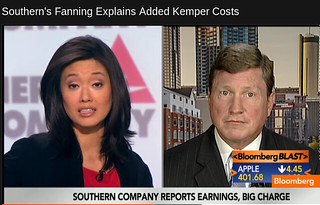
SO CEO Tom Fanning used Julia O’Neal’s question about cost overruns
to tout the alleged benefits of Kemper Coal,
which include selling CO2 to oil companies to pump into the ground to
produce more oil.
He didn’t mention that oil is then burned to produce more CO2.

Can you justify the Kemper Plant on your metrics? --Julia O Neal

And that Mississippi lignite coal he said would otherwise stay in the ground?
Yes it and its CO2 would stay there if SO would get on with solar instead of coal.

Before her question, he had not said much about that project, mostly this about Major Projects, at
29 minutes and 28 seconds in

SO’s own video

of
the 22 May 2013 Southern Company Stockholder meeting
.
You’ll have to skip there manually, because of the SO’s video format.

SO prohibited “unauthorized” videoing
,
so we don’t have the usual LAKE video on YouTube.

I always call out Vogtle and Kemper County.
Both projects are going to serve our customers for decades to come.
We’ve had some challenges with Kemper.
We’ll probably talk about those later.
But when I think about the value that these projects will bring,
I think our customers, and the economy of the southeast,
will be benefited for decades.
And we’re very excited about the progress we’re making on both of those.


It’s curious he mentioned SO’s flagship coal and nuclear projects
without saying coal or nuclear.
And if by “progress” he means Continue reading

Gulf 3 years ago; Caspian 5 years ago: BP oil well blowouts


Two years before

BP’s Deepwater Horizon oil rig poisoned the Gulf of Mexico

(Saturday was the third anniversary),
apparently BP had a very similar disaster in the Caspian Sea
and covered it up.
Is this a company or this the

13 spills in 30 days

industry we want piping tar sands crude across
America to the Gulf

for all of 35 permanent jobs and CO2 emissions like 51 coal plants
?
There’s a cleaner, cheaper, and more energy-independent way:

solar

and

wind
power can power the U.S. and the world.

Greg Palast wrote for EcoWatch 19 April 2013,

BP Covered Up Blow-out Two Years Prior to Deadly Deepwater Horizon Spill
,

Two years before the Deepwater Horizon blow-out in the Gulf of
Mexico, another BP off-shore rig suffered a nearly identical
blow-out, but BP concealed the first one from the U.S. regulators
and Congress.

This week, EcoWatch.org located an eyewitness with devastating new
information about the Caspian Sea oil-rig blow-out which BP had
concealed from government and the industry.

The witness, whose story is backed up by rig workers who were
evacuated from BP’s Caspian platform, said that had BP revealed the
full story as required by industry practice, the eleven Gulf of
Mexico workers “could have had a chance” of survival.
But BP’s insistence on using methods proven faulty sealed their
fate.

One cause of the blow-outs was the same in both cases: the use of a
money-saving technique—plugging holes with
“quick-dry” cement.

By hiding the disastrous failure of its penny-pinching cement
process in 2008, BP was able to continue to use the dangerous
methods in the Gulf of Mexico—causing the worst oil spill in
U.S. history. April 20 marks the second anniversary of the Gulf oil
disaster.

There’s more in

the article
, such as this:

Continue reading

35 jobs for 51 coal plants of CO2: Keystone XL Pipeline


What pollutes almost as much as one and a half coal plants per permanent job?
The proposed Keystone XL Pipeline.
Does that sound like a good deal to you?

Talia Buford and Darren Goode wrote for Politico 1 March 2013,

State Dept. Keystone report plays down climate fears
, Continue reading