Tag Archives: jail

How do anti-amnesty directives equate to available prison labor for private prisons?

Somebody recently asked:

I have seen no verification that the private prisons intend to make
money from inmate labor & the recent article claiming prison labor would
displace more citizen jobs if illegals were jailed as a positive for
amnesty was ridiculous. All anti-amnesty directives I have seen call for
the illegals being deported back to their country of origin ASAP. How
does this equate to available prison labor for private prisons?

OK, let’s go look at the anti-immigrant law passed by Arizona.


It’s littered with “federal custody” and
“imprisoned not more than thirty days” and
“imprisoned not more than six months” and
“A person who is sentenced pursuant to this section is not eligible
for suspension or commutation of sentence or release on any basis until
the sentence imposed is served.”
and
“class 1 misdemeanor”
and
“class 3 felony”
and
“class 4 felony”
and
“twenty days in jail” and
“thirty days in jail”.


Arizona Revised Statutes Section 11-1051

D. Notwithstanding any other law, a law enforcement agency may securely
transport an alien who the agency has received verification is unlawfully
present in the united states and who is in the agency’s custody to a
federal facility in this state or to any other point of transfer into
federal custody that is outside the jurisdiction of the law enforcement
agency. a law enforcement agency shall obtain judicial authorization
before securely transporting an alien who is unlawfully present in the
United States to a point of transfer that is outside of this state.


13-1509. Trespassing by illegal aliens; assessment; exception; classification
Continue reading

State needs to rethink locking up nonviolent offenders –Nathan Deal

Conservative Georgia governor Deal wants fewer people in prison,
discovering, like Texas before, that Georgia can’t afford it.
Jim Galloway reported in the AJC 17 Jan 2011,

Georgia Gov: Drug court offers good alternative
Cost of crime and punishment is high on new governor Nathan Deal’s list
:

Georgia Governor Nathan Deal has said that violent offenders will remain
behind bars, but the state needs to rethink the costs of locking up
others, like nonviolent drug offenders.

Last May we noted that
Georgia spends a billion dollars a year to keep the fourth-largest
number of prisoners of any state.

Now that the state is cutting every other budget,
including huge cuts in education, we just can’t afford
to lock so many people up.


The number of people locked up

has grown way faster than violent crime since 1980.

The U.S.,
with 5% of the world’s populatioon now has 25% of
the world’s prison population
:
more than any other country total and per capita:
more than China, more than Russia, more than Cuba.
As Sen. James Webb remarked in 2009:

Continue reading

South Georgia GBI; Roundup of Blacks In Quitman

In the appended post about yesterday’s events in Quitman,
George Rhynes cites the
WCTV
and
WALB
stories.
Curiously, the nearest local daily newspaper,
the Valdosta Daily Times, seems to have nothing online about this.
-jsq


At 8:30 AM, I began receiving phone calls from Quitman, Georgia
in the County of Brooks where the County
Sheriffs Office was arresting citizens at random concerning the recent
Absentee Ballot Problems.

These arrests reminded me of the alleged problems Black Voters/Citizens have
had with the GBI harassing them during their investigation before and during
the last run off election.
This included alleged actions by the GBI
Investigators that local citizens complained about intimidation before,
during and after the election. However little or no Public Media
Attention was given to alleged Black Voter intimidation by local media.
Moreover, little to nothing was published in the
FREE PRESS surrounding citizen’s fear from GBI Investigators. This was a
major point of discussion when I along with a local Pastor from Valdosta,
Georgia walked the streets to get a better understanding of what

Brooks County Voters had to go through during the last election.

Today’s arrest will surely end up in the courts.

Continue reading

STPP: Dismantling the School to Prison Pipeline Symposium


Did you know that:

Children are far more likely to be arrested at school than they were a generation ago.

The vast majority of these arrests are for non-violent offenses such
as “disruptive conduct” or “disturbance of the peace.” Five
year olds are being led out of classrooms in handcuffs for acting out
or throwing temper tantrums. Students have been arrested for throwing
an eraser at a teacher, breaking a pencil, and having rap lyrics in a
locker. These children do not belong in jail.

Why do we pay more to incarcerate people than it would cost
to educate them?

Why is this happening? “Zero tolerance” policies criminalize minor
infractions of school rules and high-stakes testing programs encourage
educators to push out low-performing students to improve their schools’
overall test scores. Students of color are especially vulnerable to the
discriminatory application of discipline and push-out trends.

Here’s a chance to do something about it.

The School To Prison Pipeline (STPP) refers to a disturbing national
trend in which students are funneled out of public schools and into the
juvenile and criminal justice systems. Most of these kids are children
of color, and many have learning disabilities or histories of poverty,
abuse or neglect, and would benefit from additional educational and
counseling services. Instead they are punished and isolated.

The Valdosta

Dismantling the School to Prison Pipeline Symposium

is one of

a series throughout the state of Georgia.

It’s 9:30AM – 4PM 30 Oct 2010.

-jsq

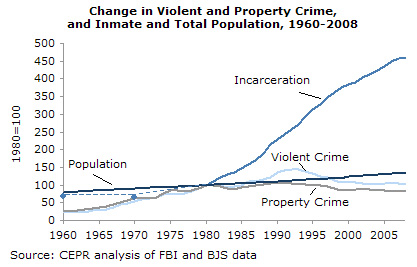
Jailing Too Many People Costs Too Much


John Schmitt, Kris Warner, and Sarika Gupta write about

The High Budgetary Cost of Incarceration
:

The United States currently incarcerates a higher share of its population than any other country in the world. We calculate that a reduction in incarceration rates just to the level we had in 1993 (which was already high by historical standards) would lower correctional expenditures by $16.9 billion per year, with the large majority of these savings accruing to financially squeezed state and local governments. As a group, state governments could save $7.6 billion, while local governments could save $7.2 billion.

These cost savings could be realized through a reduction by one-half in the incarceration rate of exclusively non-violent offenders, who now make up over 60 percent of the prison and jail population.

A review of the extensive research on incarceration and crime suggests that these savings could be achieved without any appreciable deterioration in public safety.

There’s a 19 page PDF report published by the Center for Economic and Policy Research,
but that one graph pretty much spells it out:
incarceration went up abruptly starting in the early 1980s and continued up,
while crime did not.
What we have here is a very expensive policy mistake.

And where does most of the cost come from?

Continue reading

Cost of Incarceration in Lowndes County

I don’t know what we pay in local or state taxes to lock people up
in Lowndes County, Georgia, although probably it’s in line with
the high cost of incarceration in Georgia.
I do know there are a lot of indirect costs,

including this one:

Prisoners have to be released from prison or the county jail into the same community, and can’t get a job because they’re ex-cons, and often not even an apartment. Result? Homeless ex-cons turning to crime.

Female ex-cons in Lowndes County have some places they can turn to for
housing. Male ex-cons have only the Salvation Army, and they have to leave
there every morning early.
In Atlanta they’ve examined their situation and determined that

housing is the most central issue.

Which would we rather do? Pay as much per year to send them back to jail
as it would cost to send them to college?
Or find a way to provide housing for them?

How about helping ex-prisoners learn job-hunting skills and job-holding skills?
Employment is the best preventative for crime.
There are local organizations ready to work on that, such as

CHANCE: Changing Homes and Neighborhoods, Challenging Everyone
.

Local tax dollars need to be spent in a way that benefits
the entire community, and not just a few. Maybe we can
afford to do something about getting ex-prisoners a place to live and jobs so they stay
out of crime and improve the local economy.
Actually, can we afford not to do that to reduce incarceration expenditures?

Cost of Incarceration in Georgia


Carrie Teegardin and Bill Rankin
write in the AJC about

A billion-dollar burden or justice?
AJC investigation: Georgia leads nation in criminal punishment
:

Georgia taxpayers spend $1 billion a year locking up so many criminal offenders that the state has the fourth-highest incarceration rate in the nation. When it comes to overall criminal punishment, no state outdoes Georgia.

They note that scare tactics made that happen.

But today, many public figures with strong anti-crime credentials are asking if that expenditure is smart, or even if it’s making Georgians safer. The debate about crime and punishment, once clearly divided along party lines, is now a debate in which conservatives often lead the charge for change.

Continue reading

Prisoner Re-Entry

Prisoners have to be released from prison or the county jail into the same
community, and can’t get a job because they’re ex-cons, and often not even
an apartment.
Result? Homeless ex-cons turning to crime.
A New York Times editorial suggests
Smart Answers to Recidivism
:

Faced with soaring prison costs, states are finally focusing on policies that would help former prisoners stay out of jail after they are released. Some legislatures are reshaping laws that land parolees back inside for technical violations that should be dealt with on the outside. More than a dozen cities and counties have taken steps that make it easier for qualified ex-offenders to land government jobs, except in education and law enforcement and other sensitive areas from which people with convictions are normally barred by law.

Still, the nation as a whole needs to do much more about laws that marginalize former offenders — and often drive them back to jail — by denying them voting rights, parental rights, drivers licenses and access to public housing, welfare and food stamps, even in cases where they have led blameless lives after prison.

The specific example they consider is New Jersey, but Texas has also
led in throwing people into jail and now is starting to try to do something
about ex-prisoners once they get out.
Paying as much per prisoner as would cost to send them to college,
in a time of chronic budget shortfalls, is not very attractive.
Georgia could also make changes to reduce recidivism,
and reduce its prison population.

Jails in Erie County, NY: DoJ Sues


Jail conditions are a widespread problem.
Matthew Spina reports in the Buffalo News about Erie County, New York jails:

“Jails must provide for the basic medical and mental health needs of inmates and must keep them safe from attacks by other inmates and excessive force by staff,” Loretta King, the acting assistant attorney general for the Justice Department’s Civil Rights Division, said in a statement.

“We have repeatedly sought the county’s cooperation in working toward an amicable resolution in this matter, and we regret that the county’s failure to cooperate compels us to litigate,” she continued.

“In light of the severity of the conditions, including multiple suicides and beatings, we must take action to ensure that the constitutional rights of those persons detained at the facilities, many of whom have not been convicted of any crime, are protected.”

This is a continuation of series on incarceration started on Canopy Roads of South Georgia;
that series is now moving over here to On the LAKE Front.