Tag Archives: Georgia Power

Gov. Deal: the ugly on energy

Gov. Nathan Deal said he’s a free-enterprise person and doesn’t want to subsidize renewable energy, but he maybe doesn’t know that the state of Georgia subsidizes Georgia Power’s new nuclear plants through an indirect tax, and that fossil fuels are far more subsidized than renewable energy. That plus the chickens.

Continuing Gov. Deal: the good, the ugly, and the bad on prisons, quoting again from David Rodock’s interview with Gov. Nathan Deal in today’s VDT.

The Ugly

Continue reading

gapower to buy 50 MW solar by 2015

Previously I wrote PSC lining up to vote for solar and last week they went and did it.

Georgia Power will buy solar by 2015, By Associated Press – Athens Banner-Herald, 24 July 2011:

ATLANTA — The Public Service Commission has approved Georgia Power’s plans to buy up to 50 megawatts of solar power by 2015.

The utility plans to strike agreements with individual solar-power producers to meet the deadline. The providers would have to be able to connect to the transmission system for Georgia Power or its sister utilities in Alabama, Florida and Mississippi.

Continue reading

Georgia Power wants taxpayers to take profit risk for new nukes

After already hiking rates to pay for Plant Vogtle units 3 and 4, Georgia Power now balks at taking any risk to its profit if costs go above the projected budget.

Kristi E. Swartz wrote in the AJC today, Georgia Power trashes regulatory staff’s financial proposal for Vogtle cost overruns:
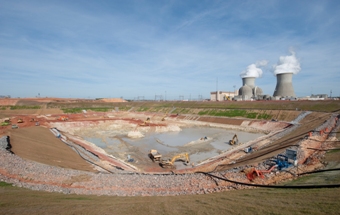
Georgia Power officials told state regulators they never would have started to build a new multi-billion-dollar nuclear power plant if they knew the company might be on the hook for certain potential cost overruns.

The company, they said, would be building a natural gas plant instead.

Georgia Power, which is the largest stakeholder in a partnership building two new reactors at Plant Vogtle, is responsible for $6.1 billion of the $14 billion project. The Georgia Public Service Commission’s staff wants to cut into the utility’s allowed profit margin if the project runs more than $300 million over budget. Profits would similarly get a boost if the reactors come in under budget by the same amount.

The PSC deal sounds fair to me, or actually rather generous.

But not to the big-company socialists at Georgia Power:

At a PSC hearing Wednesday, company executives said the proposal could drive up financing costs of the project, potentially damage the ability to raise capital and eventually increase customer bills.

“As a member of the management team of the company, if this mechanism had been part of the original certification, we very likely would have not proceeded [with the project],” said Ann Daiss, Georgia Power’s comptroller.

Privatize the profits; socialize the risks! That’s the ticket!

They could spend less money building distributed solar farms and wind generators and get them built a lot faster with very little risk of cost overruns. Why isn’t Georgia Power interested in that?

“Even under the most adverse outcomes, the units remain highly profitable with very limited risk for investors,” [PSC staff member Tom] Newsome said. “We’ve been talking a lot about investors in this hearing and I think we need to be talking about [customers].”
Profits paid for by customer rate hikes and taxes from you, the taxpayer. You’d have a better deal if Georgia Power built solar and wind plants.

-jsq

PS: Owed to Mandy Hancock.

Georgia officials are getting it about solar

Chuck Eaton, Georgia Public Service Commissioner, moderating a panel of Georgia’s Policy Makers at Southern Solar Summit said
Solar is great for diversity, independence, research, and business.
He said that until recently he had discounted solar, but now he had seen it. Continue reading

Sign up for renewable energy from Georgia Power —Jaime Hockin @ Solar Summit

Panelist Jaime Hockin of Georgia Power pointed out that gapower customers can sign up for green energy right now. Here’s where: Residential Green Energy Signup.
  1. Standard Green Energy Option: $3.50 (plus tax) a month per 100 kWh block.
    This option delivers Green-e Energy certified renewable energy that is generated entirely by biomass.
  2. Premium Green Energy with Solar Option: $5.00 (plus tax) a month per 100 kWh block.
    This option delivers Green-e Energy certified renewable energy that contains a mix of at least 50% solar and 50% biomass energy.
You get a separate line item on your bill for whichever one you buy.

Some people claim that there’s no way to do this because it’s just electrons once it gets on the wire. Sure, and money is just dollars once you spend it. But contracts can determine where those dollars go, and in exchange for what:

Due to the way electricity is transmitted and distributed, energy purchased or produced from renewable energy resources may not be specifically delivered to you. However, the renewable energy you purchase will be added to the power grid and will displace incremental power that would have otherwise been produced from traditional generating resources.
So as Jaime Hockin advised, if you want to show you want renewable energy, and you are a Georgia Power customer, sign up and Georgia Power will hear you!

-jsq

Southern Company committed to communities, renewable energy, energy efficiency

Thomas A. Fanning, chairman, president and CEO of Southern Company, says his company is committed to communities, renewable energy, and energy efficiency. So helping finance municipal refitting and solar projects should be a natural for Southern Company!

According to PR from Southern Company, 25 May 2011, Southern Company Holds Annual Meeting of Shareholders

Fanning also emphasized a continued commitment to the communities the company serves and stressed the need for a national energy policy and a robust research and development initiative.

“Southern Company keeps customers at the center of every decision we make,” said Fanning. “We remain committed to providing reliable, affordable energy for our customers and to do that we need to maintain a diverse fuel mix as well as stay focused on developing the newest technologies.”

Referencing a diverse fuel mix, Fanning highlighted the company’s commitment to nuclear energy, including building the nation’s first new units in 30 years. He also discussed the importance of preserving coal – America’s most abundant energy resource – as well as the role of natural gas, renewable energy and energy efficiency in meeting its customers energy needs.

“Furthermore, we are the only company in the industry that is doing it all. We’ve committed more than $20 billion to these efforts,” Fanning said.

Sure, he listed renewable energy and energy efficiency last. But this is the same Thomas A. Fanning who said in May that he’s “bullish” on solar. The same CEO of the parent company of Georgia Power, which just connected a 300 kiloWatt solar plant in Lowndes County. The same CEO who’s being nagged by the Georgia PSC chairman “to come up with options in the next 30 days for expanding the tiny amount of electricity generated from solar power.” And a company that spends more than $20 billion on new energy projects can afford a few tens of millions for community refitting and solar.

-jsq

Birmingham U.K. municipal solar didn’t wait for larger governments

Banks and power companies can fund municipal solar projects; cities and counties don’t have to wait for state or federal governments to provide them grants. Or at least Birmingham, U.K. has done it for public housing. And Quitman, Georgia did it last year, too.

According to Larry Elliott in the Guardian, 3 October 2010, 10,000 Birmingham council homes to get solar panels: City agrees £100m scheme, partly funded by banks and energy suppliers, to meet target for cutting carbon emissions

Plans to fit power generating solar panels to council-owned properties in Birmingham will be pushed forward this week after the council agreed a “green new deal” scheme covering 10,000 homes.

In the biggest proposal for retrofitting houses through an energy efficiency upgrade yet seen in the UK, the council agreed a £100m proposal last week designed to create jobs and meet the city’s ambitious targets for reducing carbon emissions.

The plan – Birmingham Energy Savers – will be jointly funded by Birmingham council and investment from energy suppliers and commercial banks, and follows two successful pilot schemes conducted in Europe’s biggest local authority.

Energy efficiency and solar power to create jobs!

We have local proof of concept right next door Continue reading

Georgia Power needs to expand solar —Lauren McDonald, Chairman, GA PSC

An unlikely ally in getting Georgia Power to do solar. Maybe too unlikely.

Kristi E. Swartz wrote in the AJC 8 June 2011, Regulator: Georgia Power needs more solar sources

Georgia utility regulator Lauren McDonald wants Georgia Power to come up with options in the next 30 days for expanding the tiny amount of electricity generated from solar power..

“I think we need to take an aggressive move and explore what we can do,” McDonald, a veteran member of the Public Service Commission, told The Atlanta Journal-Constitution. “I don’t think the company and even our staff has been challenged to the degree that they should be.”

Georgia Power responded saying they would “comply”. Which doesn’t mean much since there’s nothing but one person’s opinion to comply with.

I tend to agree with Neill Herring on this one:

Neill Herring, a lobbyist for the Sierra Club, called the action “back scratching.”

“They both get to look responsible,” said Herring, adding that there’s a growing and vocal solar lobby in Georgia. “They have to deal with those people. That’s what this is about.”

So I guess we need to be more vocal to get them to scratch harder.

The article notes:

Georgia Power has resisted building solar and other alternative energy projects for years, citing cost and a cloudy Southeast as the two main issues.
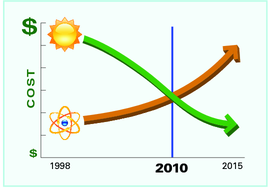
Which of course are both bogus excuses, since solar already costs less than nuclear to deploy, and Georgia Power’s own web pages admit that:
…insolation values in Georgia are significant enough to support solar energy systems in our state, with the southern two-thirds of Georgia having equivalent solar insolation values to most of the state of Florida.
Also more sun than Houston, which is busily deploying solar, and the same amount as Austin, which is a national leader in solar.

Maybe some cities also could suggest Georgia Power do something.

-jsq

PS: Claudia Collier pointed out this AJC article.

Southern Company “bullish” on solar

Colleen Kiernan, director of the Georgia chapter of the Sierra Club, wrote in the Atlanta Business Chronicle 22 May 2011, Wind energy a viable option for Southern Co.’s portfolio:
Two years ago, Southern Co. claimed “Renewable energy sources like wind and solar are not really an option for us in the Southeast.”

Now the new CEO, Thomas Fanning, says he’s “bullish” on solar. While the new attitude on solar is refreshing,

I’ve seen this before. AustinEnergy went in one year from solar isn’t an option to Continue reading

Nuclear reactor Vogtle 1 at August shut down

Nuclear really more reliable than wind or solar? What’s with the unscheduled shutdowns?

Colin McClelland reported for Bloomberg 21 April 2011, U.S. Nuclear Output Falls as Vogtle Reactor in Georgia Shuts

U.S. nuclear-power output remained near a 4½-year low for a fourth day as the Vogtle 1 reactor in Georgia shut down unexpectedly, the Nuclear Regulatory Commission said.

Power generation nationwide decreased 538 megawatts to 71,781 megawatts from yesterday, or 71 percent of capacity, the smallest amount since Oct. 22, 2006, according to an NRC report today and data compiled by Bloomberg. Twenty-nine of the nation’s 104 reactors were offline.

Southern Co. (SO)’s 1,109-megawatt Vogtle 1 reactor automatically tripped offline yesterday at 5:34 p.m. when it was at full power. The cause is under investigation, the NRC said.

The shutdown was ironically two days after an NRC public meeting “to discuss Plant Vogtle’s annual safety evaluation and assessment.”

That would be the same location where, according to Tice Brashear back in 18 March 2009: Continue reading