Tag Archives: GA PSC

Georgia Power inches towards more solar, trailing New Jersey

If you’re quick, you may be able to sell solar from your roof
to Georgia Power.
If the PSC approves a pending request.
If you get in before that new quota gets filled.
And if you’re a Georgia Power customer.
The rest of us?
Not until the
1973 Georgia Electric Territorial Act
is changed.
Until then, Georgia will continue to lag way behind New Jersey in solar power.
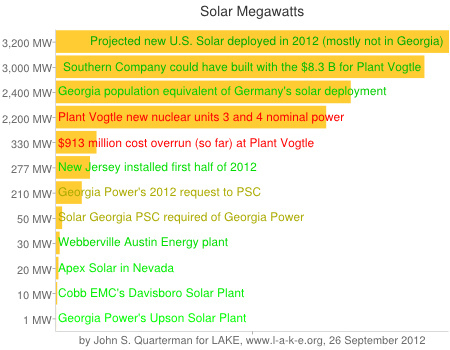

210 MW is more than 50 MW but way less than 3,000 MW

Walter C. Jones wrote for the Augusta Chronicle today,

Georgia Power plans to triple solar power use
,

Georgia Power filed Wednesday seeking permission from state
regulators to more than triple the amount of solar power it uses to
generate electricity for its 2.4 million customers by swapping it
for what was already planned from other renewable sources.

What “other renewable sources”?

The Georgia Power plan won’t affect rates because it is based on
paying the solar providers what it would have paid the biomass
provider, 13 cents per kilowatt hour, which is already figured into
customer’s rates.

OK, that’s good, because it means biomass is well and truly
dead in Georgia.
But it also means Georgia Power isn’t very serious about solar,
if all it’s doing is fiddling with accounting for the small amount
of power biomass might have produced and not going for the real
numbers solar can produce.
OK, how many solar megawatts?
Continue reading

Germany Added 543 MW of Solar Power Capacity in July

While we in Georgia were still pouring money down that nuclear pit near the
Savannah River, Germany has been getting on with real renewable energy.
We could have deployed almost that much solar power with just the cost overruns
so far at Plant Vogtle.

Nicholas Brown wrote for Clean Technica 8 September 2012,

Germany Added 543 MW of Solar Power Capacity in July,


According to Matt McDermott of Treehugger: “[In] the first
half of 2012 Germany has installed just over 4.37 gigawatts of
grid-tied solar power. Remarkably just about 1.8 GW of that happened
in June alone (perhaps even more remarkable, this isn’t even a
record amount for one month in Germany).”

The amount of solar power capacity added in June was much more than
July’s, but July’s was still impressive. July’s addition brings
Germany’s total installed capacity for the first half of 2012 to
4,900 MW (4.9 GW).

This impressive solar installation rate had a lot to do with Germany’s
famous Feed-in Tariffs (FIT), but it also had a lot to do with
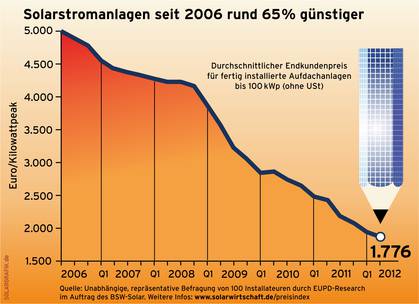
Moore’s Law, illustrated by that graph of cost per kilowatt rapidly
going down.


543 MW?
That’s more than the 330 MW of solar
the $913 million cost overrun at Plant Vogtle in the
first half of 2012 could have bought.
1800 MW in June and 543 MW in July?
That’s 2343 MW, which is more than the entire rated 2200 MW output of Plant Vogtle 3 and 4 put together, if they ever get built.
Sure, the sun doesn’t shine all the time, but in the years until the nukes ever
get built (if ever), how much solar could we deploy at the rate of one Vogtle unit equivalent a month?

Hey, maybe we should cancel Plant Vogtle and deploy solar instead!
Maybe Georgia Power and Southern Company will realize their big bet
has already gone bad.
Or maybe we should elect some Public Service Commissioners and legislators
who will get them to realize it.

-jsq


Change the Atomic Energy Act? How about change the Georgia Electric Territorial Act?

In reaction to

the NRC denying a nuclear permit for Calvert Cliffs,


some nuclear backers suggest

changing the
Atomic Energy Act of 1954 to permit majority foreign ownership
of nuclear reactors.

What will they suggest next?
Asking Iran to invest in U.S. nukes?

Steve Skutnik wrote for http://theenergycollective.com 5 September 2012,

A cost-free way to open up nuclear investment
,

If this seems entirely backward in a world of global production and
investment, that’s because it is. The current regulation is an


artifact of the Atomic Energy Act of 1954, which first authorized
private ownership of nuclear facilities. (Prior to this—per
the Atomic Energy Act of 1946, all nuclear technology was considered
a state secret, during the short time in which the U.S. enjoyed a
monopoly on the technology.)

Is there any real compelling reason for restrictions on foreign
ownership and investment in nuclear facilities to exist at a time
when the U.S. holding a monopoly on the technology has long since
passed? Issues of safety here of course are irrelevant—the
facilities would be licensed and regulated by the NRC, just as any
other nuclear facility is now. About the only salient objection is
the political one—i.e., the implications of a foreign entity
maintaining controlling ownership in key infrastructure. (Although
it’s hard to see anyone getting particularly upset about the
reverse—U.S. entities owning a controlling stake in
infrastructure in other nations.)

Yeah, sure, strict regulation
will deal with that, just like it prevents fracking from setting
drinking water on fire, or BP from poisoning the Gulf.
The new NRC head is

maybe well-meaning
,
but it’s the same NRC

that gave Vogtle 1 a clean bill just before it had to shut down

and the same NRC that’s ignoring

cancer in Shell Bluff.

Oh, by the way, the article gets to the main point eventually:

Continue reading

NRC rejects nuke permit for EDF in Maryland

French nuclear operator Électricité de France (EDF)


was denied a license last week for the proposed Calvert Cliffs

nuclear reactor in Maryland, because the
Atomic Energy Act of 1954 prohibits majority foreign ownership
of nuclear plants.
EDF now has 60 days to find a U.S. partner, or give up the project.
Who could the possible suitors be?
Hint: think southeast.

The handwriting was on the wall two years ago when
Constellation Energy pulled out of the project.
Jim Polson and Alan Katz wrote for Bloomberg 10 October 2010,

Constellation Drops Nuclear Plant, Denting EDF’s U.S. Plans
,

Constellation Energy Group Inc. pulled out of negotiations on a $7.5


billion loan guarantee to build a nuclear reactor in Maryland with
Electricite de France SA, potentially damaging the French utility’s
U.S. expansion plans and the companies’ partnership.

The cost of the U.S. government loan guarantee that the companies’
joint venture, UniStar Nuclear Energy, would need to build the
Calvert Cliffs 3 reactor is too high and creates too much risk for
Constellation, the Baltimore-based utility said in a statement
yesterday. The statement said the next step is up to EDF. Enlarge
image U.S. Deputy Energy Secretary Daniel Poneman

In a letter Oct. 8 to Daniel Poneman, deputy secretary of the U.S.
Department of Energy, Constellation said it received a government
estimate that the venture would have to pay about $880 million to
the U.S. Treasury for the loan guarantee, “dramatically out of
line with both our own independent assessments and of what the
figure should reasonably be.”

Constellation’s decision may make it more likely that the U.S.
utility will exercise a put option forcing EDF to buy as much as $2
billion of Constellation’s non-nuclear power plants, said Ingo
Becker, head of utilities sector research at Kepler Capital Markets.

“EDF very clearly said if they exercise the put, this thing is
over,” Becker said. “Constellation may have just turned
around the calendar and pulled out of the new build before
exercising the put, anticipating EDF’s reaction.”

In a letter Oct. 8 to Daniel Poneman, deputy secretary of the U.S.
Department of Energy, Constellation said it received a government
estimate that the venture would have to pay about $880 million to
the U.S. Treasury for the loan guarantee, “dramatically out of
line with both our own independent assessments and of what the
figure should reasonably be.”

Meanwhile, Southern Company

is still trying to reduce what it has to pay for its
$8.3 billion federal loan guarantee
.

Back in Maryland, the news got worse for the nuke last year.
EDF

asked for the state’s help
,
but didn’t get the answer it wanted.
Scott Dance wrote for Baltimore Business Journal 16 December 2011,

EDF: Constellation-Exelon settlement hurts Maryland nuclear industry
,

Continue reading

Energy experts making excuses for fracking

Numerous eminent current and former regulators, governors,
and legislators’ best advice for how to keep fracking from
polluting our aquifers and drinking water: “strict regulation”.
As Gandhi reputedly said about western civilization: that would be a good idea.
But in Georgia and many other places, where the regulatory agency
(GA PSC) and the legislature are pretty much captured by the utilities
they pretend to regulate, how will we get that “strict regulation”?

This was at a Politico event, sponsored by American Wind Power,
called Energy & the Presidency.

Join POLITICO for a lunch conversation with energy experts and
policy leaders

Energy & the Presidency panel

as they discuss current energy legislation, the
energy debates facing the nation, policy options and what’s ahead in
the year to come. Speakers include: ClearView Energy Partners’ Kevin
Book; former Administrator of the EPA and former Director of the
White House Office on Climate Change, Carol Browner; Rep. Ed Markey
(Mass.); former Gov. Bill Richardson (NM) and former Gov. Bill
Ritter (Colo.).

When: Wednesday, September 5, 2012 at 12:00 pm ET


This event was in North Carolina, where the late John Blackburn, Ph.D.
already reported two years ago that

the whole state could be powered by wind, sun, existing hydro, landfill gas, and less natural gas than is already in use,

why do we need fracking at all?

Georgia has similar real renewable energy potential,
plus studies by

Georgia Tech

and Duke
indicate that Georgia doesn’t need any additional total electric power
anyway, if it gets on with energy efficiency.
Add

solar
and

wind
instead of natural gas, and we can retire a lot of
coal plants.
With no need for fracking.

I have an idea:
let’s elect Public Service Commissioners and legislators who are not
beholden to the utilities they will regulate!

-jsq

Where would Georgia Solar Utilities Inc. get enough land for 80 MW solar generation?


Plant Branch in Georgia

Where will
Georgia Solar Utilities Inc.
get

the 2,200 acres it says it needs to build 80 MW of solar generation?

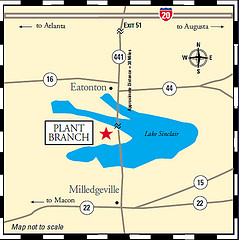
Well, it’s supposed to be “adjacent to Georgia Power Co’s coal-burning Plant Branch near Milledgeville, Ga.”, so let’s look there.


Plant Branch Location Map

A

brochure on Plant Branch by Georgia Power

(undated, but last date mentioned is 1998, so I’m guessing 1999)
says:

Located on 1,900 acres on Lake Sinclair in Putnam County between
Eatonton and Milledgeville, Plant Branch was the first
million-plus-kilowatt electric generating station to operate on the
Georgia Power system. It is named for Harllee Branch Jr., former
chairman of the board of Southern Company and president of Georgia
Power. Construction on the plant began in 1961, and by the summer of
1969,

Coal pouring onto pile

four units were in operation. The 1,539,000 kilowatts
generated by Plant Branch provides enough electrical power for
342,000 households.

And now Plant Branch will be among the first to close coal-generating
units.
According to
Melissa Stiers for GPB News 12 July 2011,

Georgia Power Closing Three Plants
,

Two coal fired units at Plant Branch in Milledgeville will close in
2013. That’s a result of federal regulation tightening air pollution
controls. The company has said it’s too costly to upgrade those
units.


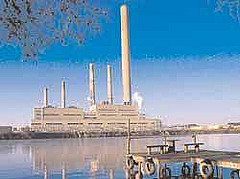
Plant Branch across Lake Sinclair

As we know, Georgia Power’s parent The Southern Company

claimed it was incompetent to deal with the new EPA regulations

even though it had already announced the Plant Branch closures (amounting to about 770 MW),
and later SO announced

4,000 MW of coal plant closures.

While the various news stories keep saying Plant Branch is in Milledgeville,
actually, it’s on the other side of Lake Sinclair, closer to Eatonville,

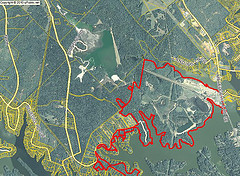
Plant Branch site in Putnam County qpublic map

and in Putnam County.
A quick glance at the

Putnam County Tax Assessor database maps

shows that the land parcel containing Plant Branch
is 913.87 acres, much of which isn’t actually used by the plant.
And Georgia Power owns a total of more than 3,000 acres adjacent
to that site.
So I’m guessing the 2,200 acres figure is simply around 3,100 total
Georgia Power acres minus 913 acres for the present Plant Branch site.

Estimates for land needed for a megawatt of solar power generation range

Continue reading

Company to build 90 MW solar and become a utility

What to do if you can’t interest Georgia Power in building solar?
Do it yourself, and do enough so you can be a utility yourself.
That’s the loophole in the 1973

Electric Territorial Act

that FPL and JEA use to burn coal at Plant Scherer in Georgia and export the power to Florida.
Now Georgia Solar Utilities Inc. is using the loophole for a better purpose:
building almost twice as much solar generation
as Georgia Power’s meager 50 MW.


Georgia Solar Utilities

Dave Williams wrote for the Atlanta Business Chronicle yesterday

New Georgia utility pitches solar plant:
A new utility is planning to build a $320 million solar power plant on 2,200 acres adjacent to Georgia Power Co’s coal-burning Plant Branch near Milledgeville, Ga.

Georgia Solar Utilities Inc. initially approached Georgia Power, a
unit of Southern Co. (NYSE: SO), with a proposal to build the plant
and sell it to Georgia Power through a power-purchasing agreement.

Georgia Power is retiring two coal-fired units at Plant Branch, part
of a move to reduce the Atlanta-based utility’s reliance on coal.

But when Georgia Power officials declined to take part in the
project last May, Georgia Solar Utilities executives decided to
build the plant on their own and operate it as a new utility
independent of Georgia Power.

Once cost prohibitive, solar energy has become competitive with
fossil fuels because of the rising costs of coal and tighter
government regulation of coal emissions, said Robert Green, founder
of Georgia Solar Utilities.

“When you don’t have to buy coal or worry about environmental
hangovers, it overwhelms the costs of fossil fuels, Green said
Thursday after presenting the proposal to the Georgia Public Service
Commission’s Energy Committee.

Some say the PSC can’t approve such a utility because of that 1973 law.
I suspect that if they don’t approve this proposal, the next one
will be even harder to turn down, and the next one,
as they become even more competitive.

How competitive?

Continue reading

1.5MW solar field near Philadelphia

Far to the north of here, a botanical garden installed
more than a megawatt of solar power a year ago.
Maybe Georgia Power should ask them how it’s done.

PR of 16 June 2011,

LONGWOOD GARDENS COMMISSIONS 10-ACRE SOLAR FIELD:
Installation first step of goal to achieve 3 MW of solar energy by 2018


June 16, 2011, Kennett Square, PA — Longwood Gardens today
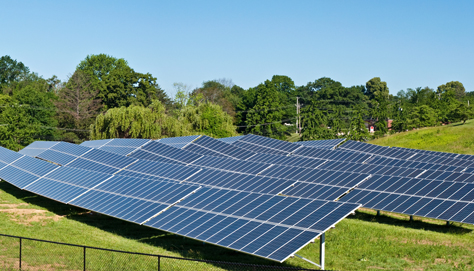
commissioned a new, ground-mounted solar field spanning more than 10
acres at the horticultural showplace in Kennett Square,
Pennsylvania.

One of the largest examples of clean emission-free energy in the
region, the solar field produces 1.2 MW (megawatts) of power and
will produce 1.5 MW when the final panels are installed in the
coming weeks. The fixed-tilt, 1.5 MW solar installation will produce
enough electricity to offset the usage of approximately 138 average
Pennsylvania homes and reduce Longwood’s annual carbon dioxide
emissions by 1,367 tons.

“We are always looking for ways to advance our sustainable
practices,” said Paul Redman, Longwood Gardens Director.
“It is integral to Longwood’s mission to decrease our
dependence on fossil fuels.” We want to establish best
practices and lead the way in showing communities how to live
responsibly,” said Redman.

Imagine if Georgia Power and Southern Company acted responsibly
and led the way in solar power!

Continue reading

PSC rubberstamps Vogtle costs; next day Fitch affirms Southern Company ratings

Need any more proof that Southern Company’s nuclear boondoggle
only works with Georgia Power customer and taxpayer subsidy?
PSC rubberstamps one day and Fitch affirms ratings the next day.
Maybe we should elect Public Service Commissioners who will
serve the public.

Georgia Power PR 21 August 2012,

Georgia PSC approves Vogtle construction costs


The Georgia Public Service Commission (PSC) today in a 5-0 vote
approved Georgia Power’s spending on Plant Vogtle units 3 and 4 for
the period including July 1, 2011 through Dec. 31, 2011.

The next day, Fitch PR 23 August 2012,

Fitch Affirms Ratings for Southern Company and Subsidiaries
,

Continue reading

New research shows Natural Gas far more dangerous for climate stability —Seth Gunning

Received yesterday on U.S. CO2 emissions lowest in 20 years: that's good and bad: natural gas is methane, after all. -jsq

Yet another comprehensive article. I might also add that one of the major down-falls (if not the most significant) of large-scale conversions to natural gas is the resources lifecycle methane emissions.

As your readers likely know, Methane is about twenty times as 'potent' a greenhouse gas as Carbon Dioxide. That is to say, it is far more efficient at trapping heat then Co2. So, less methane has a far greater impact on climate disruption then more Co2.

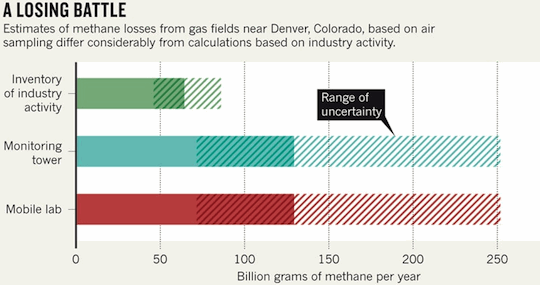
Natural Gas, from the point of combustion, releases about half the amount of Co2 released from burning coal, and about 30% of what's released in burning oil. To keep the benefits of reduced Co2 levels when switching from coal to natural gas, natural gas wells and transport lines must leak less then 2% of methane into the atmosphere. Recent research from Cornell is showing that Fracking wells are regularly releasing more then 4%, and often as much as 8% —far exceeding the 2% threshold— and thus making Natural Gas a far more dangerous resource for climate stability.

Tom Zeller Jr. wrote for the NYTimes 11 April 2011, Studies Say Natural Gas Has Its Own Problems

-Seth Gunning

-jsq