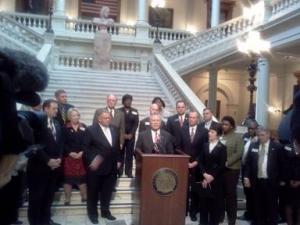
There is no direct reference to a regional land bank authority. However, the bill [GA SB 284 -jsq] allows for “Intergovernmental contract” defined as “a contract as authorized pursuant to Article IX, Section III, Paragraph I of the Constitution of GA and paragraph (5) of Code Section 36-34-2 and entered into by counties, consolidated governments, and municipal corporations pursuant to this article.” Section 48-4-103 further lists that a land bank may be created by two or more counties, which spells regional to me. Therefore regional land bank authorities can be established if this bill is passed.Continue readingThe bill also allows for public/private partnerships which co-mingle government and private enterprise. Under Section 48-4-106 which enumerates the powers of a land bank, Lines 307 – 315 state
Why CWIP is a bad idea
Herman K. Trabish wrote for Green Tech Media 22 February 2012, The Nuclear Industry’s Answer to Its Marketplace Woes: Construction Work in Progress (CWIP) financing shifts the risks of nuclear energy to utility ratepayers,
A sign of the nuclear industry’s difficult situation in the aftermath of Fukushima is a proposal before the Iowa legislatureAnd the Iowa Utilities Board staff agreed with Cooper and recommended against CWIP.that would allow utility MidAmerican Energy Holdings, a subsidiary of Warren Buffett’s Berkshire Hathaway, to build a new nuclear facility in the state using Construction Work in Progress (CWIP) financing (also called advanced cost recovery).
“Construction Work in Progress was intended to circumvent the core consumer protection of the regulatory decision-making process,” “Investment in nuclear power is the antithesis of the kind of
investments you would want to make under the current uncertain conditions,” explained nuclear industry authority Mark Cooper, a senior fellow for economic analysis at Vermont Law School’s Institute for Energy and the Environment. “They cannot raise the capital to build these plants in normal markets under the normal regulatory structures.”
CWIP would allow the utility to raise the money necessary to build a nuclear power plant by billing ratepayers in advance of and during construction.
“Construction Work in Progress was intended to circumvent the
core consumer protection of the regulatory decision-making process,” Cooper explained. “It exposes ratepayers to all the risk.” The nuclear industry’s answer to its post-Fukushima challenges, he said, “is to simply rip out the heart of consumer protection and turn the logic of capital markets on their head.”
His message to policymakers is simple, Cooper said. “This is an investment you would not make with your own money. Therefore, you should not make it with the ratepayers’ money.”Meanwhile, in Georgia: Continue reading
Private prison is like biomass —Ashley Paulk
I asked Lowndes County Commission Chair and Georgia Department
of Corrections (GDOC) board member Ashley Paulk if he had heard whether
the private prison contract had been extended past yesterday’s
deadline.
He had not.
However, he did volunteer that he had asked the GDOC board whether
they had had any discussion about such a prison and they had not.
Further, GDOC just last year
approved a CCA prison in Jenkins County, Georgia,
so why would another one be built here?
Prison populations are decreasing in Georgia, Paulk said.
He even said, “It’s like the biomass situation,”
in that there’s no business model.
It was Ashley Paulk who
signaled the end of the biomass project.
And he already signaled the end of the private prison project
on the front page of the VDT
and
he told Eames Yates of WCTV 29 Feb 2012,
Until you have a customer, you won’t see a prison, and they don’t have a customer.He said several times yesterday he did not expect the private prison to be built. And he went beyond what he had said before in explicitly likening the private prison project to the biomass project.
After last Thursday’s Valdosta City Council meeting, two different Valdosta City Council members and Mayor John Gayle all told me they had talked to various people and they didn’t expect CCA’s private prison to be built.
I hope they’re all correct about that.
But we all still wait for the Industrial Authority to tell us. They’re missing a huge potential positive PR opportunity by not holding a big press conference and taking credit for ending the private prison. They still could do that this morning.
Or they could keep claiming that
community activism has no effect,
even though it is activism that got both of those projects in the news and
got people like Ashley Paulk to speak out.
Maybe the Industrial Authority likes people to laugh at them.
Me, I’d prefer an Industrial Authority that stood up for the people of this community.
-jsq
VLCIA executive session on real estate transactions last Thursday noon
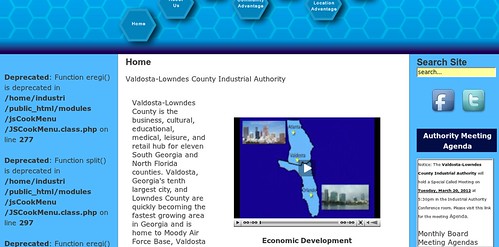
This is on the front page of the VLCIA website:
Notice:The Valdosta-Lowndes County Industrial Authority will hold a Special Called Meeting on Thursday, March 8, 2012 at noon, for the purpose of reviewing bids and awarding a contract for the Miller Business Park Landscape/Irrigation Project and discuss real estate transactions.Here’s the agenda. I congratulate the Industrial Authority for posting agendas!
Note the executive session. The agenda doesn’t say what the executive session is for (isn’t it supposed to, according to Georgia sunshine laws?). We can guess it’s for real estate transactions, as in the notice on the VLCIA front page.
Hm, what real estate transactions could that be? A contract for a landscaping and irrigation project isn’t a real estate transaction. Let me think… oh, the CCA private prison is a real estate transaction! Could that be what they were discussing?
The rest of VLCIA’s website is pretty thoroughly broken right now, as in
Warning: Parameter 3 to showItem() expected to be a reference, value given in /home/industri/public_html/includes/Cache/Lite/Function.php on line 100None of the other links seem to work.
-jsq
Special Called Meeting of the
Valdosta-Lowndes County Industrial Authority
Thursday, March 8, 2012, 12 noon
Valdosta Lowndes County Industrial Authority
Conference Room
Valdosta, Georgia
- Call to Order Special Called Meeting
- Invocation
Welcome Guests
Westside Business Park
- Reviewing bids and awarding a contract for the Miller Business Park Landscape and Irrigation Project
- Adjourn Special Called Meeting into Executive Session
- Adjourn Executive Session/Call to Order Special Called Meeting
- Adjourn Special Called Meeting
How to ban CWIP in Georgia
after
Three Mile Island.
OK, plus a state Supreme Court ruling, but that would be easier in Georgia
since the New Hampshire Supreme Court already set a precedent of upholding
the NH law.
After Fukushima,
Georgia could ban CWIP and end the new Plant Vogtle construction.
The we could
get on with building solar.
Here’s the text of the NH law, taken from the NH Supreme Court ruling:
“378:30-a Public Utility Rate Base; Exclusions. Public utility rates or charges shall not in any manner be based on the cost of construction work in progress. At no time shall any rates or charges be based upon any costs associated with construction work if said construction work is not completed. All costs of construction work in progress, including, but not limited to, any costs associated with constructing, owning, maintaining or financing construction work in progress, shall not be included in a utility’s rate base nor be allowed as an expense for rate making purposes until, and not before, said construction project is actually providing service to consumers.”Simple enough. The Georgia legislature could do it. Knowing the NH CWIP ban caused PSNH to go bankrupt on costs for the Seabrook nuclear plant, Georgia Power might back off on Plant Vogtle rather than have such a law passed.
-jsq
The Lowndes-Lanier County EF3 Tornado —NOAA
The tornado was an F2 in Lowndes County and an F3 in Lanier.
It went west to east, wrote the NWS in Tallahassee.
The
pictures we posted that day
were apparently where it first touched down, and even then
it ripped limbs off of trees and broke some off and threw them.
According to the National Weather Service Weather Forecast Office in Tallahasse, Severe Weather & Flooding Event of March 3, 2012; Lowndes-Lanier Co. EF3 Tornado,
The most significant damage of the severe weather event in south Georgia and north Florida was caused by a tornado that moved from just northwest of Moody Air Force Base to near Lakeland, Georgia. The damage was assessed by a survey team from the National Weather Service in Tallahassee. Most of the damage was consistent with an EF1 or EF2 tornado on the Enhanced Fujita Scale. However, the most severe damage — near Boyette Road and Highway 122 — was consistent with an EF3 rating on the Enhanced Fujita Scale. Maximum wind speeds were estimated to be around 140 mph at that location.As you can see by NOAA’s map, the tornado was an EF0, EF1, and EF2 while it was in Lowndes County, (as Ashley Tye told the Lowndes County Commission this morning), rising to an EF3 in Lanier County, peaking at 140 mph winds.
-jsq
Tornado report —Ashley Tye @ LCC 2012-03-12
No injuries or loss of life from the March 3rd tornado, but no disaster declaration
and thus no government financial assistance,
said
Ashley Tye
in a long report to the Lowndes County Commission this morning.
Such reports are not normally repeated at the Tuesday evening
regular sessions, so if you weren’t there, here is the only
place you will see it.
Ashley Tye remarked:
The good news is that there were no reported injuries or no loss of life.There was a lot of property damage. He said the National Weather Service determined it was an F2 tornado, and once it got to Walker’s Crossing it had winds of about 100 miles an hour. He said 34 homes were affected, of which 19 were destroyed, meaning uninhabitable.
He’s checking types of assistance that might be available.
He said there had been a tremendous outpouring of volunteer support. And insurance might pay off, although some people may not have enough insurance.Unfortunately, financial assistance is unavailable; it requires a federal declaration. And while the level of damage is obviously devastating to us in Lowndes County, it didn’t reach the level that would meet the threshold that would cause the governor to request a federal declaration.
He added that the county’s code red emergency system worked well, and probably had something to do with there being no loss of life. I know I got at least six county code red messages that day before my message box filled up (I was in a building with no signal).
Commissioner Richard Raines asked if FEMA had to have a declaration for GEMA to respond. Ashley Tye answered: Continue reading
Video of this morning’s Lowndes County Commission Work Session 2012-03-12
The Lowndes County Commission had its regular work session this morning.
Apparently some assembly was required.
Here’s
the agenda.
Here’s a playlist:
Video of this morning’s Lowndes County Commission Work Session 2012-03-06
Work Session, Lowndes County Commission (LCC),
Valdosta, Lowndes County, Georgia, 12 March 2012.
Videos by Gretchen Quarterman for LAKE, the Lowndes Area Knowledge Exchange.
-jsq
Marching at the Industrial Authority 2012-03-06
After
starting up at the prison site
and
heading out,
Here’s Part 1 of 3:
Marching at the Industrial Authority 2012 Part 1 of 3:
No private prison in Lowndes County,
Motorcade against Corrections Corporation of America, Drive Away CCA,
CCA, VLCIA, Corrections Corporation of America, Valdosta-Lowndes County Industrial Authority,
Valdosta City Council, Lowndes County Commission, incarceration, prison, private prison,
Valdosta, Lowndes County, Georgia, 6 March 2012.
Videos by Gretchen Quarterman for LAKE, the Lowndes Area Knowledge Exchange.
They weren’t in, since they only meet once a month.
Here’s Part 2 of 3: Continue reading
What we can learn from no nukes and solartopia of 30 years ago
Harvey Wasserman wrote for The Free Press 13 May 2007, How creative mass non-violence beat a nuke and launched the global green power movement,
Thirty years ago this month, in the small seacoast town of Seabrook, New Hampshire, a force of mass non-violent green advocacy collidedHow effective?with the nuke establishment.
A definitive victory over corporate power was won. And the global grassroots “No Nukes” movement emerged as one of the most important and effective in human history.
It still writes the bottom line on atomic energy and global warming. All today’s green energy battles can be dated to May, 13, 1977, when 550 Clamshell Alliance protestors walked victoriously free after thirteen days of media-saturated imprisonment. Not a single US reactor ordered since that day has been completed.
Richard Nixon had pledged to build 1000 nukes in the US by the year 2000. But the industry peaked at less than 120. Today, just over a hundred operate. No US reactor ordered since 1974 has been completed. The Seabrook demonstrations—which extended to civil disobedience actions on Wall Street—were key to keeping nearly 880 US reactors unbuilt.The only new nukes ordered since then are the ones Georgia Power wants to build at Plant Vogtle on the Savannah River, for which Georgia Power customers are already getting billed Construction Work in Progress (CWIP).
Thirty years later, some things haven’t changed: Continue reading