Tag Archives: Safety

Sinkhole costs, and prevention vs. reaction


The day after the VDT ran

Lowndes County’s admission that the sewer line break was theirs, not Valdosta’s
,
did the VDT start a series of financial investigation

like they did about Valdosta’s water issues
?
Nope, they ran a piece about how much weather costs the county,
with no recognition of watershed-wide issues,
nor of any need for the county to participate in proactively
dealing with them, to reduce costs, for better quality of life,
to attract the kinds of businesses we claim we want.
Nope, none of that.

Jason Schaefer wrote for the VDT 27 April 2013,

What natural events cost Lowndes taxpayers
,


In the Deep South, near a river plain where floodwaters rise and ebb
from season to season and wetlands that distinguish the region from
anywhere else in the nation, flooding makes a significant portion of
the concern for Lowndes County emergency management.
OK, that’s close to getting at some of the basic issues.
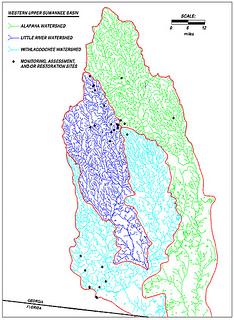
We’re all in the same watershed, and we need to act like it
instead of every developer and every local government
clearcutting and paving as if water didn’t run downhill.
Does the story talk about that?
After all, the county chairman attended the

11 April 2013 watershed-wide flooding meeting

that led to the

city of Valdosta’s likely participation in flodoplain planning
.
Nope; according to the VDT,
everybody around here seems to be hapless victims of weather:

Continue reading

Another rat at Fukushima: cooling down third time in five weeks

It doesn’t take a tsunami to take down Fukushima: rats can do it repeatedly.


Mainich.jp
, and

Google Translate version
,

Inspection and rat carcasses found cooling system stop: Unit 2 Fukushima Daiichi nuclear power plant


(23 minutes 15:22 April last update) 01 minutes 13:22 April Mainichi Shimbun in 2013


From state = Fukuichi live camera of Fukushima Daiichi nuclear power plant of 50 at around 2:00 pm

The 22nd, TEPCO announced that it had stopped the cooling system of
the spent fuel pool of Unit 2 Fukushima Daiichi nuclear power plant.
Since the corpse of two dogs rat is found inside the transformer in
the outdoors, I will check the equipment.

According to the Nuclear Regulatory Agency and Tokyo Electric Power,
15 at around 10:00 am the same day, workers found a dead rat in the
two animals terminal near the pool cooling transformer inside.
Remove the mouse, stop the power for inspection of equipment 35 at
around 11:00 the same. expected start is 3 to 4 hours later.

Water temperature of the pool of power stop time is 13.9 degrees.
There is enough time to rise up to 65 degree of operational safety,
TEPCO has “no problem. Administrative stopped just in case for
inspection” he said. [Torii true flat]

Reuters’ version,

Fukushima nuclear cooling system offline for 3rd time in 5 weeks
,
adds:

Last month, a 29-hour power supply halt affecting nine facilities,
including four spent fuel pool cooling systems, was caused by a rat
touching exposed wires in a temporary switchboard, triggering a
circuit breaker.

In early April, the No.3 unit’s spent fuel pool cooling system
stopped, after workers appeared to have had inadvertently caused a
power outage when they were trying to install a net to keep small
animals from crawling into the reactor building. (Reporting by Risa
Maeda; Editing by Chris Gallagher)

Apparently that net didn’t work.
Should we trust our safety to nuclear plants that can be shut down by rats?
The

tritium-leaking

reactors at Plant Hatch at Baxley

are the same design as at Fukushima
.
Former U.S. NRC Chairman Jaczko says

we should phase them all out
while
former Indian Atomic Energy Regulatory Board Chair Gopalakrishnan says the reactors currently building in India, already three years behind schedule and now found to incorporate numerous defects and deficiencies amid gross lack of transparency, must be stopped.
We know a better way:
solar and wind power.
Let’s get on with that.

-jsq

Owed to Masaichi Shiozaki.

Gulf 3 years ago; Caspian 5 years ago: BP oil well blowouts


Two years before

BP’s Deepwater Horizon oil rig poisoned the Gulf of Mexico

(Saturday was the third anniversary),
apparently BP had a very similar disaster in the Caspian Sea
and covered it up.
Is this a company or this the

13 spills in 30 days

industry we want piping tar sands crude across
America to the Gulf

for all of 35 permanent jobs and CO2 emissions like 51 coal plants
?
There’s a cleaner, cheaper, and more energy-independent way:

solar

and

wind
power can power the U.S. and the world.

Greg Palast wrote for EcoWatch 19 April 2013,

BP Covered Up Blow-out Two Years Prior to Deadly Deepwater Horizon Spill
,

Two years before the Deepwater Horizon blow-out in the Gulf of
Mexico, another BP off-shore rig suffered a nearly identical
blow-out, but BP concealed the first one from the U.S. regulators
and Congress.

This week, EcoWatch.org located an eyewitness with devastating new
information about the Caspian Sea oil-rig blow-out which BP had
concealed from government and the industry.

The witness, whose story is backed up by rig workers who were
evacuated from BP’s Caspian platform, said that had BP revealed the
full story as required by industry practice, the eleven Gulf of
Mexico workers “could have had a chance” of survival.
But BP’s insistence on using methods proven faulty sealed their
fate.

One cause of the blow-outs was the same in both cases: the use of a
money-saving technique—plugging holes with
“quick-dry” cement.

By hiding the disastrous failure of its penny-pinching cement
process in 2008, BP was able to continue to use the dangerous
methods in the Gulf of Mexico—causing the worst oil spill in
U.S. history. April 20 marks the second anniversary of the Gulf oil
disaster.

There’s more in

the article
, such as this:

Continue reading

Sinkhole on US 82 near Tifton August 2012


Water disasters of droughts and floods and sinkholes
already affect us more here in south Georgia
than the kinds of disasters TV news likes.
In

north Florida
,
next to

a church in Albany
, under

a garage in Lowndes County
,
and next to the Shoney’s in Tifton,
sinkholes are spreading: can we go beyond reacting to them and work
on preventing them?

Next to a

story yesterday about disaster preparedness
,
the Tifton Gazette posted this picture and caption:

Tift County experienced massive flooding in early August 2012. The
heavy rains made the then-sinkhole located on Hwy. 82 into a massive
waterfall. Tift County EMA has to be prepared for such events in our
community. Photo credit: Latasha Everson/The Tifton Gazette


Here’s

a 2011 YouTube video of the sinkhole

that says the sinkhole had been next to the Shoney’s five years already then,
two years ago.
Stephanie Springer wrote for WALB 9 and 13 August 2012,

Tifton sinkhole continues to grow
,

Continue reading

Transparency could have prevented TX fertlizer plant explosion

Has anybody checked on the various agricultural chemical plants around here?
Lack of transparency can kill.


Joshua Schneyer, Ryan McNeill and Janet Roberts wrote for Reuters today,

Texas fertilizer company didn’t heed disclosure rules before blast
,

The fertilizer plant that exploded on Wednesday, obliterating part
of a small Texas town and killing at least 14 people, had last year
been storing 1,350 times the amount of ammonium nitrate that would
normally trigger safety oversight by the U.S. Department of Homeland
Security (DHS).

Yet a person familiar with DHS operations said the company that owns
the plant, West Fertilizer, did not tell the agency about the
potentially explosive fertilizer as it is required to do, leaving
one of the principal regulators of ammonium nitrate—which can
also be used in bomb making—unaware of any danger there.

Fertilizer plants and depots must report to the DHS when they hold
400 lb (180 kg) or more of the substance. Filings this year with the
Texas Department of State Health Services, which weren’t shared with
DHS, show the plant had 270 tons of it on hand last year.

There’s more in

the article
.

-jsq

Two former national nuclear regulatory chiefs: stop nukes


Last month former U.S. Nuclear Regulatory Commission Chair Jaczko
said all 104 operating U.S. nuclear power reactors are unsafe.
This month former Indian
Atomic Energy Regulatory Board Chair Gopalakrishnan
says the reactors currently building in India, already three years
behind schedule and now found to incorporate numerous defects and
deficiencies amid gross lack of transparency, must be stopped.
When will the NRC stop the restart of the flawed and non-transparent San Onofre 2?
When will the NRC or GA PSC or the GA legislature or even Southern Company
coming to its senses stop the 19-month-late $1-billion-overbudget

flawed-concrete
Plant Vogtle 3 and 4 before they waste any more
of our resources that could be going to solar and wind jobs and energy?

Continue reading

BP: the beaches are open for everyone to enjoy!


BP must be getting desperate about people catching onto what they did to the Gulf.
A BP video ad has been replaying itself every few minutes beside various
news stories since yesterday, claiming two years after the oil disaster
(“spill” doesn’t describe it) “the beaches are open for everyone to enjoy!”

BP’s website

says “We are helping economic and environmental restoration efforts in the Gulf Coast as part of our ongoing commitment to the region following the Deepwater Horizon accident in 2010”.
Neither the ad nor the website says BP actually cleaned up the oil.
Because they didn’t.
It’s still there, as is the even more toxic “dispersant” Corexit BP
dumped on top of the oil to make it sink.
Both are busily poisoning dolphins, fish, birds, and humans.

Antonia Juhasz wrote for The Nation 7 May 2012,

Investigation: Two Years After the BP Spill, A Hidden Health Crisis Festers
,

Continue reading

Believe So. Cal. Edison about San Onofre?

Should we believe the operator of the broken San Onofre 2
nuclear plant that it’s safe to restart at 70% power?
The same operator

that knew the now-broken steam generators were flawed before
it installed them?

Recommended
by

the same NRC staff who couldn’t answer opponents’ questions
?
The same NRC that

doesn’t publish licensee documents

and says that’s

never been a practice
?


SanDiego6.com wrote yesterday,

Sen. Boxer Blasts Report on San Onofre Nuclear Generating Station
,

On Monday, Southern California Edison announced it had formalized a
request to amend its operating license to allow it to operate its
Unit 2 reactor at 70 percent beginning June 1.

The reactor was undergoing scheduled maintenance in January 2012
when a small, non-injury leak was discovered in plant’s other
reactor. The plant has been shut down since.

According to Edison, vibrations that led to premature wearing of
steam pressure tubes in the reactors don’t occur at 70 percent
power. The utility wants to operate on limited power for the five
warm weather months and then shut down for an inspection of the
tubes.

After the inspection, the reactor would resume operating at 70
percent power. The company said it would use the collected tube data
to determine an appropriate power setting for the long term.

There’s the catch:

Continue reading

Alcohol, drugs, and broken nuke equipment

A broken cooling water pump at Fermi 2 yesterday plus
60% lost safety data today.


Airflow and quality problems at Kewaunee and Three Mile Island.
Drugs at Saint Lucie in Florida
and alcohol at Nine Mile Point 1 in New York and
at Braidwood in Illinois.
And four workers injured at Callaway in Missouri.
Apparently nuke employees can get terminated for off-site
recreational drug use, but not for fires or broken equipment.

We’ve already seen the

event about fire at Plant Vogtle
.
Here are more events in the NRC

Current Event Notification Report for April 4, 2013

and also today,

April 5, 2013
,

Continue reading

Fire at Plant Vogtle


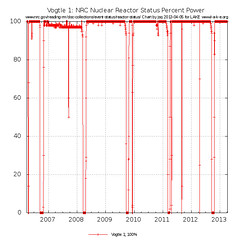
Vogtle 1 since 2006

Does a
Nuclear Operations Unusual Event (NOUE) give you a warm and fuzzy feeling?
When it’s a fire at a nuke on the Savannah River?
They didn’t shut Unit 1 down for that,
but Unit 2 has been down for almost a month.

NRC

Current Event Notification Report for April 4, 2013
,

NOTIFICATION OF UNUSUAL EVENT BASED ON A FIRE IN THE PROTECTED AREA
LASTING GREATER THAN 15 MINUTES

“Vogtle Unit 1 has declared an NOUE based on a fire within the
protected area boundary not extinguished within 15 minutes of
detection.

“At 0632 [EDT] Unit 1 received a fire alarm in the Unit 1 control
building. A systems operator was dispatched to investigate and
reported back that a small flame was visible inside 1ND3I1, computer
inverter. Fire brigade was dispatched in accordance with fire
response procedures. No other systems or parameters affected.

Continue reading