Category Archives: Coal

“I’m amazed at how someone could dare say…”

Brad Lofton responds to
Leigh Touchton’s letter of 16 September 2010.

-jsq

Date: Sun, Sep 19, 2010 at 7:54 AM

From: Brad Lofton <blofton@industrialauthority.com>

Good morning Kay, Sandy et al.

Our unprecedented effort of educating the public included numerous public
hearings, briefings with all elected officials, the VDT Editorial Board and
groups all across Valdosta. We’ve even spent a great deal of effort trying
to brief the NAACP leaving messages and making numerous phone calls to Leigh
Touchton that have never been returned. We’ve spent more time educating the
community on this project then the sum of any other projects we’ve worked
combined. I’m amazed at how someone could dare say that we’ve not informed
the public. The vast majority of her concerns for our project would have
been answered two years ago if she had come to any of our forums or if she
would at least answer her phone when we call. Now that we’re moving into the
third year of due diligence, she’s concerned all of a sudden.

Continue reading

Leigh Touchton wonders what Brad Lofton is hiding

This message was sent to me by the author, who requested I blog it.

-jsq

Subject: My response to Brad Lofton, why doesn’t he want his correpondence in
the Valdosta Daily Times? What is he hiding?

From: Leigh Touchton

To: blofton@industrialauthority.com

Date: Thu, 16 Sep 2010 20:53:56 EDT

(Please see
correspondence below mine which I am responding to:

Mr. Brad Lofton’s email to his “stakeholders”

which he doesn’t want to put in the newspaper )

Mr. Lofton:

My title is President of the Valdosta-Lowndes branch of the NAACP, I am not
the Chairperson. I have a Master’s in Science in Biology from the
University of Virginia, I have taught Environmental Science classes at the
college level. It is incorrect and furthermore rude for you to refer to the
President of the NAACP as part of the “misinformation on the street.”

I would be happy to deconstruct your arguments on the trip to Cadillac,
Michigan, and how “green” Biomass Incineration can be. I invite readers to
research all the Biomass incinerators around the country that have been shut
down. They are banned in Massachusetts. They have been blocked in
Florida. They show up in areas of the country where wealthy industrialists
control the government and environmental regulations are lax. All the major
environmental organizations in this country oppose them because they burn
more wood that can be sustainably harvested. In the decade that is the
hottest on record, in a crucial period in human history when life literally
hangs in the balance over Global Climate Change, the Lowndes County
Industrial Authority has decided to implement a Biomass Incinerator which
spews more carbon dioxide than a coal plant.

Continue reading

Industrial Authority Response to Two Letters to the Editor

The appended message from a tax-supported public official
to many people about official business was forwarded to me;
perhaps the public would also like to see it.

The CCA press conference he mentions seems to have been
covered by the VDT in this article:
to be about
Private prison company picks Valdosta as potential site
.

The rest of the letter is about issues related to the

biomass plant

proposed for Lowndes County by Wiregrass Power LLC
(wholly owned by Sterling Energy Assets of Atlanta)
and backed by the

Valdosta-Lowndes County Industrial Authority (VLCIA)
,
of which Brad Lofton is the Executive Director.
Here’s the letter from Leigh Touchton of the NAACP to which he refers.

-jsq


From: Brad Lofton [mailto:blofton@industrialauthority.com]

Sent: Thursday, August 19, 2010 4:37 PM

To: ‘Brad Lofton’

Subject: Industrial Authority Response to Two Letters to the Editor Yesterday

Importance: High

Good afternoon everyone:

Thanks to all of you that were able to attend our CCA press conference and
breakfast yesterday. We’ve had positive feedback today from around the
region, and we’ve received congratulations from most of the other 15
communities competing for the project.

After reading the two letters to the editor yesterday, I felt compelled to
e-mail our stakeholders to provide you an update with facts and information
related to the biomass plant. We have intentionally avoided a response in
the paper because we do not want to energize a forum for continued
misinformation. Despite numerous town hall meetings and other meetings
we’ve facilitated for two years, there is still plenty of misinformation on
the street.

Continue reading

Video of Biomass Air Quality Hearing, Valdosta, 27 April 2010


A video of
a hearing about the biomass plant Wiregrass Power LLC proposes
to build in Lowndes County just outside of Valdosta was held

in Valdosta on 27 April 2010

by the Air Protection Branch (APD)
of the Environmental Protection Division (EPD) of the Georgia
Department of Natural Resources (DNR).

Eric Cornwell of APD explains location,
process flow, and specific items
covered by the permit (soot, SO2, NOX, CO, VOC, HCL, etc., but not
CO2).
He remarks that Wiregrass Power LLC is building a small plant with a
“lower emission limit in order to avoid some of the red tape”
by getting a minor permit instead of a major permit.
The first half hour concludes with Bob Turner, the plant manager,
presenting similar material, ending with:

“No new carbon is added to the atmosphere when burning woody byproducts.”

I beg to differ on that:
in the time it takes trees to grow back,
there is indeed new carbon dioxide added to the atmosphere.

More from

Dr. William Sammons
on that.

Back to the video of the hearing.

Questions
start at 00:29:44.
Here are some time markers and very brief summaries
of Q and A; see the video for the full questions and answers.

Continue reading

Proposed Coal Plants


In the July 2010 National Geographic,
Joel Achenbach writes about

The 21st Century Grid
.
It’s mostly about how we need a smart grid and additional power lines
to redistribute power better,
but it does get into proposed power plants to generate new power.

Although everyone acknowledges the need for a better, smarter, cleaner grid, the paramount goal of the utility industry continues to be cheap electricity. In the U.S. about half of it comes from burning coal. Coal-powered generators produce a third of the mercury emissions in America, a third of our smog, two-thirds of our sulfur dioxide, and nearly a third of our planet-warming carbon dioxide—around 2.5 billion metric tons a year, by the most recent estimate.

Then it talks about how it’s hard to get stodgy electric utilities to
invest in anything else. However, there is at least one way:

A California law requires utilities to generate at least 20 percent of their electricity from renewable sources as of this year.

OK, so what new energy plant are proposed for Georgia?
The

online interactive map

lets you select different energy types.
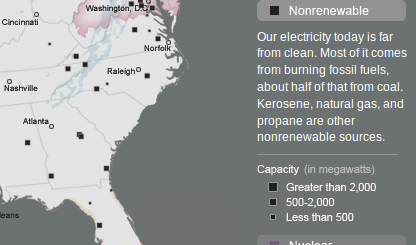
The map above shows four proposed new coal plants in Georgia,
surrounding south Georgia (plus something nonrenewable in Florida near Tampa).
I recognize the one in far southwest Georgia as the one proposed for Early County
and fortunately still tied up in litigation.
All four are in addition to the existing Plant Scherer at Juliett, GA,
near Macon, the dirtiest coal plant in the country, and the one that generates
2/3 of our power for south Georgia (as well as selling a lot of power to Florida).
Adding still more dirty coal plants does not look like progress.

Continued in next blog entry.

-jsq

Georgia Power Away from Coal?


Walter Jones writes about how

Georgia Power aims to rely less on coal
:

For years, solar and wind were described as unsuited for the South’s weather conditions and geography, although Georgia Power is now taking another look at them in this year’s version of it’s integrated-resource plan, a document it updates every three years.

I suppose late is better than never.
However, Georgia Power is turning more to nuclear and natural gas.

But why is it turning away from coal at all?

Stricter environmental regulations are also changing the economics of
coal. Even without a “carbon tax” or “cap and trade” passing in
Congress, the federal government is stepping up its existing authority
over power plants. And an ongoing court case related to a proposed power
plant owned by an independent company, Longleaf, could open the door
in Georgia to regulation of carbon dioxide emissions. Any combination
of those factors could lead regulators to force Georgia Power to shut
down more of its older coal plants.

“The financial outlook for coal is grim,” Thompson said.

People are finally wising up that coal is bad for us, and the company
sees that affecting its bottom line.

-jsq

Nix on biomass plant in Traverse City, Michigan

Looking farther afield

in Cadillac, Michigan
than schools and realtors,

there are some people who aren’t completely pleased with the local biomass plant:


Complaints are more frequent along Mary Street, a short stretch a few hundred yards south of the plant. Residents there deal with more intense noise and odors.

Craig Walworth’s home is among the closest to the plant. He walked up to his Jeep — a vehicle he cleaned the day before — and dragged his finger through a layer of film on the hood.

“Every morning, you have that to look forward to,” he said. “I clean my screens three times a year during the summer because they clog up.”

Nonetheless he didn’t say it affected his property values.
However, that’s not the only issue.

Meanwhile, about an hour north on the edge of Lake Michigan,

in Traverse City
local activism caused cancellation of a proposed biomass plant:

Continue reading

Biomass and Carbon Dioxide

Natasha Fast, Angela Manning, Allan Ricketts (Project Manager), Geraldine Fairell, Ken Klanicki, Brad Lofton (Executive Director)


Natasha Fast (SAVE), Pastor Angela Manning (New Life Ministries), Allan Ricketts (Project Manager), Geraldine Fairell, Ken Klanicki, Brad Lofton (Executive Director), picture by John S. Quarterman (LAKE)

Pictured is a group of concerned citizens meeting about the
proposed biomass plant with Valdosta-Lowndes County
Industrial Authority (VLCIA)
Project Manager Allan Ricketts
and Executive Director Brad Lofton.
Ricketts and Lofton gave a two-hour presentation,
took some action items, and have provided a schedule
on which they will fulfill them.
I thank them for that and look forward to the further materials.

Lying in the center of the table in the picture is this document:


Biomass carbon neutrality in the context of forest-based fuels and products


by Reid Miner, NCASI, Al Lucier, NCASI

The copy on the table is dated April 7, 2010; the online version
is dated May 2010.
It’s a powerpoint presentation that makes many good points,
among them that coal doesn’t grow back, while trees do.
So in theory it would be possible, by organizing harvesting of biomass
over a region to make burning biomass for electricity carbon neutral.

The document comes right out and says:

At point of combustion, CO2 emissions per unit of energy produced
are generally higher for biomass fuels than for fossil fuels.

Continue reading

Biomass Plant Hearing Today

You can ask questions and expect answers.


The Georgia Department of Natural Resources (DNR) Environmental Protection Division (EPD) Air Protection Branch issued a

Press Release on April 12, 2010 announcing a meeting
:

EPD will hold a question and-answer (Q&A) session and a public hearing on Tuesday,
April 27, from 6:30 p.m. – 8:30 p.m. in the multipurpose room in the Valdosta City Hall Annex. The city hall annex is located at 300 N. Lee Street.

The subject is “on Proposed
Biomass-Fired Power Plant Application Submitted by WireGrass Power, LLC”

You can also submit questions and comments in writing:

Continue reading

Encouraging New Energy Production Via Solar

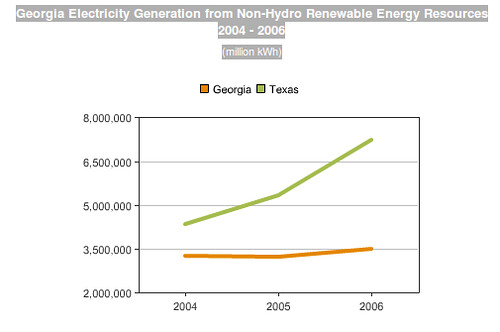
While Georgia did little to deploy renewable energy, Texas
has almost doubled its renewable energy source from 2004 to 2006:


How did Texas do that, and how can Valdosta and Lowndes County help Georgia catch up?

Some years back, Austin, Texas, which has been growing rapidly for decades,
needed to find a way to produce more energy.
Building a coal plant was not really an option for a city that had long
sold itself as a home of green industry.
Nuclear had a bad taste because in the 1980s Austin had been an investor
in the South Texas Nuclear project, which had been late, over budget,
never produced what it was supposed to, and had many political problems.
So Austin settled on a new plan: instead of spending big bucks to build
a dirty coal plant, use the same money to give rebates to homeowners
and businesses for installing solar power.
Big rebates: 75%, the largest, and among the first in the country.
This made perfect economic sense, producing as much new energy as needed,
without coal or nuclear, and distributed where it was needed.

Now Austin is

trying a new wrinkle:

The Austin, Texas, city council has approved Austin Energy’s solar incentive program, which includes a new approach for commercial, multifamily and nonprofit customers. The new approach saves $2.4 million over the life of the program, according to the utility.

Continue reading