Tag Archives: Valdosta City Council

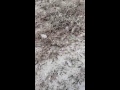
What the sewer system is currently doing to our backyards —Gabe Fisher

Received today in response to

Tim Carroll’s email.


All, Gabe Fisher here—2420 Meadow Brook. I do not currently
have the time, nor mental capacity to fully think through this
issue, but I want you all to see what the sewer system is currently
doing to our backyards.

This video
was taken today, in by backyard,
after the flood. It has been spilling at least at this same rate for
the last 7 days.


What the sewer system is currently doing to our backyards —Gabe Fisher

Video by Gabe Fisher, Valdosta, Lowndes County, Georgia, 3 March 2013.

This contaminated water breached my crawlspace, around 24″ deep, and
must absolutely be dealt with ASAP. What is the city going to do for
me, and my neighbors who are in this same situation??

There is no other word for it—I am pissed. I have seen zero
results since the flood in 2009. Yes, maybe receiving 12″ inches of
rain is an act of God, but that does not account for all the man
made structures that force the flood waters higher at my location,
nor other obstacles it must overcome to quickly and efficiently
escape our area—such as the train trestle along Gornto. And it
absolutely does not account for the city’s poorly planned sewer
system..

This isn’t the first sewage spill since the flood of
2009—there have been countless others in my area. I have
photos and video evidence of at least 5 that would likely be
classified as ‘major’.

This cannot and will not be ‘swept under the rug’.. I am still
currently upside down on my property due to the flood of 2009 and
this current flood has only further degraded my property’s value.

Gabe

Looking at his address in the Lowndes County Tax Assessor’s maps,
and turning on Flood Map, Lakes and Rivers, and Aerial Photos,
you can see that his property and most of all his neighbors’
lots are in the flood plain:
Continue reading

The rest of the story on waste water —Tim Carroll

Received today from Valdosta City Council Tim Carroll, who
sent it to a long list of people,
apparently responding to
the VDT's recent article and editorials.

All,

During my tenure as a city councilman, I have tried to keep everyone
updated on events and issues with our city. I want to share and


email I sent out recently that hopefully you will agree is important
information. In regards to today's paper — the story has some
serious errors and omissions. First of all in 2009- all we saved
from the flood was the pump station. No sewage treatment was taking
place and contrary to what the VDT says, then as we are now —
raw sewage was going into the river. It lasted about a month in
2009. With the decision to pull equipment/tanks etc so they would
not be destroyed this year — we not only saved a lot of tax
payer money….but we will be able to bring the plant back on line
in about a week. Reducing by several weeks the amount of sewage
going into the river. In regards to city water systems being
compromised — considering our water plant is 10-15 miles north
of the WWTP and the amazing fact that the river flows south —
your water is completely safe. Do we like discharging raw sewage
into the river? Of course not. During the flood it was going to
happen either way.

I want to add one other note — the men and women in our
Utility department, fire, police, sanitation, engineering etc, etc

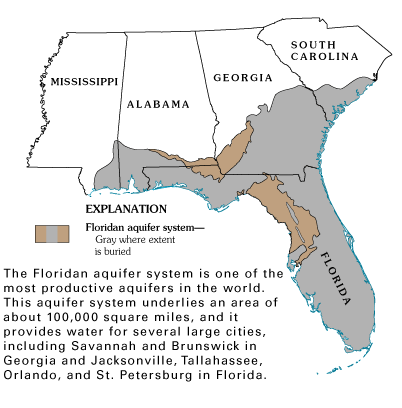
Floridan Aquifer

have been working long days this past week trying to manage flooding
issues. They deserve our thanks. It is very frustrating for those
whose homes and businesses were threatened by the flood. It is very
frustrating to our city employees who have worked so hard to manage
this crisis.

So as Paul Harvey says — “here is the rest of the
story”.

I think Council Carroll is a bit cavalier about
the city's wells being upstream of the wastewater treatment plant,
because while the river may flow south, it's not clear how
the Floridan Aquifer flows, especially with multiple 800 foot
deep wells sucking water out of it.
Also I wonder what people downstream of the Withlacoochee Wastewater
Treatment Plant think of all that raw sewage coming down at them,
especially considering some of them have wells downstream.

However, he makes a number of points that the VDT omitted,
including a plan to do something about the situation,
and appended is his "rest of the story".

Continue reading

VDT v Valdosta Re Wastewater

The VDT has apparently decided the City of Valdosta is to blame
for the
Withlacoochee Wastewater Woes,

and has made its case in a story and two editorials.
They seem to have forgotten about

the overflow in 2012
already.
And the VDT seems to have forgotten about it and its editor's own
apparent roles in the loss of the recent SPLOST election that
would have funded a new wastewater plant.

Jason Schaefer wrote for the VDT today,

Money saved at river's expense:
EPD investigates cause of sewage release as waters recede
,

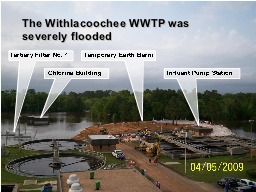
When the flooding occurred in April 2009, the City made


extraordinary efforts to hold back the flooding, bringing in dirt
and heavy machinery to build a berm around the influent pump station
and other treatment equipment, working round the clock.

The efforts were successful. The treatment plant remained on during
the duration of the flood, and Valdosta's raw sewage remained
contained, though the facility incurred damages to its electrical
and biological purification systems, according to Utilities Director
Henry Hicks.

This year, the City opted for a different approach—cut
electricity to the underwater portions of the plant, submit to the
flooding and clean up afterwards.

The plant was “taken offline” Thursday at 9 a.m.
“to prevent further damage to equipment and associated
electrical and control systems,” according to a statement
issued by the Department of the City Manager.

The City stated that as a result of the shutdown, “untreated
sewage will be discharging directly into the river” at a rate
of between five and six million gallons of raw sewage per day.

In addition, the floodwaters were allowed into the plant and around
the remaining portions of the berm that was constructed in 2009
during the rising flood. Only half of the berm now remains, as the
other half was removed to allow access to the lower portions of the
plant, Hicks said.

So far, this year's response strategy seems to have saved the City
money. In 2009, about $500,000 was spent in manpower, equipment and
supplies to build the berm alone, and the plant, kept running,
incurred significant damages though raw sewage was kept out of the
river. This year, the money was not spent on the berm or to prevent
the flooding, and at least 15 to 20 million gallons of raw sewage
will have been released into the Withlacoochee by the time the plant
is back online.

There's more in the story, which is well worth a read.
Also note this inserted in the middle of the story:

Editor Kay Harris contributed to this story.

The VDT cites the EPA report,

National Enforcement Initiative (FY 2011 – 2013)
Keeping Raw Sewage and Contaminated Stormwater Out of Our Nation’s Waters
,
(more about that EPA initiative

here
)
and continues:

Continue reading

Videos of the Withlacoochee River in flood

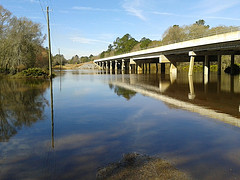
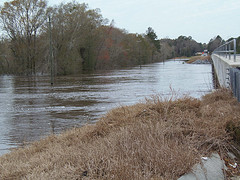
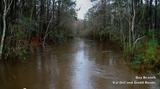
Here are pictures and videos of the Withlacoochee River at GA 122

18 Feb 2013 Withlacoochee River @ GA 122


27 Feb 2013 Withlacoochee River @ GA 122

on

18 February 2013

(on the left when the river was rising)
and

27 February 2013
(on the right,
when it was clearly in flood stage).

Pictures and videos of the Withlacoochee River at GA 122
by John S. Quarterman and Gretchen Quarterman for

WWALS Watershed Coailition.


Brandon Powers for the VDT

And the Valdosta Daily Times has discovered video!
VDT posted 25 February 2013,

The effects of rain
,
which includes video of numerous locations around Lowndes County.
This is all relevant to the

Withlacoochee Wastewater Woes for Valdosta and Lowndes County.

-jsq

Withlacoochee Wastewater Woes for Valdosta and Lowndes County

AP picked up the story about flooding at Valdosta's Withlacoochee
wasterwater treatment plant, citing the VDT and the City
as sources.
The City of Valdosta thinks the County should contribute to replacing the plant,
or maybe the legislature will authorize a municipal option sales tax (MOST).

AP in GPBNews 1 March 2013,

Valdosta Treatment Plant Floods
,


Authorities shut down a Valdosta wastewater treatment plant as a river flooded critical buildings and structures. The city estimates an average of 5 million to 6 million gallons of untreated sewage will discharge daily into the Withlacoochee River until the flood waters recede and the plant can resume operation. (Photo Courtesy of John S. Quarterman via Flickr.)

VALDOSTA, Ga. —

Authorities shut down a south Georgia wastewater treatment plant as a
river flooded critical buildings and structures.

Valdosta city officials said power at the plant was shut down
Thursday to prevent further damage to equipment and control systems.

The city estimates an average of 5 million to 6 million gallons of
untreated sewage will discharge daily into the Withlacoochee River
until the flood waters recede and the plant can resume operation.

The AP story continues, but let's cut to the sources.

Continue reading

Internet and Energy at the Bird Supper

Dear Bird Supper attendees,

Two things could greatly help south Georgia:
better Internet access and solar power.
You could help stop two telecommunications bills
and help pass two energy bills for jobs and education
in south Georgia.

Internet Access: help stop two telecommunications bills

The local Industrial Authority, Chamber of Commerce, Valdosta City Council,
and Lowndes County Commission have recently realized that
fast Internet access is essential to attract businesses,
for their employees to work at home, for applicants to apply for jobs,
for students to submit assignments, and for general quality of life.


  • HB 282 against muni broadband


    This bill would prohibit local governments from providing Internet access
    if any local census block has 1.5Mbps access.
    Localities may or may not want to do it themselves, but they shouldn't
    be prohibited from using this option now that it is obvious to everyone
    that the commercial incumbents are not doing the job.
    Legislators please vote this bill down.


  • HB 176 for higher cell towers with less local government oversight


    This really bad bill would let cell telephone companies build towers
    wherever they want to at any height, taking away local government
    power to regulate that.
    It could even let private companies exercise eminent domain.
    Legislators please vote this bill down.

Energy: help pass two energy bills

Solar power can be a
distributed source of jobs in south Georgia.

Antique laws and a subsidized nuclear boondoggle are hobbling solar power.


  • GA SB 51, The Georgia Cogeneration and Distributed Generation Act


    Senator Buddy Carter has introduced a Senate bill for the current session
    of the legislature, SB 51, "The Georgia Cogeneration and Distributed
    Generation Act of 2001". It attempts to fix Georgia's special solar
    financing problem, the antique 1973 Territorial Electric Service Act,
    which says you can only sell power you generate to your one and only
    pre-determined electric utility, at whatever rate that utility sets.


  • HB 267 Financing costs; construction of nuclear generating plant


    Stop Georgia Power from charging customers for cost overruns for Plant Vogtle,
    already 15 months behind schedule and a billion dollars overbudget for power
    that nobody has received, yet Georgia Power has already billed customers about
    $1.7 billion.
    Bipartisan cosponsors are Jeff Chapman (R—Brunswick) District 167 and
    Karla Drenner (D—Avondale Estates) District 85.
    This boondoggle on the Savannah River is what Georgia Power and Southern Company
    are doing instead of deploying solar inland and wind off the coast.

-jsq

Broadband “huge strategic initiative for our community” —Mary Gooding for VSU @ VLCIA 2013-02-19


Mary Gooding spoke up for VSU at

the Industrial Authority 19 February 2013
,
saying that
VSU President McKinney was
in Athens (as was President Perrin of Wiregrass), but he and
VSU:

We too believe that this is a huge strategic initiative for our community.
And we were thrilled after the meeting that we attended that
the city, the county, both educational institutions, the Industrial
Authority, everyone there, the hospital for sure, all agreed
that this had to be a significant incentive.

Mary Gooding

added:

At Valdosta State it’s becoming one of our biggest road barriers to
online degrees, to online classes.
That’s again more bandwidth that’s needed to be able to deliver
degrees and classes online.

That’s all good, but where were the superintendents and school boards
of the two K-12 school systems?
Where were library

Continue reading

Companies need broadband, especially in rural areas of our county —Andrea Schruijer @ VLCIA 2013-02-19


Andrea Schruijer’s

Executive Director’s Report
to

the Industrial Authority 19 February 2013

had one theme: Internet broadband speed and access.

It’s a concern, especially in more rural parts of our county….

It’s up to us to make sure that we create an awareness of the
importance of having that technology in our community.

Why the sudden (just started late last year) emphasis on broadband?

We’ve worked with a few of our existing industries
that do not have the capacity.
Operations have had to change
or move to different locations that have better connectivity.

That’s a not-so-veiled reference to the the company that located
in Lake Park and discovered there was no broadband,
and to the two companies that moved their IT operations to Thomasville.

She emphasized again that

broadband throughout the county was important:

Continue reading

National attention on GA HB 282 against muni broadband: needs GA leg. to vote it down

Another bad idea from ALEC already passed in SC and NC and is now in the GA
legislature, getting coverage in several national technical
and political blogs:

HB 282
, which would effectively forbid
municipal broadband if any commercial carrier offers 1.5Mbps.
It's up for a hearing this week: time to call your state rep.

Timothy B. Lee wrote for ArsTechnica 14 Feb 2013,

Bill would ban muni broadband if one home in census tract gets 1.5Mbps:
Approach could leave some Georgia residents without a viable broadband option.


Incumbent broadband providers are pushing legislation that would
restrict Georgia towns from building municipal broadband networks.
Under the proposal, if a single home in a census tract has Internet
access at speeds of 1.5Mbps or above, the town would be prohibited
from offering broadband service to anyone in that tract.

State-level restrictions on municipal broadband networks are

Continue reading

Retreat tab?


Local governments here probably don’t want to get into the news
for the cost of their upcoming retreats, Lowndes County Commission
this month, and Valdosta City Council next month,
like Roswell alrady did.

Pat Fox wrote for the AJC 15 Feb 2013,

Record shows $4,800 tab for Roswell retreat
,

Roswell city officials ran up a tab of at least $4,800 for their
three-day work retreat this month at the Reynolds Plantation, 106
miles away in Greensboro.

Financial records from five north Fulton cities show these planning
sessions can run the gamut, from a shoestring event for $700 in
Sandy Springs to more than $10,000 for Johns Creek.

The Roswell retreat, held Jan. 31-Feb. 2, included nine people
— Mayor Jere Wood, six council members, City Administrator Kay
Love and a facilitator, who did not charge for his services. All
spent two nights at the Reynolds facility near Lake Oconee.

Perhaps stay close to home where hotels aren’t necessary.

-jsq