Tag Archives: Coal

Banned or Blocked Biomass Incinerators

Leigh Touchton responds to Brad Lofton’s letter of 22 September 2010.
WACE is Wiregrass Activists for Clean Energy; more on that new organization later.

-jsq


From: Leigh Touchton

Date: Wed, 22 Sep 2010 20:04:48 -0400

Subject: Mr. Lofton once again misrepresents the facts

To: wace-georgia@googlegroups.com

Cc: blofton@industrialauthority.com, [and the VDT and some elected officials and other interested parties]

Dear WACE:

1. Mr. Lofton stated: “Despite what Mrs. Touchton stated, we’ve been in
touch with the Massachusetts and Florida EPD, and in no way, shape, or form
is either state banning biomass facilities. In fact, there are 15 scheduled
now for New England, many in Mass, and a number in Florida. There have been
discussions regarding the level of incentives (tax credits) allowed, but no
moratorium. We’ll be happy to share our contacts with you.”

I would like for Mr. Lofton to share his contacts with WACE. Because
previously his contacts at the Sierra Club were misrepresented by him.
Sierra Club does NOT endorse Biomass Incineration, neither does any other
major environmental organization in America.

I would also like Mr. Lofton to share his private email list of stakeholders
with WACE, in particular the investors, because I would like to share some
information with them. I expect transparency in our public officials and
his refusal to address my letter to the editor of the Valdosta Daily Times
in the same newspaper in which it was published does not lead me to believe
that he is operating in good faith. I am very disturbed that any public
official would state that they did not want to “energize a forum for
misinformation” regarding published concerns in the local newspaper. Mr.
Lofton has a duty to respond to all citizens’ concerns publicly. I am very
disturbed that he thought he could privately email a group about my
published letter to the editor and that the first I learned of it was nearly
a month after he did so. And no, I still don’t wish to have a private
telephone conversation with him or a private meeting with him, I’ve been
reading all the public documents that have resulted from his supposed
lengthy due diligence period. As I stated, the first I learned of this
proposed biomass incinerator was when the EPD called for public comments.
Mr. Lofton and Councilman James Wright were both invited to the June Women
in the NAACP meeting and neither man showed up so I don’t really care to
engage in who didn’t return whose phone calls. Additionally he could have
made contact with the schools and churches in the area, or attended an SCLC
or NAACP meeting but he did not. All our our meetings are open to the
public, unlike his private list of stakeholders.

Here’s one internet article on the moratorium in Massachusetts.

Continue reading

“Carbon is absolutely not an issue with our plant.”

Below is a response to my letter of 22 September 2010.

-jsq

Date: On Wed, Sep 22, 2010 at 3:16 PM

From: Brad Lofton <blofton@industrialauthority.com>

John:

Thank you for your e-mail and the professional way in which you have come
and met with our staff to discuss these issues. I certainly respect your
concerns, especially since you felt it important enough to take the time to
meet with us a number of times to pursue dialogue and exchange information.

You are absolutely correct in stating that we provided you peer reviewed
scientific literature proving that biomass plants are indeed carbon neutral.
Dr. Carl Manning, an environmental professor at VSU who has done
significant research in biomass, agrees and completely supports our project.
It is also important to note that we will be using inert landfill material
that would otherwise produce methane if left to rot in a landfill. As you
know, methane is considered a greenhouse gas. This is another very positive
environmental benefit of our project (one of many). Carbon is absolutely
not an issue with our plant.

Rest assured that no trees will be harvested for this plant. The plant’s
EPD permit is very specific about this point, and federal tax credits
require the use of “wood waste.” Any deviation will result in plant closure
by the EPD. Our Authority would not have supported “whole log” production,
because of the environmental impact and also because of the competition it
would create for several of our large existing industries (PCA, Langdale)
that count on whole logs for production. We made the use of “wood waste” a
condition of moving forward.

A couple of other areas of misinformation that we would like to correct:

Continue reading

Unanswered Concerns about the Biomass Plant

I’m quoting myself here, responding to
Brad Lofton’s letter of 19 Sepember 2010.

-jsq

From: “John S. Quarterman”

To: <blofton@industrialauthority.com>, Leigh Touchton

Cc: [VDT and several elected officials; list available upon request]

Subject: Re: Brad Lofton, Executive Director Industrial Authority, doesn’t want his correpondence in the Valdosta Daily Times

Date: Wed, 22 Sep 2010 14:08:17 -0400

Brad Lofton,

Leigh Touchton has forwarded me copies of the correspondence between
you on behalf of the Valdosta-Lowndes County Industrial Authority (VLCIA)
with her and the VDT.

I must say I don’t agree with your assertion that:

“The vast majority of her concerns for our project would have
been answered two years ago if she had come to any of our forums…”

Here are some examples of unanswered concerns.

Continue reading

“I’m amazed at how someone could dare say…”

Brad Lofton responds to
Leigh Touchton’s letter of 16 September 2010.

-jsq

Date: Sun, Sep 19, 2010 at 7:54 AM

From: Brad Lofton <blofton@industrialauthority.com>

Good morning Kay, Sandy et al.

Our unprecedented effort of educating the public included numerous public
hearings, briefings with all elected officials, the VDT Editorial Board and
groups all across Valdosta. We’ve even spent a great deal of effort trying
to brief the NAACP leaving messages and making numerous phone calls to Leigh
Touchton that have never been returned. We’ve spent more time educating the
community on this project then the sum of any other projects we’ve worked
combined. I’m amazed at how someone could dare say that we’ve not informed
the public. The vast majority of her concerns for our project would have
been answered two years ago if she had come to any of our forums or if she
would at least answer her phone when we call. Now that we’re moving into the
third year of due diligence, she’s concerned all of a sudden.

Continue reading

Leigh Touchton wonders what Brad Lofton is hiding

This message was sent to me by the author, who requested I blog it.

-jsq

Subject: My response to Brad Lofton, why doesn’t he want his correpondence in
the Valdosta Daily Times? What is he hiding?

From: Leigh Touchton

To: blofton@industrialauthority.com

Date: Thu, 16 Sep 2010 20:53:56 EDT

(Please see
correspondence below mine which I am responding to:

Mr. Brad Lofton’s email to his “stakeholders”

which he doesn’t want to put in the newspaper )

Mr. Lofton:

My title is President of the Valdosta-Lowndes branch of the NAACP, I am not
the Chairperson. I have a Master’s in Science in Biology from the
University of Virginia, I have taught Environmental Science classes at the
college level. It is incorrect and furthermore rude for you to refer to the
President of the NAACP as part of the “misinformation on the street.”

I would be happy to deconstruct your arguments on the trip to Cadillac,
Michigan, and how “green” Biomass Incineration can be. I invite readers to
research all the Biomass incinerators around the country that have been shut
down. They are banned in Massachusetts. They have been blocked in
Florida. They show up in areas of the country where wealthy industrialists
control the government and environmental regulations are lax. All the major
environmental organizations in this country oppose them because they burn
more wood that can be sustainably harvested. In the decade that is the
hottest on record, in a crucial period in human history when life literally
hangs in the balance over Global Climate Change, the Lowndes County
Industrial Authority has decided to implement a Biomass Incinerator which
spews more carbon dioxide than a coal plant.

Continue reading

Industrial Authority Response to Two Letters to the Editor

The appended message from a tax-supported public official
to many people about official business was forwarded to me;
perhaps the public would also like to see it.

The CCA press conference he mentions seems to have been
covered by the VDT in this article:
to be about
Private prison company picks Valdosta as potential site
.

The rest of the letter is about issues related to the

biomass plant

proposed for Lowndes County by Wiregrass Power LLC
(wholly owned by Sterling Energy Assets of Atlanta)
and backed by the

Valdosta-Lowndes County Industrial Authority (VLCIA)
,
of which Brad Lofton is the Executive Director.
Here’s the letter from Leigh Touchton of the NAACP to which he refers.

-jsq


From: Brad Lofton [mailto:blofton@industrialauthority.com]

Sent: Thursday, August 19, 2010 4:37 PM

To: ‘Brad Lofton’

Subject: Industrial Authority Response to Two Letters to the Editor Yesterday

Importance: High

Good afternoon everyone:

Thanks to all of you that were able to attend our CCA press conference and
breakfast yesterday. We’ve had positive feedback today from around the
region, and we’ve received congratulations from most of the other 15
communities competing for the project.

After reading the two letters to the editor yesterday, I felt compelled to
e-mail our stakeholders to provide you an update with facts and information
related to the biomass plant. We have intentionally avoided a response in
the paper because we do not want to energize a forum for continued
misinformation. Despite numerous town hall meetings and other meetings
we’ve facilitated for two years, there is still plenty of misinformation on
the street.

Continue reading

LTE: Biomass is Environmental Racism

This is a letter to the editor that appeared in the VDT on about 17 August 2010.

-jsq

When Wiregrass Power chose the site for their Biomass plant, they put
it near one of Valdosta’s most affluent black communities. There are
at least six black churches:  New Life Ministries, Morning Star,
Evangel Temple, Southside Church of Christ, Church of Prophecy, Church
at Pine Hill. Two predominantly black elementary schools are in the
area: Southeast and Moulton Branch. A large senior citizen assisted
living community, Sands Horizon, is located in the affected area and
serves over 60 families. Scott Park, where the Sands Horizon residents
enjoy outings and the local children enjoy baseball games, is located
nearby. Huge apartment complexes with several buildings, Park Chase
and Brittany Woods, whose residents are primarily people of color, are
located near the proposed site.

Continue reading

Proposed Solar Plants


OK, let’s look at “solar” in the

online interactive map
from
Joel Achenbach’s story about

The 21st Century Grid

in the July 2010 National Geographic.
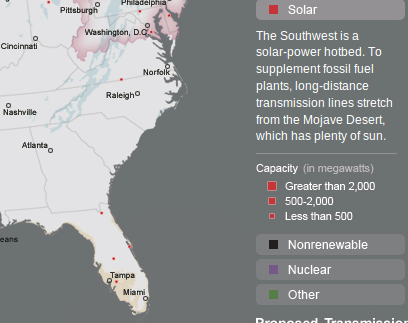
It’s easy to count the proposed solar power plants in Georgia: zero.
Yet there’s one in Virginia, one in Maryland, and at least three in Florida,
adding to the

currently largest solar plant in the country near De Soto, Florida.


The map legend repeats the GEFA canard that

The Southwest is a solar-power hotbed.
To supplement fossil fuel plants,
long-distance transmission lines stretch from the Mojave Destert,
which has plenty of sun.


Yes, that’s true, but what about this.
At least three solar plants are proposed around San Antonio and Austin,
which are not in the area of the southwest the map blurb is referring to.
In fact, the largest solar plant in the country is proposed for Austin.
Austin is one degree of latitude south of Valdosta,
and has been leading the country in solar deployment for many years now.
Texas in general

almost doubled renewable energy generation between 2004 and 2006

while Georgia did nothing.
Texas hasn’t stopped.
When will Georgia start?

The Austin solar solution doesn’t require massive new power lines, either.
It’s mostly been accomplished with solar panels on houses and business roofs;
panels that wouldn’t show up on National Geographic’s map because they’re
small and distributed.
Which is the point:
they generate power where it’s needed, and at peak times when it’s needed,
namely when it’s hot and sunny out and air conditioners are running on max.
There’s no reason Georgia can’t do the same.

I would continue this series by showing wind generation proposed for Georgia,
but there isn’t any of that, either.
There could be, off the coast.

Which makes more sense: polluting our air with more coal and biomass plants,
or getting a move on with solar and wind?

-jsq

Proposed Biomass Plants


Let’s select “other” in the

online interactive map
from
Joel Achenbach’s story about

The 21st Century Grid

in the July 2010 National Geographic.
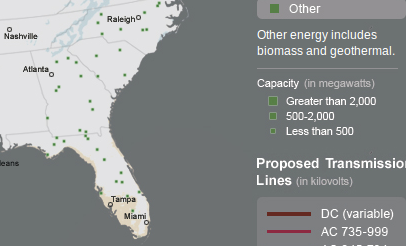
This map clearly shows the proposed Wiregrass LLC plant in Valdosta,
as well as two plants proposed just to the south for Hamilton County, Florida,
and one in Echols County, Georgia, which presumably would
be the Oglethorpe Power alternative site.
Several of the other plants shown are probably the other proposed Oglethorpe
Power plants.
Missing is Georgia Power’s Plant Mitchell in Albany, which is supposed
to convert from coal to biomass.
(Also if you select “nuclear”, the two Georgia Power proposed nuclear plants
on the Savannah River are missing.)
Apparently National Geographic edoesn’t have a complete list of proposed
biomass plants.
I wonder who does, if anybody?

Nonetheless, take this map of proposed biomass plants and
combine it with the
map of proposed new coal plants
,
plus the existing coal plants in Juliette, Georgia (dirtiest in the country)
and Albany,
and south Georgia is slated to become even more infested with
polluting energy sources.

Does that seem like a good idea to you?

Next: proposed solar plants.

-jsq

Proposed Coal Plants


In the July 2010 National Geographic,
Joel Achenbach writes about

The 21st Century Grid
.
It’s mostly about how we need a smart grid and additional power lines
to redistribute power better,
but it does get into proposed power plants to generate new power.

Although everyone acknowledges the need for a better, smarter, cleaner grid, the paramount goal of the utility industry continues to be cheap electricity. In the U.S. about half of it comes from burning coal. Coal-powered generators produce a third of the mercury emissions in America, a third of our smog, two-thirds of our sulfur dioxide, and nearly a third of our planet-warming carbon dioxide—around 2.5 billion metric tons a year, by the most recent estimate.

Then it talks about how it’s hard to get stodgy electric utilities to
invest in anything else. However, there is at least one way:

A California law requires utilities to generate at least 20 percent of their electricity from renewable sources as of this year.

OK, so what new energy plant are proposed for Georgia?
The

online interactive map

lets you select different energy types.
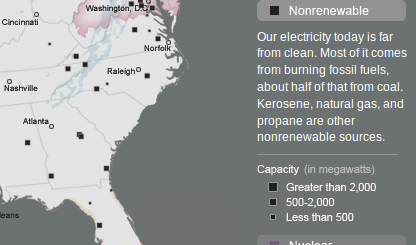
The map above shows four proposed new coal plants in Georgia,
surrounding south Georgia (plus something nonrenewable in Florida near Tampa).
I recognize the one in far southwest Georgia as the one proposed for Early County
and fortunately still tied up in litigation.
All four are in addition to the existing Plant Scherer at Juliett, GA,
near Macon, the dirtiest coal plant in the country, and the one that generates
2/3 of our power for south Georgia (as well as selling a lot of power to Florida).
Adding still more dirty coal plants does not look like progress.

Continued in next blog entry.

-jsq