Tag Archives: Coal

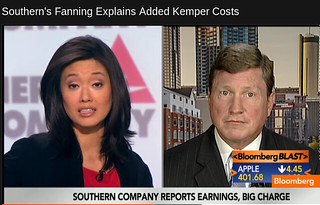
Kemper Coal greatest transfer of wealth from customers to a monopoly –Brandon Presley, MS PSC

Too ambitious, technology untried, like Katrina and the BP oil spill:
that’s Southern Company’s Kemper Coal plant, according to a Mississippi
Public Service Commissioner.

Geoff Pender wrote for ClarionLedger.com yesterday,

PSC member slams Miss. Power
,


“This is the greatest transfer of wealth from customers to a
monopoly in the history of the state of Mississippi,” [Brandon] Presley
said. “Where are all these so-called conservatives on
that?”

Maybe Mississippi, like Georgia, Continue reading

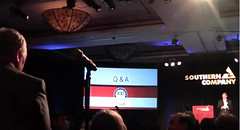
Kemper Coal cost overruns at Southern Company Stockholder Meeting @ SO 2013-05-22

SO CEO Tom Fanning used Julia O’Neal’s question about cost overruns
to tout the alleged benefits of Kemper Coal,
which include selling CO2 to oil companies to pump into the ground to
produce more oil.
He didn’t mention that oil is then burned to produce more CO2.

Can you justify the Kemper Plant on your metrics? --Julia O Neal

And that Mississippi lignite coal he said would otherwise stay in the ground?
Yes it and its CO2 would stay there if SO would get on with solar instead of coal.

Before her question, he had not said much about that project, mostly this about Major Projects, at
29 minutes and 28 seconds in

SO’s own video

of
the 22 May 2013 Southern Company Stockholder meeting
.
You’ll have to skip there manually, because of the SO’s video format.

SO prohibited “unauthorized” videoing
,
so we don’t have the usual LAKE video on YouTube.

I always call out Vogtle and Kemper County.
Both projects are going to serve our customers for decades to come.
We’ve had some challenges with Kemper.
We’ll probably talk about those later.
But when I think about the value that these projects will bring,
I think our customers, and the economy of the southeast,
will be benefited for decades.
And we’re very excited about the progress we’re making on both of those.


It’s curious he mentioned SO’s flagship coal and nuclear projects
without saying coal or nuclear.
And if by “progress” he means Continue reading

VDT should dig deeper into county trash


The VDT should dig deeper into the finances of Lowndes County trash collection.
Nobody has ever seen an accounting of where where the money went for
the county’s former waste collection sites, so nobody knows whether
the county was really losing money or how much, and the county’s
version of how those sites had to be paid for doesn’t match state law..
Sure, Bill Slaughter defending a decision made when Ashley Paulk was chair
is amusing, but instead of transcribing what county officials tell it,
the VDT could find lots more under the county’s garbage with a little digging.

Jason Schaefer write for the VDT Thursday,

Concerns continue over garbage agreement:
Business owner argues case against County
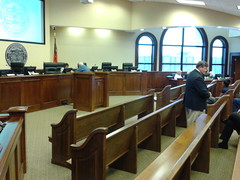


The County is not required under Georgia law to issue RFPs to any
company for waste disposal services, according to Slaughter. That
decision was made in a good-faith effort to find the lowest possible
rate for garbage service for the citizens of Lowndes County, he said
Tuesday.

Is that the point of county government, to act like Wal-Mart?
Is money the only value the county government can name?


Everyone I talked to about the trash issue in 2012 who already
had a waste collection card said they’d be willing to pay more
to keep the sites open.
Maybe if the county had held public hearings they would have learned that.

And does anyone believe ADS’s rates are going to stay that low?
Look at

Wakulla, Florida, where it’s $196/year
.
But the bigger question is why did the county privatize trash collection
anyway?

Continue reading

Kemper Coal Crashes Southern Company Rating and Stock Price


Standard & Poor’s lowered Southern Company’s rating from stable to negative
because of the risks of Kemper Coal in Mississippi, and SO’s stock price plummetted.
This was immediately after

activists grilled SO on that and other topics

at the

SO stockholder meeting
.
Wait ’till S&P catches on to the risks of SO’s

19-months-late and $1 billion-over-budget nukes
at Plant Vogtle in Georgia!
Or SO’s non-action so far on

the challenge of distributed solar
.

Kristin Jones wrote for WSJ 24 May 2013,

S&P Lowers Outlook on Southern Co., Noting Project Risks
,

Continue reading

Video of Southern Company shareholders meeting @ SO 2013-05-22


Here’s

Southern Company’s own video

of the
22 May 2013 shareholders meeting.
More detail will follow on the record number of questions,
and CEO Tom Fanning’s answers, in addition to this one already posted.

-jsq

Profits also link Vogtle nukes and Kemper coal


Southern Company gets substantial profits from utility customers paying in advance
for “clean coal” in Kemper County, MS and for new nukes at Plant Vogtle
on the Savannah River in Georgia.
As long as SO can keep raking in those profits, it has incentive
not to get on with distributed solar power.

Kristi E. Swartz wrote for the AJC 27 July 2011,

Southern Co.’s profits up on nuke finance fees
,

A fee added to Georgia Power bills to help finance a planned nuclear
plant expansion also helped parent Southern Co. post an 18 percent
profit gain in the second quarter.

The $3.73 monthly fee offsets financing costs for two proposed
nuclear reactors at Plant Vogtle.

Atlanta-based Southern cited it as one of the factors lifting net
income to $603.3 million, or 71 cents a share, in the April-June
quarter compared with $510.2 million, or 62 cents a share a year
earlier. Profits were also helped by a hot early summer, the company
said.

Back then SO CEO Tom Fanning said,

“The whole issue is to preserve schedule and costs,” Fanning said.

Continue reading

Kemper Coal: SO’s bitter pill @ SO 2013-05-22


“Corporate responsiblity,” answered Southern Company CEO Thomas A. Fanning
to questions about Kemper Coal from Linda St. Martin of Mississippians
For Affordable Energy.
I don’t think that word means what he thinks it means.

Ray Henry wrote for AP yesterday,

Southern Co. CEO defends Miss. power project
,

Continue reading

Georgia missing out on solar jobs behind New Jersey and Michigan


Other states, even New Jersey and far-north Michigan,
are beating Georgia to solar jobs.
Why isn’t sunny Georgia leading in one of the fastest-growing industries in the country that is deploying rural jobs everywhere else?
Hint: who’s

holding a shareholder meeting this month
?

Carin Hall wrote for energydigital 13 May 2013,

Solar Jobs Outnumber Texas Ranchers and US Coal Miners:
New statistics show that solar is one of the fastest growing industries in the US, creating thousands of jobs across the country

There are now more solar energy workers in the state of Texas than
there are ranchers, according to solar research group The Solar
Foundation.

The group’s data mapping out solar jobs across the nation also
showed that there are more solar jobs in California than actors, and
more solar workers than coal miners nationwide. Sunny states like
California and Arizona topped the list. Wyoming came in last, with
just 50 workers, while Utah showed a mere 290 solar workers despite
being one of the country’s sunniest states.

Even the states with less sunshine like New Jersey and Michigan
showed a high number of solar jobs—thanks to favorable tax and
regulatory policies that help attract developers to cope with high
electricity prices.


New Jersey is #9 and Michigan is #15 according to

The Solar Foundation’s map of State Solar Jobs
.
Where’s Georgia?
Number 41 in solar jobs per capita.
Yet Michigan is #47 by maximum solar resource and New Jersey is #36,
while Georgia is #18: much sunnier than those northern states.
Why is Georgia so far behind?

LEGAL STATUS OF THIRD-PARTY OWNERSHIP: NOT ALLOWED

Because of Continue reading

Dear SO: Time to move beyond coal –Sierra Club

You can to talk to Southern Company
even if you can’t come to SO’s

annual stockholder meeting 22 May at Callaway Gardens
.


Sierra Club helps you to ask SO CEO Thomas A. Fanning questions; maybe

about SO’s nuclear financial and safety performance
,
or

why SO is already losing on its “clean coal” bet in Mississippi
,
or

when SO might get serious about distributed solar power
,
or

when SO will help Georgia join the Atlantic Offshore Wind Energy Consortium
,
or….
So many possible questions, and you don’t even have to go to ask them!


Sierra Club message to Southern Company,

Tell Southern Company to Move Beyond Coal
,

On May 22, Southern Company will host its annual shareholder meeting
in Georgia, giving us a great opportunity to push them forward on
clean energy.


Southern Company has taken steps to grow clean energy in the
Southeast — Alabama Power and Georgia Power both invested in
wind energy and Georgia power increased solar energy investments
— but they can do a lot more.

Southern Company still provides some of the dirtiest, most
unreliable, dangerous, and expensive power in the country. And its
subsidiaries continue to place “Big Bets” on dirty coal electricity
that poisons the health of our communities’ water, air, and
families. Georgia is even home to the biggest emitter of carbon
pollution in the nation, Scherer Plant in Juliette.

Send a message to Southern Company’s CEO Tom Fanning to thanking him
for clean energy investments, and demand that Southern Company clean
up its act and invest in job creating clean energy.

Follow the link to send a message.

-jsq

The Super Bowl of disruptive distributed energy: Georgia Power and Southern Company are losing

It’s literally game-changing time with solar power at the electric utilities,
while Georgia Power and Southern Company are sticking with big baseload
nuclear, “clean coal”, and natural gas.
They cannot win if they don’t even try.


Steven Schultz wrote for Physorg 6 May 2013,

Growth of ‘distributed’ electricity generation could transform
utility systems
,

(Phys.org) —The U.S. electric utility industry faces a
critical juncture as new technology and declining prices allow a
more “distributed” system of small-scale generators, renewable
energy installations and energy-efficiency strategies, according to
a group of high-level energy industry executives and regulators who
met at Princeton University recently.

“We have a monumental challenge,” said Jon Wellinghoff, chairman of
the Federal Energy Regulatory Commission, who participated in the
all-day meeting Friday, April 26. Citing commentary by an analyst
who warned of a potential “train wreck” in the industry, Wellinghoff
outlined converging tends in which technological advances are
allowing consumers and companies to take matters of reliability,
security and efficiency into their own hands, while utility
companies are under pressure to maintain and upgrade a national
electricity system that is broadly accessible.

“Everybody saw the Super Bowl,” Wellinghoff said, referring to the
half-hour blackout that disrupted the 2013 football championship.

He didn’t mention that after blacking out the Super Bowl Continue reading