Category Archives: Renewable Energy

Wind for 1/3 of Georgia electricity, plus solar

“Georgia has about 14.5 gigawatts of feasibly developed offshore wind energy potential–enough power to provide one-third of Georgia’s current electrical needs.”

And the wind blows at night when the sun doesn’t shine.
Add solar for the peak power day,
and there’s no excuse for coal, nuclear, or natural gas.


Georgia’s Offshore Wind Energy Potential Showcased at CoastFest
,
by Allie Brown
for SACE 15 October 2013.

Georgia Power and Southern Company know this.
When will they act on it?

PS: Owed to Danielle Jordan

-jsq

Actually, green solar power is winning

An article that dismisses without investigation the fastest
growing industry in the world, solar power, after solar has become

cheaper than any other energy source
, is not a serious article.


Richard Smith wrote for Truthout 9 January 2014,

Green Capitalism: The God That Failed
.
Sure,
there are lots of good points in there (such as we need a carbon tax,
but it’s not enough), but given that

only 90 companies account for 2/3 of GHG emissions

saying we can’t change that without crashing the world’s economy is
like saying we can’t deal with horse manure in cities in 1900 without
crashing the world’s economy, and

people did say things like that back then
.

Most of the world’s oil and gas is used to produce power,
so once we

convert to solar and wind
,
we’ll have plenty of remaining petroleum for other uses
such as lubrication.


Saying in 2014 that solar and wind can’t power the world is like
saying in 1994 that Continue reading

SAVE has a new website

Reminding everyone of what they do and
what VSU President McKinney said,
Students Against Violating the Environment
has

a new website
.


S.A.V.E. is an environmental activist organization based on the
campus of Valdosta State University (VSU). It is composed of
students from all majors, and any VSU student is welcome to join
regardless of race, gender, age, or sexual orientation.


The mission of the organization is Continue reading

Organic battery with no metals –Harvard SEAS


Solar already provides peak power at peak load, and through distribution
is resilient, and that plus ever-decreasing prices will drive solar
deployments up exponentially for a decade or so yet.
If we add an inexpensive metal-free battery,
solar will take over even faster.
And that’s what Harvard’s School of Engineering and Applied Sciences has just
published as a discovery.

Harvard SEAS PR of 8 January 2014,

Organic mega flow battery promises breakthrough for renewable
energy:
Harvard technology could economically store energy for use when the wind doesn’t blow and the sun doesn’t shine
,


The paper reports a metal-free flow battery that relies on the
electrochemistry of naturally abundant, inexpensive, small organic
(carbon-based) molecules called quinones, which are similar to
molecules that store energy in plants and animals.

And much less expensive, reported CBC News 9 January 2014, Continue reading

Utilities desperate to shade solar power

The same Edison Electric Institute that warned electric utilities
that distributed solar is already eating their lunch has codified
a net metering talking point that utilities are pushing to try
to shade solar power.
It’s not working.

Power play: Utilities want solar users to pay up
Mark Koba wrote for CNBC yesterday,

Power play: Utilities want solar users to pay up
,


But some experts say the mere fact that utilities—

which generate $360 billion a year in energy sales
—are battling with
solar indicates the threat it now poses to them.

“The success of solar power is forcing utilities to rethink their
business model and push for the changes,” said Franc Del Fosse, an
energy industry lawyer and partner at Snell & Wilmer. “If you have
an individual putting solar panels on the roof, it’s easy to suggest
that a utility is making less money.”

The effort for higher fees on solar panel users could backfire, Continue reading

Solar is now competitive with … natural gas –Crossborder Energy study

Colorado, California, North Carolina: when will Georgia catch up in solar power?
What will it take to get the Georgia legislature to realize all Georgians
will benefit economically from much more solar power than

GA PSC in July required Georgia Power to buy
?
And why should we permit

a methane gas pipeline to gash through Georgia

to profit executives in Houston and Juno Beach, Florida
when we could be deploying solar everywhere in Georgia
for

local jobs, profit, lower electric bills, and clean air and water
?

Here’s
the study

that showed solar benefits outweigh costs in North Carolina,

The Benefits and Costs
of Solar Generation
for Electric Ratepayers
in North Carolina
,
by R. Thomas Beach and
Patrick G. McGuire for Crossborder Energy, 18 October 2013.

Wholesale solar PPA prices provide perhaps the most dramatic
evidence of the continued decline in solar PV costs. Solar PPA
prices have fallen dramatically over the past several years, to the
point that, in some regions of the U.S., solar is now competitive
with other generation resources, including wind and natural gas.
Xcel Energy in Colorado recently announced that it is proposing to
add 170 MW of utility-scale solar to its system, with its CEO
stating “[f]or the first time ever, we are adding cost
competitive utility scale solar to the system.”33
The
California electric utilities make public each year the average PPA
prices for renewable contracts approved by the CPUC in the prior
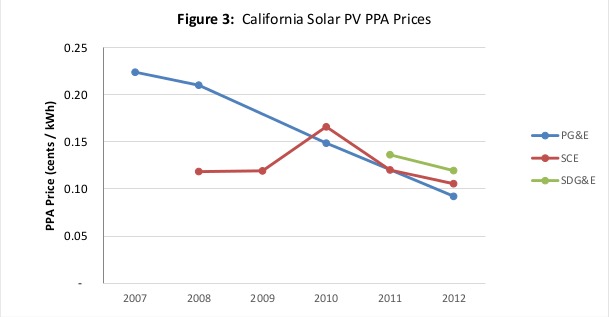
year. Figure 3 shows the trend in the prices for their solar PV
PPAs; CPUC contract approval can occur up to a year or more after
bids are received, so the figure is indicative of prices through
roughly 2011.34
2012 solicitations for solar PPAs in California in
the 3 MW to 20 MW size range through the Renewable Auction Mechanism
(RAM) have yielded market-clearing prices in the
8 to 9 cents
per
kWh range.3


The Lawrence Berkeley National Lab (LBNL) conducts and publishes
regular national surveys of the installed costs of solar PV; these
surveys include Continue reading

Solar benefits outweigh costs in NC

And the same is true in Georgia, despite Georgia Power and Southern Company.

John Downey wrote for
Charlotte Business Journal 23 October 2013,

Study: Solar benefits outweigh costs in NC


An independent study published by a nationally known energy
consultant asserts that adding 500 megawatts of solar generation in
North Carolina would save utility ratepayers about $26 million
annually.

It notes the gains from solar projects — such as lower
transmission and distribution costs, avoided emissions, lower losses
of electricity in transmission.

The study calculates that such benefits

outweigh the costs by 30 percent to 40 percent.

Update 2017-04-25:
Energy NC seems to have removed or moved its copy of that report,
but fortunately SEIA lists it
on
a backup website, and I’ve linked it into the quotation above, plus a copy on the LAKE website.
SEIA also lists many other studies for other states, such as
one for Virginia which is on the
MDV-SEIA website, and now also has
a copy on the LAKE website.
For Georgia SEIA lists the testimony of GSEIA before the Georgia Public Service Commission in 2013.
For Florida SEIA lists only a very old (2003) study with a broken link,
which can be found as a google book, but now would mostly be worthwhile as a museum piece.
Duke’s own actions in Florida in 2016 and 2017 indicate
Duke Energy knows the sun is rising even on the Sunshine State.

The study considered two intertwined solar methods: Continue reading

Nash County, NC has agendas and minutes for many local boards online


A county

no bigger
than Lowndes County has

agendas and minutes online
for
its Board of Commissioners, Board of Health, Local Emergency Planning Committee,
Board of Adjustment,
Board of Elections,
Social Services Board,
and yes, its Planning Board.

Why can Nash County, NC afford this yet Lowndes County Chairman Bill Slaughter
says Lowndes County can’t afford to put agendas and minutes online for
the Greater Lowndes Planning Commission?

And if a county can require a solar farm to follow stormwater management
and numerous other regulations, why can’t a county require a natural
gas pipeline to follow local regulations?

It can
, if its elected officials actually stand up for their citizens.
And why can Nash County, quite a bit north of Lowndes County,
install solar farm after solar farm while there are none in Lowndes County?

The Nash County online documents also include the details of what the
various boards were considering, such as in the

Agenda and Minutes of the Nash County Planning Board 21 October 2013
,
which include this item:


  1. Conditional Use Permit Request CU-130901 (Previously Tabled Item).


    Made by Chris Killenberg With Community Energy Solar on Behalf of Castalia Solar LLC to
    Develop a Solar Farm on an Approximately 22.91 Acre Portion of Two Tracts Located on
    the West Side of N NC Highway 58 and South of NC Highway 56 in the A1 Agricultural
    Zoning District.

And not just the agenda item, also

extended discussion in the meeting
, including: Continue reading

Utilities can’t take the solar heat


Utilities are trying increasingly desperate tactics in their
losing battle against distributed rooftop solar power.
It’s time for them to get out in front and lead instead.

Clare Foran wrote for NationalJournal

Are Utilities Wilting From Heat of Solar Competition?

Regulatory battles over solar power payment models played out in
several states this year. And as the dust settles, solar providers
are claiming victory. Utilities, on the other hand, are trying to
reframe the conversation entirely by insisting they aren’t an enemy
of solar.

After discussing utlities’ attempts to bash net metering, she notes
the

Sierra Club


hard-won

victory over the

ALEC solar tax
:

In November, Georgia Power

backed down
Continue reading

Sandy Hill Solar, Elm City, NC


Can’t miss this driving north on I-95:
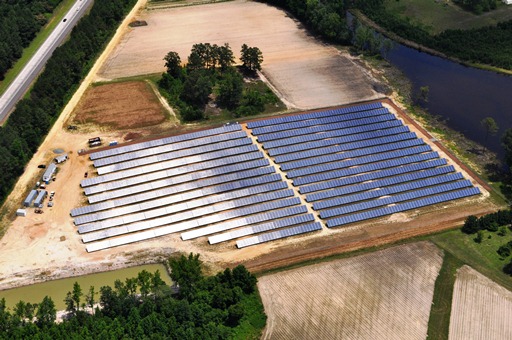
acres of solar panels next to the highway,
paying a local farmer for decades.

MacDonald wrote for enerG September/October 2012,

Solar picking upsteam in the U.S. South
,

The Sandy Cross solar farm is the most recent project completed by
O2energies, a mid-sized Charlotte-based solar development firm that
has built a reputation for combining sustainable agriculture and
sustainable energy production on farms in the southeastern U.S. The
company owns and operates several solar farms in North Carolina.

The company’s president, Joel Olsen, notes that agriculture and
energy production can complement each other. Solar farms have a low
profile, are noiseless, produce no pollution, and consume no water.

Olsen points out an interesting fact: solar farms can often be Continue reading