Category Archives: Renewable Energy

The nuclear renaissance is dead: somebody tell the Georgia legislature the wind is blowing towards the sun


Sombody should tell Georgia Power and Southern Company
they’re still pushing a dead power source.
It’s time to go from far-too-expensive nuclear directly
to solar onshore and wind offshore.

Remember in the last year or so

five U.S. nukes have been shut down and five more have been cancelled

while in Canada two more have been cancelled, plus maybe two more,

and maybe as many as six are to be shut down
.
Dr Jim Green wrote for Ecologist yesterday,

The nuclear renaissance is stone cold dead
,

Perhaps the most shocking developments have been in the United
States, where the industry is finding it increasingly difficult to
profitably operate existing reactors—especially ageing
reactors requiring refurbishments—let alone build new ones.

Almost half of the world’s reactors Continue reading

Warren Buffett moves from nuclear to wind


How to get Georgia Power and Southern Company off of

nuclear

and onto offshore wind and onshore solar power: stop approving

Construction Work in Progress (CWIP)

rate hikes for nukes that are already a billion dollars
over budget and more than a year late.
So far Mississippi is doing better about this than Georgia,
by

capping ratepayer and taxpayer costs for Kemper Coal
.
Iowa did, and look what happened.

SimplyInfo wrote 23 December 2013,

What Power Companies Do When Nuclear Is No Longer An Easy Option
, Continue reading

Coal tax and a gas pipeline for Christmas?


This was an op-ed submission to the VDT, which didn’t respond.
Today’s the GA PSC vote, so I’m blogging it now.

On Tuesday, the Georgia Public Service Commission (PSC) wants to do
for coal what

the Florida PSC already did
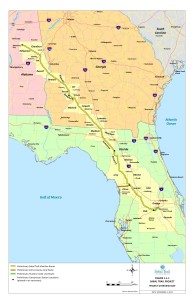
for that gas pipeline
Sabal Trail wants to gash through here: raise utility customer
rates!


Who wants a Christmas present of higher electricity rates and
continued coal smoke, plus increased guaranteed profit for Georgia
Power of 11.5%? They

already raised rates
each of the last three
years for gas and nuclear plants not yet even built; why should we
permit more rate hikes when the PSC votes December 17th? Last week’s
Public Policy poll

found 69% of Georgia voters oppose that rate hike
.

Is a one-time payment enough to let a huge 36 inch fracked methane
pipeline gash through our communities while Spectra Energy of


Houston and FPL of Juno Beach, Florida profit forever, and your
property values go down and your hazards go up?

Those FPL profits come from rate hikes on your cousins the Florida
ratepayers.

AARP opposes that
, saying: Continue reading

Green bonds for rooftop solar?

What if the Industrial Authority used its bond-issuing power
to finance rooftop solar?
And what if it combined that with utility-scale solar projects
on its own industrial park lands, and for example at the airport,
or at the new Withlacoochee Wastewater Treatment Plant?

Here’s the idea, in a report by
Citi GPS,

Energy Darwinism: The Evolution of the Energy Industry
,
October 2013,
pages 48-49,


It is not just the technology that is evolving in the solar
industry; the financing of solar projects, both residential and
utility-scale is evolving quickly. The most notable development here
has been in the form of solar leasing, whereby the rooftop panels
are owned by a third party who effectively leases the rooftop from
the home/factory/office owner, the latter receiving payment normally
through a reduction in electricity bills paid for by the lessee.
This provides the benefits of cheaper and cleaner solar electricity
to the homeowner, whilst negating the need for the significant
initial capital outlay. The panel owner or lessee earns their return
via incentive mechanisms such as the U.S. Investment Tax Credit, and
via the sale of the electricity back to the local utility. This
financing mechanism has proved particularly successful in the U.S.
and is gaining traction in the UK, with companies in other countries
looking to follow suit.

This is what

Southern Company CEO Tom Fanning suggested back in May
that SO might do.
But we don’t have to wait on Southern Company or Georgia Power.

At the utility scale level, the emergence of innovative financing
vehicles such as green bonds Continue reading

ALEC solar tax

Arizona, Virginia, and

now they’re trying in Georgia
:
ALEC wants to tax your solar panels.
ALEC is trying to legislate buggy whip requirements in an age of
affordable electric cars.

Suzanne Goldenberg and Ed Pilkington wrote for the Guardian 4 December 2013,

ALEC calls for penalties on ‘freerider’ homeowners in assault on clean energy
,


Documents obtained by the Guardian
show the core elements of its
strategy began to take shape at the previous board meeting in
Chicago in August, with meetings of its energy, environment and
agriculture subcommittees.

Further details of Alec’s strategy were provided by John Eick, the
legislative analyst for Alec’s energy, environment and agriculture
program.

Eick told the Guardian the group would be Continue reading

Inexpensive electric cars


Plug one into solar panels on your roof, and you’ve got a solar powered car.

Zachary Shahan wrote for evcentral.org today,

11 Electric Cars Priced Lower than the Average New Car
,
including a list of November prices starting less than $16,000 and
no more than $30,000:

  1. Nissan Leaf$21,300
  2. Chevy Volt$26,685
  3. Toyota Prius Plug-in Hybrid$27,490
  4. Ford C-Max Energi$28,943
  5. smart electric drive$12,490
  6. Ford Focus Electric$27,700
  7. Chevy Spark EV$19,995
  8. Mitsubishi i$15,495
  9. Fiat 500e$24,300
  10. Wheego Whip — $18,995
  11. Wheego LiFe — $25,495

-jsq

Buried under nine feet of manure: 19th century horse predictions


There is a big difference between the 19th century horse excrement
crisis and the current 21st century energy crisis,
similar as they may sound.
One was real.
The other is manufactured by the modern equivalent of stagecoach vendors.

Stephen Davies wrote for The Freeman 1 September 2004,

The Great Horse-Manure Crisis of 1894
,

In 1898 the first international urban-planning conference convened
in New York. It was abandoned after three days, instead of the
scheduled ten, because none of the delegates could see any solution
to the growing crisis posed by urban horses and their output.


The problem did indeed seem intractable. The larger and richer that
cities became, the more horses they needed to function. The more
horses, the more manure. Writing in the Times of London in 1894, one
writer estimated that in 50 years every street in London would be
buried under nine feet of manure. Moreover, all these horses had to
be stabled, which used up ever-larger areas of increasingly valuable
land. And as the number of horses grew, ever-more land had to be
devoted to producing hay to feed them (rather than producing food
for people), and this had to be brought into cities and
distributed—by horse-drawn vehicles. It seemed that urban
civilization was doomed.

Continue reading

Solar Oakland Schools expect 45% savings


Maybe local school districts would like to do this.

Dublin, GA High School did
.

Lowndes County School District has the bond rating
to do it.

SunPower PR in WSJ today,

Oakland Unified School District Plans to Reduce Electricity Costs by Nearly Half with SunPower Solar Systems at 16 Schools
,

SAN JOSE, Calif., Dec. 5, 2013 /PRNewswire/ — SunPower Corp.
(NASDAQ: SPWR) today announced that it is designing and building
high efficiency SunPower solar power systems for 16 schools in the
Oakland Unified School District (OUSD) in Oakland, Calif. Once
completed in 2014, the district estimates it will reduce electricity
costs at those facilities by 46 percent.


“Our contract with SunPower will enable Oakland Unified School
District to Continue reading

Videos: Solar Canopy Ceremony @ SAVE 2013-11-15


VSU’s president turns out to be a professor of environmental ethics,
as he reminded us at the

VSU Solar Canopy Ceremony 15 November 2013
.

Here’s
a video playlist:

Continue reading

I am committed to developing a culture of sustainability on this campus –VSU President McKinney @ SAVE 2013-11-15


At

installation of VSU’s solar canopy
,
the president of VSU answered

SAVE’s question
:


You’ve heard about how these kinds of projects
can yield a relatively quick return on investment.
And you all need to know that, so long as I am president,
I am committed to developing a culture of sustainability on this campus.
I do not believe for a moment that environmental sustainability
and the long-term economic well-being of the university are
contradictory goals.

He offered an

autobiographical
tidbit:


I began my career in academia… as

a professor of environmental ethics
.
I didn’t leave that behind when moved into the role I’m in now.
I still hold dear to that kind of thinking.
I still hold dear that kind of open dialog.
And I remain committed to these kinds of projects.
The sun is something we have in abundance here.
And I think it is something we can continue to take advantage of.

Now I will take a little bit of credit.
I remember probably the most opposite of the day we have today.
Back over the summer, and early in the morning, and it was already
extremely hot, and we were walking around trying to decide
where we were going to put the array, and we looked a couple of spots,
and then we came back here.
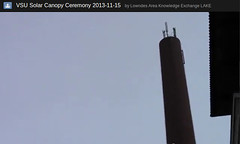

Smokestack


And the first thing that struck me from an academic perspective
was the juxtaposition of having a solar panel and the old physical plant.
Just from a metaphorical perspective, I just thought that was unique.
But then we started talking about the
fact that we could have shelter, power, for what is in many ways
an academic hub of the university, the library.
And generate some power in the process.


And be able to have not only the event that we have today,
but I would hope other kinds of events, because
I really do see this as a starting point.

He thanked everybody involved, especially SAVE
and

its president Danielle Jordan
for her leadership,
and in absentia plant operations.

Continue reading