Category Archives: Elections

The WWTP is firing back up as we speak. —Tim Carroll

Tim Carroll’s response to
Gabe Fisher. -jsq

Gabe,

I know you are frustrated and pissed. My hope was with the info
below all could see the city has not just been idly sitting by. What
has been so frustrating for us is that our biggest problem is
outside of the city limits.

As discussed below, we are about 90% complete on the design for the
big force main project. Once completed it will eliminate the sewage
spills during high rain events in your neighborhood.


Just spoke with Larry Hanson and the WWTP is firing back up as we
speak. Soon you should start seeing the current spills end as the
system is brought fully back up and running.

Something I might add we could not have done so quickly had we not
taken the steps we did these past several days.

In regards to clean up —

Continue reading

What the sewer system is currently doing to our backyards —Gabe Fisher

Received today in response to

Tim Carroll’s email.


All, Gabe Fisher here—2420 Meadow Brook. I do not currently
have the time, nor mental capacity to fully think through this
issue, but I want you all to see what the sewer system is currently
doing to our backyards.

This video
was taken today, in by backyard,
after the flood. It has been spilling at least at this same rate for
the last 7 days.


What the sewer system is currently doing to our backyards —Gabe Fisher

Video by Gabe Fisher, Valdosta, Lowndes County, Georgia, 3 March 2013.

This contaminated water breached my crawlspace, around 24″ deep, and
must absolutely be dealt with ASAP. What is the city going to do for
me, and my neighbors who are in this same situation??

There is no other word for it—I am pissed. I have seen zero
results since the flood in 2009. Yes, maybe receiving 12″ inches of
rain is an act of God, but that does not account for all the man
made structures that force the flood waters higher at my location,
nor other obstacles it must overcome to quickly and efficiently
escape our area—such as the train trestle along Gornto. And it
absolutely does not account for the city’s poorly planned sewer
system..

This isn’t the first sewage spill since the flood of
2009—there have been countless others in my area. I have
photos and video evidence of at least 5 that would likely be
classified as ‘major’.

This cannot and will not be ‘swept under the rug’.. I am still
currently upside down on my property due to the flood of 2009 and
this current flood has only further degraded my property’s value.

Gabe

Looking at his address in the Lowndes County Tax Assessor’s maps,
and turning on Flood Map, Lakes and Rivers, and Aerial Photos,
you can see that his property and most of all his neighbors’
lots are in the flood plain:

Continue reading

The rest of the story on waste water —Tim Carroll

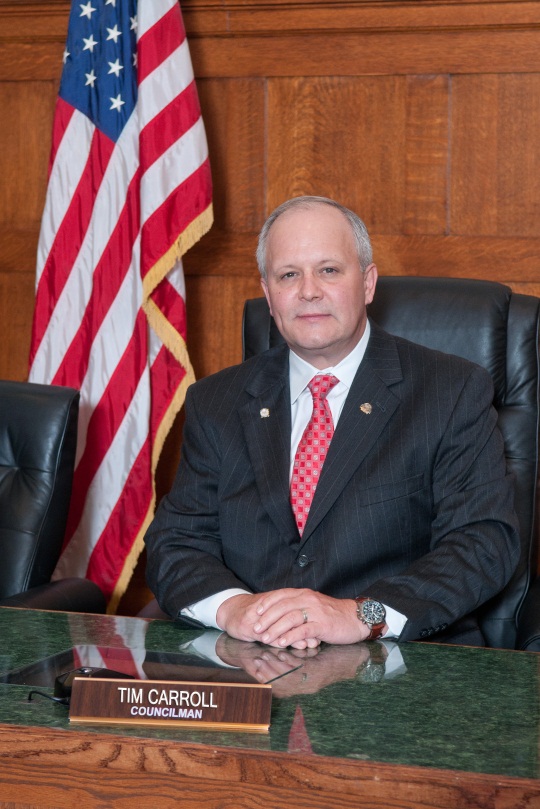
Received today from Valdosta City Council Tim Carroll, who
sent it to a long list of people,
apparently responding to
the VDT's recent article and editorials.

All,

During my tenure as a city councilman, I have tried to keep everyone
updated on events and issues with our city. I want to share and


email I sent out recently that hopefully you will agree is important
information. In regards to today's paper — the story has some
serious errors and omissions. First of all in 2009- all we saved
from the flood was the pump station. No sewage treatment was taking
place and contrary to what the VDT says, then as we are now —
raw sewage was going into the river. It lasted about a month in
2009. With the decision to pull equipment/tanks etc so they would
not be destroyed this year — we not only saved a lot of tax
payer money….but we will be able to bring the plant back on line
in about a week. Reducing by several weeks the amount of sewage
going into the river. In regards to city water systems being
compromised — considering our water plant is 10-15 miles north
of the WWTP and the amazing fact that the river flows south —
your water is completely safe. Do we like discharging raw sewage
into the river? Of course not. During the flood it was going to
happen either way.

I want to add one other note — the men and women in our
Utility department, fire, police, sanitation, engineering etc, etc

Floridan Aquifer

have been working long days this past week trying to manage flooding
issues. They deserve our thanks. It is very frustrating for those
whose homes and businesses were threatened by the flood. It is very
frustrating to our city employees who have worked so hard to manage
this crisis.

So as Paul Harvey says — “here is the rest of the
story”.

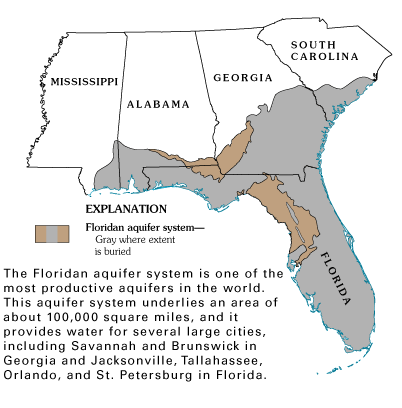
I think Council Carroll is a bit cavalier about
the city's wells being upstream of the wastewater treatment plant,
because while the river may flow south, it's not clear how
the Floridan Aquifer flows, especially with multiple 800 foot
deep wells sucking water out of it.
Also I wonder what people downstream of the Withlacoochee Wastewater
Treatment Plant think of all that raw sewage coming down at them,
especially considering some of them have wells downstream.

However, he makes a number of points that the VDT omitted,
including a plan to do something about the situation,
and appended is his "rest of the story".

Continue reading

VDT v Valdosta Re Wastewater

The VDT has apparently decided the City of Valdosta is to blame
for the
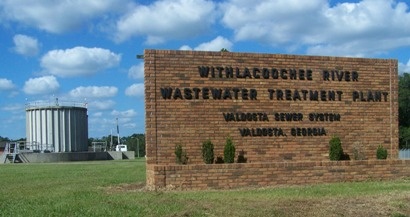
Withlacoochee Wastewater Woes,

and has made its case in a story and two editorials.
They seem to have forgotten about

the overflow in 2012
already.
And the VDT seems to have forgotten about it and its editor's own
apparent roles in the loss of the recent SPLOST election that
would have funded a new wastewater plant.

Jason Schaefer wrote for the VDT today,

Money saved at river's expense:
EPD investigates cause of sewage release as waters recede
,

When the flooding occurred in April 2009, the City made
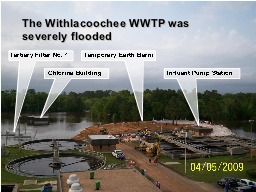

extraordinary efforts to hold back the flooding, bringing in dirt
and heavy machinery to build a berm around the influent pump station
and other treatment equipment, working round the clock.

The efforts were successful. The treatment plant remained on during
the duration of the flood, and Valdosta's raw sewage remained
contained, though the facility incurred damages to its electrical
and biological purification systems, according to Utilities Director
Henry Hicks.

This year, the City opted for a different approach—cut
electricity to the underwater portions of the plant, submit to the
flooding and clean up afterwards.

The plant was “taken offline” Thursday at 9 a.m.
“to prevent further damage to equipment and associated
electrical and control systems,” according to a statement
issued by the Department of the City Manager.

The City stated that as a result of the shutdown, “untreated
sewage will be discharging directly into the river” at a rate
of between five and six million gallons of raw sewage per day.

In addition, the floodwaters were allowed into the plant and around
the remaining portions of the berm that was constructed in 2009
during the rising flood. Only half of the berm now remains, as the
other half was removed to allow access to the lower portions of the
plant, Hicks said.

So far, this year's response strategy seems to have saved the City
money. In 2009, about $500,000 was spent in manpower, equipment and
supplies to build the berm alone, and the plant, kept running,
incurred significant damages though raw sewage was kept out of the
river. This year, the money was not spent on the berm or to prevent
the flooding, and at least 15 to 20 million gallons of raw sewage
will have been released into the Withlacoochee by the time the plant
is back online.

There's more in the story, which is well worth a read.
Also note this inserted in the middle of the story:

Editor Kay Harris contributed to this story.

The VDT cites the EPA report,

National Enforcement Initiative (FY 2011 – 2013)
Keeping Raw Sewage and Contaminated Stormwater Out of Our Nation’s Waters
,
(more about that EPA initiative

here
)
and continues:

Continue reading

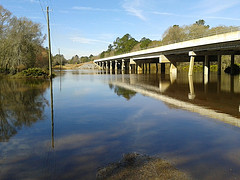
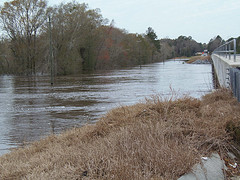
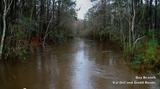
Videos of the Withlacoochee River in flood

Here are pictures and videos of the Withlacoochee River at GA 122

18 Feb 2013 Withlacoochee River @ GA 122


27 Feb 2013 Withlacoochee River @ GA 122

on

18 February 2013

(on the left when the river was rising)
and

27 February 2013
(on the right,
when it was clearly in flood stage).

Pictures and videos of the Withlacoochee River at GA 122
by John S. Quarterman and Gretchen Quarterman for

WWALS Watershed Coailition.


Brandon Powers for the VDT

And the Valdosta Daily Times has discovered video!
VDT posted 25 February 2013,

The effects of rain
,
which includes video of numerous locations around Lowndes County.
This is all relevant to the

Withlacoochee Wastewater Woes for Valdosta and Lowndes County.

-jsq

Withlacoochee Wastewater Woes for Valdosta and Lowndes County

AP picked up the story about flooding at Valdosta's Withlacoochee
wasterwater treatment plant, citing the VDT and the City
as sources.
The City of Valdosta thinks the County should contribute to replacing the plant,
or maybe the legislature will authorize a municipal option sales tax (MOST).

AP in GPBNews 1 March 2013,

Valdosta Treatment Plant Floods
,


Authorities shut down a Valdosta wastewater treatment plant as a river flooded critical buildings and structures. The city estimates an average of 5 million to 6 million gallons of untreated sewage will discharge daily into the Withlacoochee River until the flood waters recede and the plant can resume operation. (Photo Courtesy of John S. Quarterman via Flickr.)

VALDOSTA, Ga. —

Authorities shut down a south Georgia wastewater treatment plant as a
river flooded critical buildings and structures.

Valdosta city officials said power at the plant was shut down
Thursday to prevent further damage to equipment and control systems.

The city estimates an average of 5 million to 6 million gallons of
untreated sewage will discharge daily into the Withlacoochee River
until the flood waters recede and the plant can resume operation.

The AP story continues, but let's cut to the sources.

Continue reading

Make sure people in my age group know who they’re voting for —Brett Huntley @ LCC 2013-02-26


Brett Huntley responded
to the Commission's mysterious ruling against the public
at the

26 Febuary 2013 Lowndes County Commission meeting,

to close the only public access to the Alapaha River in Lowndes County.
Neither County Manager Joe Pritchard nor County Engineer Mike Fletcher
were paying any attention.

I would like to publicly say that I am shocked with the decision.
I feel the decision was in favor of a sole person, and not in the
interests of the community and the citizens.
We tried to speak and explain our side of the story.
And the county road has not ceased to be used.
It's been being used in our county for over 100 years.
I feel your guys just made a decision that will have an impact
on our culture and heritage in the community that is not good.
It's a bad decision, I feel.

I kind of feel hurt.
I feel it's a personal thing for our community.
That whole road abandonment idea stems from one sole person

Continue reading

As went Maine Yankee, so goes San Onofre: another reactor will close


San Onofre 4 will stay down
,
if opponents can stop the hidden experiment shell game.
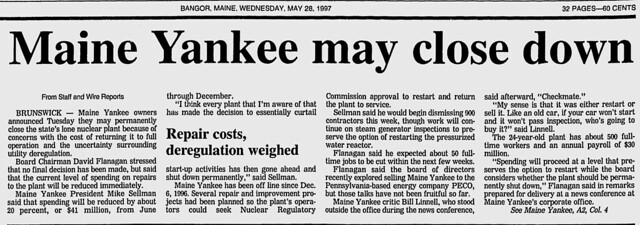
Maine Yankee was down for about a year, and never started up again.

Front page of the Bangor Daily News 28 May 1997,

Maine Yankee plant may be closed down: Owners weigh repair costs, deregulation
,


Page 1A Bangor Daily News 28 May 1997

Maine Yankee President Mike Sellman said that spending
will be reduced by about 20 percent, or $41 million, from
June through December.

“I think every plant that I’m aware of that has made the decision
to essentially curtail start-up activities has then gone ahead
shut down permanently,” said Sellman.

Maine Yankee has been off line since Dec. 6, 1966.
Several repair and improvement projects had been planned so the plant’s
operators could seek Nuclear Regulatory Commission approval to
restart and return the plant to service.

See also
“It has to close because of the pocketbook.” —Kyle Jones on Maine Yankee nuclear power plant
.

-jsq

“It has to close because of the pocketbook.” —Kyle Jones on Maine Yankee nuclear power plant

Instead of demonstrating to influence legislators, sometimes it's better
to get elected and legislate: that's what Kyle Jones did in Maine,
and he closed the Maine Yankee nuke,
de-monopolized the state's electrical utilities,
and instituted a 30% renewable energy goal.
All this was helped by the nuclear industry's own incompetence.

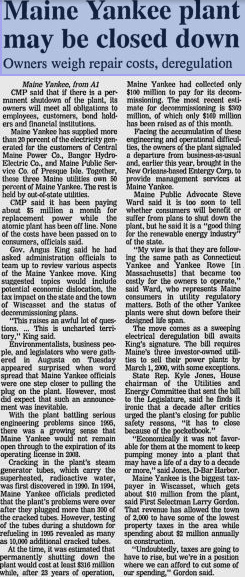
Bangor Daily News, Page A2, 28 May 1997,

Maine Yankee plant may be closed down: Owners weigh repair costs, deregulation
,


Page 2A Bangor Daily News 28 May 1997

Cracking in the plant's steam generator tubes, which carry the superheated,
radioactive water, was first discovered in 1990.
In 1994, Main Yankee officials predicted that the plant's problems
were over after they plugged more than 300 of the cracked tubes.
However, testing of the tubes during a shutdown for refueling in 1995
revealed as many as 10,000 additional cracked tubes.

Sounds a lot like

San Onofre.

At the time, it was estimated that permanently shutting down
the plant would cost at least $316 million while,
after 23 years of operation, Maine Yankee had collected only
$100 million to pay for its decommissioning. The most recent
estimate for decommissioning is $369 million, of which
only $169 million has been raised as of this month.

Facing the accumulation of these engineering and operational difficulties,
the owners of the plant signaled a departure from business-as-usual
and, earlier this year, brought in the New Orleans-based Entergy Corp.
to provide management services at Maine Yankee.

Oh, my!
The same Entergy that's now

likely to close Vermont Yankee.

And Vermont Yankee wasn’t the first to follow this financial path to closure:

Continue reading

Rural AIDS: poverty the cause, solar power part of the solution


Director Lisa Biagiotti
spent two years travelling around the South
interviewing people about AIDS to make a film,
deepsouth.
She found rural AIDS is a bigger and faster-growing problem
than AIDS in center cities,
yet most health and prevention funding goes to urban areas.
The root cause seemed clear to her: poverty.
Here’s some deeper dirt (literally) on rural poverty in the U.S.,
and one thing we know can help with that: distributed solar power,
for jobs, for reduced electrical bills, and for energy independence.
What politician wouldn’t want jobs for their constituents?

The director said the screening at

VSU at the end of November
drew more people than the
day before in Little Rock.
There were clearly more than 150 in the audience in Valdosta.
It’s a topic very relevant to here, as

Dean Poling wrote in the VDT 26 November 2012,

Organizers note that Georgia is ranked sixth highest nationally for
its cumulative number of AIDS cases reported through December 2009.
More than 40,000 known HIV/AIDS cases were reported in Georgia as of
2010.

The South Health District’s 10 counties, which include Lowndes and


surrounding counties, report 950 confirmed cases of HIV/AIDS, while
many more are likely infected and risk becoming sick because they
are not being treated. More specifically, there are about 460
reported cases in Lowndes County.

In reporting these numbers, HIV is the virus (HIV disease) and AIDS
is the medical diagnosis made by a doctor of the symptoms, according
to South Health District.

It’s a great movie and I highly recommend it.
Director Biagiotti spent a substantial amount of her own money and two years to make
this film, yet there are aspects she could only note in passing,
such as incarceration.
She can’t be expected to have researched every aspect;
maybe somebody else can step up and help follow more threads.

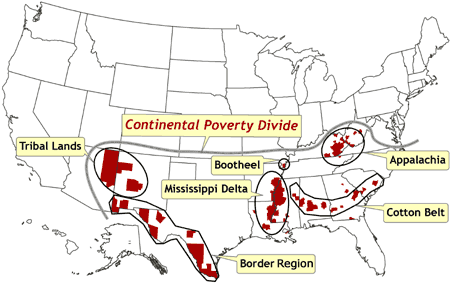
The movie starts with some maps about poverty and AIDS in the South.
It did not, however, look outside the South for poverty.
Here are better
poverty maps, from the CDC:


Continue reading