Category Archives: Economy

Cook County schools furloughing teachers

Cook county schools have a budget shortfall problem, and they think they can solve it only by furloughing teachers. Remind me again why we're wasting $1 billion a year on prisons, including private prisons for the profit of private prison shareholders and executives (like CCA CEO Damon Hininger's $3 million a year) and we're furloughing teachers instead?

Greg Gullberg wrote for WCTV 10 May 2012, Teachers in Cook County Face Furloughs,

The Cook County School System is facing a $472,352 deficit. Superintendent Lance Heard tells Eyewitness News reporter Greg Gullberg that the only way out may be to initiate system-wide furlough days and cutting jobs.

"We've done everything we can to maintain the level of education for the students that we've always had and we think we've been able to do that," said Superintendent Heard.

Nothing is set in stone yet, but 488 teachers, staff and administrators, may be facing furlough days next school year. Superintendent Heard hopes to limit them to three to five per employee.

"I would like to say also that when we do take furlough days, they are always none instructional days. The students do not miss any school," said Superintendent Heard.

Yet. Keep on in this direction and the students will be missing school. As it is, they just get less-prepared teachers, for less-effective teaching. But this is not Supt. Heard's fault.

Do we in Georgia want to prepare students for jail, or to succeed in life? Prisons cost we the taxpayers lots of money. Successful young people help pay for everything. Maybe we should choose successful young people, starting with education.

-jsq

FERC and energy demand response

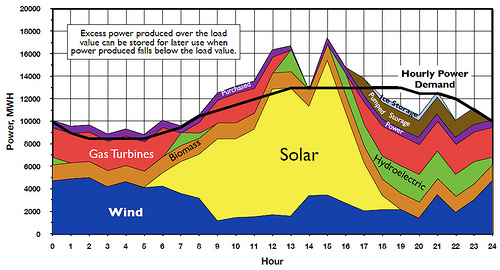
Beyond a smart grid to mix and match the supply solar and wind to get rid of any need for new coal or nuclear plants, as FERC Chairman Jon Wellinghoff recommended three years ago, FERC also has plans to mix and match demand. Energy customers can volunteer to shut off their air conditioners or clothes dryers automatically if there’s not enough supply. This could facilitate adding solar power, by basically acknowledging that it may not always supply a fixed capacity.

Todd Griset wrote for law firm PretiFlaherty 23 April 2012, FERC seeks demand response standards,

Demand response, an innovative strategy to ensuring the integrity of electric grids, is growing in popularity, prompting federal regulators to consider standardizing how demand response performance is measured.

Managing an electric grid entails ensuring a constant balance between electric generation and customer demand for electricity. As customer demand rises, grid operators have traditionally called on more and more generating units. In most markets, grid operators dispatch the lowest-cost units first to keep overall costs down. As a result, generating units needed to meet peak demand tend to be more expensive than baseload generation. Many peaking units also emit more pollutants per unit of energy than baseload units.

In a demand response program, customers can volunteer to be available to reduce their load during times of peak demand. When done right, this reduction in customer demand can play much the same role as dispatching additional generation, but at a lower cost in dollars and environmental impacts. Energy efficiency resources can also play a similar role.

The U.S. Congress and the Federal Energy Regulatory Commission have both recognized that demand response can be a decentralized, crowd-sourced alternative to peaking power plants. Utilities and regional transmission organizations across the nation are implementing demand response programs.

Across the nation…. How about it, Georgia Power, and Georgia EMCs? How are your demand response programs coming?

-jsq

FERC Chairman: baseload outdated; no new nukes needed; go sun and wind

Power companies’ main stated objection to solar or wind is that they are not “capacity” or “baseload” generation because sometimes the sun does not shine and the wind does not blow. And those utilities are required by various state, regional Energy Regulatory Commissions right up to the Federal Energy Regulatory Commission (FERC) to supply capacity or baseload power. That’s their main excuse for coal and nuclear plants. Well, the Chairman of FERC thinks we may not need baseload, nor any new coal nor nuclear plants, either.

Noelle Straub and Peter Behr wrote for ScientificAmerican 22 April 2009, Will the U.S. Ever Need to Build Another Coal or Nuclear Power Plant? The new chairman of the Federal Energy Regulatory Commission doesn’t think so

No new nuclear or coal plants may ever be needed in the United States, the chairman of the Federal Energy Regulatory Commission said today.

“We may not need any, ever,” Jon Wellinghoff told reporters at a U.S. Energy Association forum.

So what will we need?

Continue reading

Videos @ LCC 2012 05 07

Here are videos of the entire approximately eight minute 7 May 2012 Work Session of the Lowndes County Commission. They vote in Regular Session tonight at 5:30PM. Here’s the agenda.

See other post about “5. Appointments – Lowndes County Development Authority”.

Two weeks ago they decided to hold a public hearing about abandoning part of the Right of Way of old US 41 South, but this time it’s on the agenda as a Resolution, and it appears part of the request has been withdrawn, and some people would be left landlocked with no access to a public road, so it seems the Resolution will be to table at least part of it to an undetermined future date. Yet the County Engineer seemed to reccomend going ahead with the rest of the abandonment. Where’s the public hearing?

Two rezonings had no comments. The third, just north of Hahira, got opposition at the Planning Commission; see the other post on that.

A developer wants, according to County Planner Jason Davenport, a letter from the Commission so it can more readily get tax credits from the federal government. He didn’t say what the tax credits would be for. For a concrete front yard? Or for solar on the roof? It will be interesting to see how the anti-grant Commissioners vote on this one, when it’s a developer who benefits.

It sounds like the county wants to award a contract to Continue reading

Solar IS Civil Defense PSA

While /the grid power was out during and after the March F2 tornado (F3 in Lanier County), the lights at our place never blinked, because we have solar panels and batteries. George Mokray has a video that expands on that point.

Solar IS Civil Defense—what we are all supposed to have on hand in case of emergency—flashlight, cell phone, radio, extra set of batteries—can be powered by a few square inches of solar electric panel. Add a hand crank or bicycle generator and you have a reliable source of survival level electricity, day or night, by sunlight or muscle power.

Here’s the video:

Solar IS Civil Defense PSA
Valdosta, Lowndes County, Georgia, .
Video by for Lowndes Area Knowledge Exchange (LAKE).

This is also entry level electrical power for the 1.5 billion people around the world who do not yet have access to electricity. Civil defense at home and economic development abroad can be combined in a “buy one, give one” program like the Bogolight (http:// www.bogolight.com) which is a solar LED light and AA battery charger.

Solar IS Civil Defense and could be much more.

I think Lowndes County Emergency Management Director Ashley Tye did a fine job dealing with the tornado. What if beyond the resources he had available we added distributed solar power? In addition to being storm ready, solar also brings jobs for engineers, electricians, truck drivers, and plumbers, and for professors and students to study all that.

Change a few laws, and profit by selling excess power to Atlanta or points north. Add plug-in electric vehicles, and we get less need for foreign oil, so we get improved national security.

Safety, energy independence, and economic development right here at home through solar power!

-jsq

Videos, Regular Session @ LCC 2012-04-24

Here are videos of the entire 11:11 minute 24 April 2012 Regular Session of the Lowndes County Commission. They time at 0:57 (before call to order; doesn’t count), 0:42 (mostly dead air), 0:33 (invocation and pledge: not business), 0:29, 0:37, 0:40, 0:10, 0:46, 1:09, 0:46, 0:53, 1:22, 2:08, 1:30, and 0:08: eleven minutes and eleven seconds total. And that’s including the invocation and pledge and the two citizens who spoke (3:38 for those last two). It would seem a good guess that the Commissioners and staff discussed more in the previous morning’s work session, but not really; you can see for yourself.

In the Regular Session (here’s the agenda) they appointed [“mumble”, said County Manager Joe Pritchard] to the Courthouse Preservation Committee. They approved a beer, wine, and liquor license for Southern Landing Restaurant. The liquor license for Rio Grande Bar & Grill was withdrawn. The adopted the infrastructure for Jimmy Rodgers Way. They decided to hold a public hearing next meeting for unopened ROW off US 41 South. They decided to switch banking from Regions Bank to SunTrust. They accepted bids for water and coffee service for county buildings; (apparently the county’s own water that its citizens drink isn’t good enough for Commissioners and staff).

A Commissioner asked a question! Before they accepted a bid for mowing Bemiss Road, Joyce Evans wanted an explanation of the timeframe of the cutting of the grass. Public Works Director Robin English wanted to know work time or response time? County Manager Joe Pritchard and somebody else simultaneously said “response time”. Hm, how did they know that? In what open meeting was that question previously raised? Also, Pritchard demonstrated he could speak into the microphone and be heard when he wanted to. English clarified the response times quoted by the bidders, and Evans moved to go with the low bidder, which the Commissioners approved, unanimously as usual.

Two citizens spoke:

See those two separate posts for details.

Here’s a video playlist for the entire Regular Session:

Videos, Regular Session
Regular Session, Lowndes County Commission (LCC),
Valdosta, Lowndes County, Georgia, 24 April 2012.
Videos by Gretchen Quarterman for Lowndes Area Knowledge Exchange (LAKE).

-jsq

Videos, Work Session @ LCC 2012 04 23

Here are videos of the entire ten and a half minute 23 April 2012 Work Session of the Lowndes County Commission. As you can see, these videos time at 1:01, 0:33, 0:44, 1:07, 1:45, 1:40, 0:33, 2:59, and 0:10, and that’s with a camera that stops and starts almost instantaneously. Those times add up to 10 minutes and 32 seconds. Is that adequate discussion for the county’s business?

A former member of the Courthouse Preservation Commission, has moved, and the Chairman said Mike somebody was a good one to appoint as a replacement. No Commissioners asked any questions. They didn’t ask many questions on anything else, either. On 8a. Abandonment of unopened ROW on Walker Avenue (off of US 41 S) in Twin Lakes area, Commissioner Crawford Powell had a question, but it was only where the engineer was in the map.

Finance Director Stephanie Black said the county sent out an RFP for banking services to local banks. Three responded, and one was incomplete. The two complete bids were Regions Bank and SunTrust. Regions will waive charges with $6M balance; SunTrust will waive charges $2.8M balance.

On the FDIC charge, Regions will charge .135 per thousand dollars; SunTrust is waiving that.

She said that was currently about $3500 or $4500 per month. Commissioner Powell asked who they were currently using. Answer: Regions. There’s more in the video, and there was a written report the Commissioners were looking at.

Apparently the county’s own water isn’t good enough for Commissioners and staff, Continue reading

Finance, Facilities, and Projects @ VLPRA 2012 04 19

Imagine an appointed body that likes citizen input, and even puts (some) board packet items on its website before its meetings! Parks and Rec is that body.

With 1.5 mil of our tax dollars every year, it’s good to see the Valdosta-Lowndes County Parks & Recreation Authority (VLPRA) reviewing finances:

At the end of February, the Parks and Rec had $2.69 million in cash, $541,000 in liabilities, and that leaves about $2.1 million….

For the eight months ending February 29, tax receipts $3.22 million. That’s $79,000 dollars more tax receipts than for the eight months of the previous year.

So that’s about $4.3 million per year in tax receipts, plus SPLOST money (see the video). The board didn’t have any questions about finance.

At least we can see some results of their money, such as Continue reading

28 SolarWorld panels, 5.25 kilowatts –Paul Wolff @ TVC 2012 02 17

Paul Wolff showed us his solar panels on Tybee Island:

That’s 28 panels. They’re SolarWorlds, roughly 18% efficiency rating, and it’s a 5.525 kilowatt system.

And another thing I tell people if your roof is at all questionable… right now there’s a 30% federal tax credit on the materials for an EnergyStar roof….

Here’s the video:

28 SolarWorld panels, 5.25 kilowatts –Paul Wolff
renewable energy,
Paul Wolff, The Volta Collaborative (TVC),
Tybee Island, Chatham County, Georgia, 17 February 2012.
Video by Gretchen Quarterman for Lowndes Area Knowledge Exchange (LAKE).

-jsq

100 broadband municipal networks: where’s ours?

Instead of arbitrating a fixed-size LOST pie, what if Lowndes County and the local cities worked on increasing the size of the pie through broadband? It’s not just Chattanooga, 100 other municipalities have done it.

Christopher Mitchell wrote for Planetizen 30 April 2012, Should Your City Build Its Own Broadband Network?

Chattanooga is not alone; more than 100 cities and towns have built their own broadband networks. The city of Lafayette, Louisiana offers probably the best deal for broadband in the nation: ten megabits symmetrical for less than $30/month. For non-geek readers, it is actually faster than my home Comcast connection at less than half the price. The Institute for Local Self-Reliance has just released a new report detailing how Chattanooga and Lafayette built their networks.

Hm, Valdosta and Lowndes County don’t seem to be on that map. Yet. We don’t have to wait for VLCIA to organize this; there are other ways.

-jsq