Tag Archives: Wind

Does SO have a business model for energy conservation? –Dan Everett @ SO 2013-05-22

SO has done a lot about energy efficiency, but can it do more,
and how will it profit by doing so?
Prof. Dan Everett asked this
at the

22 May 2013 Southern Company Stockholder Meeting
.


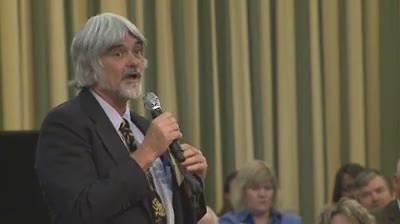
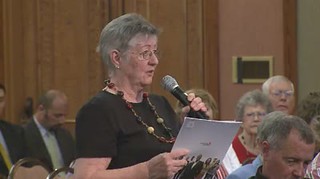
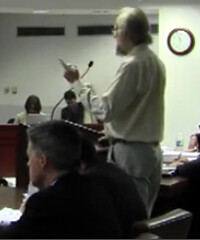
Prof. Dan Everett speaking

I have Mr. Dan Everett from Athens, Georgia, and he holds 11 shares of
Southern Company.

TF: Talked to Dan earlier today. Dan is a professor at the University of
Georgia, right?

DE: Right.


Dan Everett striding to the microphone

He’s
Daniel M. Everett,
Assistant Professor of Computer Science
, UGA Athens.
The SO Annual Stockholders Meeting apparently doesn’t get many professors.

TF: Fantastic. Well, welcome.

DE: Oh, thank you very much. And as a guy who has some professional
interest in this stuff, I totally applaud the research that y’all
are doing on energy technologies and renewable
energies and efficiency technologies because it does take a while to
deploy those.

My specific question is about energy conservation.
I’ve noticed Continue reading

Portland’s Clean Economy of Place

Ironically,
Portland is the prime example in both

Amy Liu’s slides
and
the book


The Metropolitan Revolution:
How Cities and Metros Are Fixing Our Broken Politics and Fragile Economy

by Jennifer Bradley and Bruce Katz.

Here’s Bruce Katz in the Guardian 23 April 2012,

Urbanization and Inventing a Clean Economy of Place
,


Portland, Oregon, is also internationally renowned for its
commitment to sustainable development. The Portland metropolis has
an expansive public transit system and an urban growth boundary to
control development at the urban periphery. The city boasts a

green investment fund

to provide grants for residential and commercial building projects.

Now the city is striving, like Copenhagen, to reap the economic
rewards of sustainable development through business formation, firm
expansion, job growth and private investment. In February, Portland
released its first regional export plan to double exports over five
years by building on the region’s distinctive economic and physical
attributes. A critical pillar of this strategy involves increasing
the export orientation of firms in the burgeoning clean technology
sector to serve growing markets in Asia, Latin America and
elsewhere.

Hm, a clean economy of place; there’s an idea.
Here’s one of Portland’s green investments:

12W (Indigo) Project Report
, Continue reading

Coal and natural gas cost effective vs. energy efficiency, wind, and solar power? –Stephanie Coffin @ SO 2013-05-22

SO CEO Tom Fanning is a true believer in “all of the above”,
yet a skeptic about natural gas.
However, he really doesn’t have much faith in renewables,
as he indicated at the

22 May 2013 Southern Company Stockholder Meeting

and even more strongly in the Wall Street Journal.


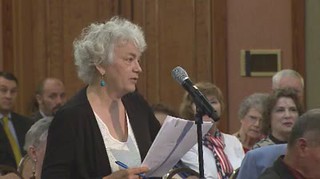
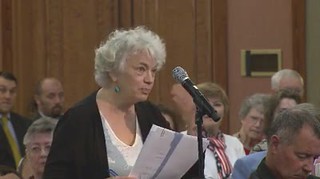
retirees and stockholders in the room wonder about the $13 million salary --Stephanie Coffin

This question is from Stephanie Coffin of Atlanta, Georgia, and she
holds 18 shares of stock.

TF:
Hello, Stephanie.

SC:
How are you, Tom?

TF:
Dynamite. How are you?


your income --Stephanie Coffin

SC:
Last year, I came to this meeting to ask a question and to listen to
the Southern Company reports. And so before I came I got to thinking
about what has changed since the last meeting. I think two things,
and then I’ll ask my question.

The first is the chairperson’s salary
increased 34 percent, over $13 million a year. I’m sure the retirees
and stockholders in the room wonder about the $13 million salary and
see that as negative PR in the face of continuing recession. $13
million a year, most of us are on fixed income. I mean, your income

My income --Stephanie Coffin

is fixed, too, but it’s very high. Mine is pretty low and we all
have to pay electric bills.

The second change, and then I’ll ask my
question, is that now 70 — 97 percent of all scientists
believe that climate change — that is, global warming —
is real and caused by human activity and this is a big shift. Last
year we were the climate deniers, we’re in control, and now 97
percent of all scientists say it’s real, it’s coming, you better get
ready.
In the face of this scientific consensus the Southern Company
has maintained its reliance on fossil fuels, mountaintop coal, old
coal plants and pushing nuclear power with huge wattage demands and
the dangers of nuclear wastes.

While I applaud the Southern
Company’s baby steps Continue reading

Why are you gambling on nuclear instead of solar? –Gloria Tatum @ SO 2013-05-22

Why is SO gambling our health and dollars on Plant Vogtle
when Georgia Power could be getting on with solar power?
SO CEO Tom Fanning avoided the first part of Gloria Tatum’s question
by simply denying it, and danced around the second part by saying
the rate hike for Plant Vogtle’s cost overruns would only be
6 to 8 percent, not 12 percent.
Do you want to pay 6 or 8 percent more for a radioactive white elephant
when you could be getting power from the sun for less?

The floor person at the

22 May 2013 Southern Company Stockholder Meeting

introduced Gloria Tatum with 164 shares, representing Nuclear
Watch South, and the SO CEO insisted

TF: Call me Tom. Gee whiz.


Gloria Tatum

GT: Tom. Hi,Tom. It’s great to be here on this beautiful day.

TF: Thank you. Yes ma’am.

GT: And I know Southern Company’s done many wonderful things, but I want
to point out a few things to you today.

First, you know, after the
Fukushima meltdown, TEPCO’s $50 billion nuclear complex became a
worthless liability. The deadly radiation still circles the planet,
polluting the earth and increasing cancer. Other countries have
abandoned their nuclear and they’re looking to renewable, but
Southern Company’s affiliate, Georgia Power, continues construction
on two new nuclear reactors at Plant Vogtle. Now Shell Bluff is a
community down the stream from Plant Vogtle and it has experienced a
25 percent increase in cancer since Vogtle 1 and 2 have been built.

Another problem with Vogtle Continue reading

Georgia Power wants more of your money to pay for its bad bets

It’s the annual Georgia Power rate hike, blaming everything
except coal and nukes.

Georgia Power PR 28 June 2013,


Georgia Power seeks cost recovery for infrastructure investments
,

Georgia Power today asked the Georgia Public Service Commission
(PSC) for permission to increase its base rates approximately $482
million, or 6.1 percent. The request is being made to allow the
company to recover the costs of recent and future investments in
infrastructure —including environmental controls, transmission
and distribution, generation, and smart grid technologies —
required in order to maintain high levels of reliability and
superior customer service.

The proposed change in rates would be effective Jan. 1, 2014.

What a coincidence!
One year to the month after

the last rate hike
.
Once again

blaming “smart grid technologies, environmental controls”
, etc.
Much more likely, this has to do with

the recent downgrades of Georgia Power’s parent the Southern Company
,
and those were for coal and nukes.
As Adam Smith said two centuries ago,
“utilities levy an absurd tax upon the rest of their fellow citizens”.

-jsq

Southern Company downgraded because of coal and nukes –two analysts

It’s not like they weren’t warned,

about coal


and

about nukes
.
It’s not Standard & Poor’s this time,
but that could happen soon, too.
SO’s biggest part, Georgia Power, is neck-deep in nukes,
as

Edison Electric Institute’s warning

about

the disruptive challenge of distributed solar

starts to affect its parent’s stock price.

Zacks.com wrote 21 June 2013,

Southern Company Slips to Sell – Analyst Blog

On Jun 20, Zacks Investment Research downgraded electric utility
firm, Southern Company ( SO ), to a Zacks Rank #4 (Sell).

Why the Downgrade?

Continue reading

Clean Green Metro Florida by Brookings Institution

Amy Liu spoke about globalization last week in Orlando,

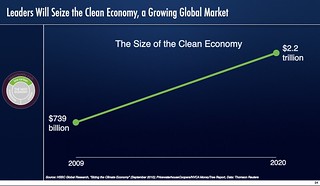
Leaders will seize the clean economy

about clean industries leading economic growth.
Even though she was talking linear growth,
her Metropolitan Policy Program at Brookings Institution
has some interesting points that mesh with the exponential growth like compound interest

Georgia can get on with in solar and wind power
.

The Florida Economic Development Council

2013 FEDC Conference 26-28 June 2013

was the venue for Amy Liu’s

A Globally Competitive Florida: Regional Opportunities in the Next Economy
.
To summarize her slides (which are

in a format not easily linkable
,
she bashes Congress to motivate cities leading.
In particular, Florida’s 20 metro ares have 61.75 of land area,
94.1% of population, and 95.9% of output.
Nothing surprising there: cities are densely populated.
Two of the biggest in Florida are in our Floridan Aquifer:
Orlando and Jacksonville.
(She didn’t mention the aquifer; I did.)

The national economic
recovery is slow, the middle class has been hard-hit,
and Florida is recovering faster, except on unemployment.
The U.S. population is rapidly getting older and by 2050
53.7% will be minorities, each of which have very different
educational achievements, and much of this is happening
in metro areas.


Her solution is Continue reading

Interactive charts: U.S. nuclear power reactors (NRC data)

Why are all these “dependable” baseload capacity nukes down so much?

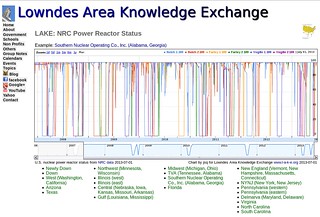
LAKE: NRC Power Reactor Status

See for yourself in these interactive graphs of

NRC Power Reactor Status
.
They’re in Google annotated timeline format,
with all the zoom and pan features used by Google finance for stock charts.
But these

Reactor Status
charts show seven years of
daily NRC power percentage data.
Want to see last month, six months, any 7 days, or some other period?
Now you can, for all 104 reactors, including
the ones recently removed by NRC from status because they’ve closed
permanently.

You can view your own local reactors

in any of 20 charts
.
Why so many graphs? Google annotated timeline charts apparently were
meant for comparing a few stock prices, and don’t handle more than about
seven curves well.
But you can see things in these graphs that are hard to spot in
NRC’s daily tables.

Example: Southern Nuclear Operating Co., Inc. (Alabama, Georgia)

Continue reading

Ready, willing, and able for wind –Jill Stuckey for Georgia Southern @ GA PSC 2013-06-18


Jill Stuckey spoke for wind power for economic development on behalf of
the College of Engineering and Information Technologies at
Georgia Southern University.
She said with its experience in solar and wind Georgia Southern
is willing, able, and ready to help
at

the Georgia Public Service Commission meeting Tuesday 18 June 2013
.

Here’s

the video:


Ready, willing, and able for wind –Jill Stuckey for Georgia Southern

Georgia Power proposed closing of coal plants,

Administrative Session, GA Public Service Commission (GA PSC),

Doug Everrett (1: south Georgia), Tim Echols (2: east Georgia), Chairman Chuck Eaton (3: metro Atlanta), Stan Wise (5 north Georgia), Bubba McDonald (4: west Georgia),

Video by John S. Quarterman for Lowndes Area Knowledge Exchange (LAKE), 244 Washington Street SW, Atlanta, GA, 30334-9052, 18 June 2013.

-jsq

The cloudy day doesn’t last for an entire month –John S. Quarterman @ GA PSC 2013-06-18

The disruptive challenge electric utilities face
is like

1: Solar power

telephone companies faced years ago, as Edison Electric Institute recently pointed out.
Circuit switching 20 years ago is like distributed solar power and
the smart grid it needs now;
this is what I described
at

the Georgia Public Service Commission meeting Tuesday 18 June 2013
.

Hi, I’m John Quarterman, I’m from Lowndes County, down near the Florida line.
These videos I’ve been taking are with Lowndes Area Knowledge Exchange
and you’ll find them on YouTube later.


Two things

Now I’d like to commend Georgia Power for helping fund our Industrial Authority
down in Lowndes County to do a strategic plan.
And in the focus groups they did with that, they discovered there’s
at least

two things everybody wants
: business, education, health care, the
people in general: Continue reading