Tag Archives: Metropolitan Revolution

Portland’s Clean Economy of Place

Ironically,
Portland is the prime example in both

Amy Liu’s slides
and
the book


The Metropolitan Revolution:
How Cities and Metros Are Fixing Our Broken Politics and Fragile Economy

by Jennifer Bradley and Bruce Katz.

Here’s Bruce Katz in the Guardian 23 April 2012,

Urbanization and Inventing a Clean Economy of Place
,


Portland, Oregon, is also internationally renowned for its
commitment to sustainable development. The Portland metropolis has
an expansive public transit system and an urban growth boundary to
control development at the urban periphery. The city boasts a

green investment fund

to provide grants for residential and commercial building projects.

Now the city is striving, like Copenhagen, to reap the economic
rewards of sustainable development through business formation, firm
expansion, job growth and private investment. In February, Portland
released its first regional export plan to double exports over five
years by building on the region’s distinctive economic and physical
attributes. A critical pillar of this strategy involves increasing
the export orientation of firms in the burgeoning clean technology
sector to serve growing markets in Asia, Latin America and
elsewhere.

Hm, a clean economy of place; there’s an idea.
Here’s one of Portland’s green investments:

12W (Indigo) Project Report
, Continue reading

Clean Green Metro Florida by Brookings Institution

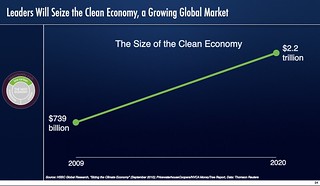
Amy Liu spoke about globalization last week in Orlando,

Leaders will seize the clean economy

about clean industries leading economic growth.
Even though she was talking linear growth,
her Metropolitan Policy Program at Brookings Institution
has some interesting points that mesh with the exponential growth like compound interest

Georgia can get on with in solar and wind power
.

The Florida Economic Development Council

2013 FEDC Conference 26-28 June 2013

was the venue for Amy Liu’s

A Globally Competitive Florida: Regional Opportunities in the Next Economy
.
To summarize her slides (which are

in a format not easily linkable
,
she bashes Congress to motivate cities leading.
In particular, Florida’s 20 metro ares have 61.75 of land area,
94.1% of population, and 95.9% of output.
Nothing surprising there: cities are densely populated.
Two of the biggest in Florida are in our Floridan Aquifer:
Orlando and Jacksonville.
(She didn’t mention the aquifer; I did.)

The national economic
recovery is slow, the middle class has been hard-hit,
and Florida is recovering faster, except on unemployment.
The U.S. population is rapidly getting older and by 2050
53.7% will be minorities, each of which have very different
educational achievements, and much of this is happening
in metro areas.


Her solution is Continue reading