Category Archives: Renewable Energy

Where could we put utility solar in south Georgia?

Where could we find

380 acres for a 30 Megawatt solar plant
in south Georgia?
Here’s a clue from Texas.

Citizen Carol wrote for Texas Vox 6 January 2012,

Austin Energy drought proofs its energy with new Webberville Solar Project


A number of years ago, the City of Austin purchased this land
planning to install a new coal-fired power plant. When those plans
fell through, a landfill was proposed for the site that now boasts
280 acres of solar panels with a view of downtown Austin along its
horizon.

How about
on the proposed coal plant site in Ben Hill County?

Of course, it doesn’t have to be that big, or all in one place.
How about on top of a landfill?
How about on the cotton fields
next to Valdosta’s Sallas Mahone Elementary School?
Energy to air condition the school instead of drifting pesticides,
and profit to the landowner!
How about at the airport?
At the mall parking lot?
On top of the new county palace?
On the warehouses in Hahira?

-jsq

Missouri has defeated CWIP: so can Georgia

A veteran of the original No Nukes movement calls Plant Vogtle
and CWIP like he sees it.

Harvey Wasserman wrote Friday for EcoWatch,

Nuclear Power’s Green Mountain Grassroots Demise
,

The accelerating revolution in renewables has allowed solar, wind


and other green sources to outstrip atomic reactors in cost, time to
build, ecological impact and safety. As billions pour into
Solartopian sources, private investment in atomic energy has all but
disappeared—except where there are massive taxpayer subsidies.

Even that’s not enough. In 2011, President Obama handed $8.33
billion in federal loan guarantees to the builders of two reactors
at Georgia’s Vogtle. But Peach State ratepayers are already being
soaked for billions more in pre-payments, and the cost of the
project is soaring. A parallel financial disaster looms at the
Robinson site in neighboring South Carolina. Though the industry
assumes these four reactors will eventually be finished, economic
realities may say otherwise.

Cost estimates for new nukes have been soaring even before
construction begins. Even with federal money, the builders still
demand that state ratepayers foot the bill as the process proceeds,
meaning consumers are on the hook for multiple billions even if the
reactors never open. Pitched battles over this Construction Work in
Progress scam have already been won by consumers in Missouri and are
being fought in Iowa and elsewhere. As the years of building drag
on, costs will escalate while renewables continue to become cheaper.
Sooner or later, construction is likely to stop, as it did at
numerous projects in the 1970s and 1980s which were never finished.

We can end CWIP in Georgia.
It will benefit Georgia Power and the EMCs as well as all the rest of us
when we stop wasting tax and customer dollars on boondoggles like Plant Vogtle
or biomass or private prisons and get on with clean, profitable, job-creating
renewable energy in Georgia: wind off the coast and sun inland.

-jsq

30 Megawatt solar plant opens near Austin

While Georgia Power

continues to block solar deployment in Georgia,

Austin Energy forges ahead in Texas with a utility-scale solar plant.

Here’s their PR,

Austin Energy Activates 30 MW Solar Farm
,

AUSTIN, Texas , Jan. 6, 2012 /PRNewswire/ — Austin Energy
along with Austin City Mayor Lee Leffingwell , and Village of


Webberville Mayor Hector Gonzales today announced the activation of
a 30 megawatt (MW) solar power plant located within the Village of
Webberville, Texas . The activation of the power plant marks the
first utility-scale solar deployment for Austin Energy and helps
bring the utility one step closer to achieving a 35% renewable
energy mix by 2020. It is the largest active solar project of any
public power utility in the country, the largest active project in
Texas and among the largest of all operating solar projects in
America. The project was activated on December 20, 2011


The key was a PPA:

The utility-scale solar project was made possible through a 25-year
solar power purchase agreement in which Austin Energy will purchase
the energy at a fixed rate along with the renewable energy credits.

In Georgia, PPAs can be made with municipal governments,
universities, companies, or even individuals,

if SB 401 passes.

An opportunity for EMCs:

Continue reading

GA HB 818 would reduce renewable energy tax credits

Snuck into a renewable energy bill is a
proposed decrease to Georgia renewable energy tax credits.
It already passed the House and needs to be fixed in the Senate.

In

HB 818 Section 2.3:

(G) For calendar year 2014, $5 2.5 million.”

The Georgia House passed this bill unanimously, apparently
paying attention only to the addition of geothermal and not
noticing this item at the end.
It is in the

Senate Finance Committee
.


Sen.

Tim Golden
is a member.
Less than a year ago he

assisted in passing
these very same renewable energy GEFA tax credits
and the next day in Valdosta at the ribbon cutting for the
Wiregrass Solar project he said:

…solar power at one time was a theory, and now it’s in practice.

He and other Georgia State Senators need
to know somebody in the statehouse is trying to stop that solar practice.

Capitol Office

121-G State Capitol

Atlanta, GA 30334

Phone: (404) 656-7580

Fax: (404) 651-6767

    tim.golden@senate.ga.gov

District Information

110 Beacon Hill

Valdosta, GA 31602

Fax: (229) 241-7732

Why decrease?
The current GEFA renewable energy tax credits are already almost
entirely subscribed through 2014.
Why not increase them?

-jsq

PS: Owed to Claudia Collier.

PPS: Current law:

Continue reading

Farm Bill Forum Friday in Tifton with Sen. Saxby Chambliss

Two farm bill forums Friday: one in Jesup at 9AM, and one in Tifton at 2PM,
both hosted by Senator Saxby Chambliss.
GA Ag. Commissioner Gary Black will be at the one in Tifton.


Might be a good place to mention you want

the farm bill to reauthorize USDA Rural Energy for America Program (REAP)
grants
.

Press Release, 8 March 2012,

Chambliss to Host 2012 Farm Bill Forum
,

Events will be held March 16th in Jesup and Tifton

On Friday, March 16th, Sen. Chambliss will hold two forums to discuss
the upcoming 2012 Farm Bill. The public is invited to attend.


Friday, March 16th, 2012
at 9 am


Altamaha Technical College

C. Paul Scott Polytechnical Center

1777 West Cherry Street

Jesup, GA 31545

Participants will include:

Zippy Duvall, Georgia Farm Bureau

Charles Hall, Georgia Fruit and Vegetable Growers Association

Robert Redding, Southern Peanut Farmers Federation

John Maguire , National Cotton Council


Friday, March 16th
at 2 pm


UGA Tifton Campus Conference Center

15 RDC Road

Tifton, GA 31793

Participants will include:

Gary Black, Georgia Commissioner of Agriculture

Charles Hall, Georgia Fruit and Vegetable Growers Association

Robert Redding, Southern Peanut Farmers Federation

John Maguire , National Cotton Council

-jsq

Separate CWIP payments to Georgia Power —WACE call for action

We don’t have to wait for

the Georgia legislature to ban Construction Work in Progress (CWIP)

for Georgia Power’s new nukes at Plant Vogtle.
WACE has put out a clever call for action about CWIP,

Go Solar, Not Nuclear!

Here’s an

excerpt:


  • Use two checks each time you pay your bill. One check covers the amount
    you are forced to pay for “Nuclear Construction Cost Recovery”
    (write “for solar construction” in the memo line). The other check
    covers the remaining amount of your actual electricity costs.

  • Include a note in the letter with your checks voicing your opposition
    to nuclear power and ask Georgia Power to invest your funds in solar
    energy instead. This note could read:

    • I oppose nuclear power because of its dangers to our health and our
      environment. (See the nuclear accidents at Fukushima, Chernobyl, and
      Three Mile Island)

    • I oppose the construction surcharge for nuclear power plants because
      they are too expensive and waste billions of our tax dollars. (Plant
      Vogtle was originally estimated to cost $660 million. Eventually, only
      2 of its proposed 4 reactors were built, costing more than $8 billion,
      and resulting in huge rate hikes for Georgia residents.)

    • I ask that GA Power invest my money and any collected surcharges in
      solar instead.

The

PDF of the call

includes these addresses:

Tim Echols, Chairman

Georgia Public Service Commission

244 Washington Street SW

Atlanta, GA 30334

1-800-282-5813
W. Paul Bowers, CEO

Georgia Power Company

241 Ralph McGill Boulevard NE

Atlanta, GA 30308

1-888-660-5890

And don’t forget Georgia Power’s parent company The Southern Company’s
CEO, Thomas Fanning,
said a year ago he’s

“bullish”
on solar.
Let’s see some solar action from The Southern Company and Georgia Power!

Here are
some more contacts.

You don’t even have to be a Georgia Power customer to write to these people.
Most of them are elected or appointed officials who are supposed to represent you,
the taxpayers.

-jsq

Why CWIP is a bad idea

Iowa is rejecting CWIP, and Georgia can, too.
Here’s why.

Herman K. Trabish wrote for Green Tech Media 22 February 2012,

The Nuclear Industry’s Answer to Its Marketplace Woes:
Construction Work in Progress (CWIP) financing shifts the risks of nuclear energy to utility ratepayers,

A sign of the nuclear industry’s difficult situation in the
aftermath of Fukushima is a proposal before the Iowa legislature

“Construction Work in Progress was intended to circumvent the
core consumer protection of the regulatory decision-making
process,”

that would allow utility MidAmerican Energy Holdings, a subsidiary
of Warren Buffett’s Berkshire Hathaway, to build a new nuclear
facility in the state using Construction Work in Progress (CWIP)
financing (also called advanced cost recovery).

“Investment in nuclear power is the antithesis of the kind of


investments you would want to make under the current uncertain
conditions,” explained nuclear industry authority Mark Cooper,
a senior fellow for economic analysis at Vermont Law School’s
Institute for Energy and the Environment. “They cannot raise
the capital to build these plants in normal markets under the normal
regulatory structures.”

CWIP would allow the utility to raise the money necessary to build a
nuclear power plant by billing ratepayers in advance of and during
construction.

“Construction Work in Progress was intended to circumvent the


core consumer protection of the regulatory decision-making
process,” Cooper explained. “It exposes ratepayers to
all the risk.” The nuclear industry’s answer to its
post-Fukushima challenges, he said, “is to simply rip out the
heart of consumer protection and turn the logic of capital markets
on their head.”

And the Iowa Utilities Board staff agreed with Cooper and recommended against CWIP.

His message to policymakers is simple, Cooper said. “This is
an investment you would not make with your own money. Therefore, you
should not make it with the ratepayers’ money.”

Meanwhile, in Georgia:

Continue reading

What we can learn from no nukes and solartopia of 30 years ago

Why were only 12% of the projected 1000 nuclear plants built in the U.S. by
the year 2000?
Because of the no nukes movement started in Seabrook, New Hampshire
in 1977.
And because New Hampshire banned CWIP.
Here in Georgia in 2012 we can cut to the chase and do what they
did that worked.

Harvey Wasserman wrote for The Free Press 13 May 2007,

How creative mass non-violence beat a nuke and launched the global green power movement
,

Thirty years ago this month, in the small seacoast town of Seabrook,
New Hampshire, a force of mass non-violent green advocacy collided


with the nuke establishment.

A definitive victory over corporate power was won. And the global
grassroots “No Nukes” movement emerged as one of the most important
and effective in human history.

It still writes the bottom line on atomic energy and global warming.
All today’s green energy battles can be dated to May, 13, 1977, when
550 Clamshell Alliance protestors walked victoriously free after
thirteen days of media-saturated imprisonment. Not a single US
reactor ordered since that day has been completed.

How effective?

Richard Nixon had pledged to build 1000 nukes in the US by the year
2000. But the industry peaked at less than 120. Today, just over a
hundred operate. No US reactor ordered since 1974 has been
completed. The Seabrook demonstrations—which extended to
civil disobedience actions on Wall Street—were key to keeping
nearly 880 US reactors unbuilt.

The only new nukes ordered since then are the ones Georgia Power
wants to build at Plant Vogtle on the Savannah River, for which

Georgia Power customers are already getting billed Construction
Work in Progress (CWIP).

Thirty years later, some things haven’t changed:

Continue reading

Farm bill would reauthorize USDA REAP grants


Sen. Richard Lugar (R-Ind.) and Rep. Marlin Stutzman (R-Ind.) wrote for
The Hill 5 March 2012,

REFRESH Act: Strengthen rural communities and U.S. energy security

Reauthorize and reform the popular REAP program to demonstrate
opportunities for economically viable energy investments and encourage
loans rather than grants.


Rep. Sanford Bishop (D-Ga.) has long been working with local
farmers and USDA
to help with agriculture and rural jobs.

The Indiana Congress members continued:

Real commitment to rural growth requires that we put money where our
mouth — or authorization — is. We offer basic mandatory funding
that is more than paid for through cutting waste.

Renewable energy production creates jobs. Rural communities see
potential for real economic growth in the emerging biofuel sector.
Advances in technologies and agricultural techniques could offer
economic benefits from coast to coast. Using the REFRESH Act as the
basis for the next Farm Bill would help galvanize private investment
in the sector, bringing jobs to a ready economy.

Indeed it can.
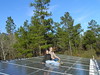


Obviously I like REAP grants, since

we got one for Okra Paradise Farms.

That 25% REAP grant plus an 35% ARRA NREL plus 35% GEFA credits
will add up to 90% covered by grants and tax credits,
which is a pretty good deal.

Now that remaining 10% is still a significant amount;
like the price of a small car.
But in 7-15 years (how long it will take to pay off this system,
depending on how you figure it),
what would




the value of a car be?
Much less than when you bought it.
Meanwhile, these solar panels will be generating almost as much
power as they are now, and they will continue to generate for
at least a decade more, probably much more.

The big missing piece is up-front financing.
Local banks will do it, but only for collateral.
By which they mean real estate.
Nope, they won’t take the solar equipment as collateral,
even though it would still be operational many years from now.

Local banks or credit unions could see this as an opportunity and start accepting solar equipment as collateral.
Beyond that, with a few changes to Georgia law,


to deal with the power utility territoriality clause
,
and maybe to

ban boondoggle charges for more dangerous and less job-producing power sources,

we could get a

commodity market in solar power in this state.

You could put up solar panels like this, or more,
on your house or business roof,
and sell your excess
power to somebody in Atlanta with less roof space.


That would produce widely distributed energy,
reducing need for foreign oil or dirty coal,
lowering your electric bills,
maybe even producing you a profit,
and generating local jobs right here in south Georgia.

Private investment is ready

to come in for utility-scale solar projects.

And companies like

SolarCity

that already do everything from financing to installation
could do that in Georgia.
Or home-grown companies could do that.
Or local banks could finance while local companies installed.

Anyway, we have

here on our workshop roof
a proof of concept,
operational right now, purchased partly via a USDA REAP grant.

-jsq

Can Georgia ban Construction Work in Progress (CWIP)?

Georgia Power

charges its customers
Construction Work in Progress (CWIP)
for the nuclear plants
it is constructing at Plant Vogtle on the Savannah River.
This while
claiming a solar energy commodity market would raise rates for its customers.

If nuclear is so great, why does it need to be pre-funded by customers?
Can Georgia ban CWIP?
Other states have.

This interesting

survey by Wisconsin
, courtesy of


National Association of Regulatory Utility Commissioners (NARUC)
,
says Illinois, Montana, New Hampshire, Ohio, and Oregon
ban CWIP (except in certain cases for some of those states)
and North Carolina and Washington in practice do not use it.

Appended below is the first question from the survey and the answers.
The entire survey is
on the LAKE website.

Here’s
who in the Georgia state government
you can contact about CWIP.

-jsq


CURRENT RETURN ON CWIP

VERSUS AFUDC [Allowance for Funds Used During Construction]

REGULATORY SURVEY RESULTS

March 2006

The Wisconsin
Commission is relooking at its current practice for allowing a
current return on construction work in progress (CWIP). We
would appreciate it if you or someone else from your agency could
respond to the following questions.

Continue reading