Category Archives: Nuclear

Fracking water

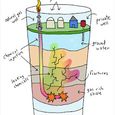
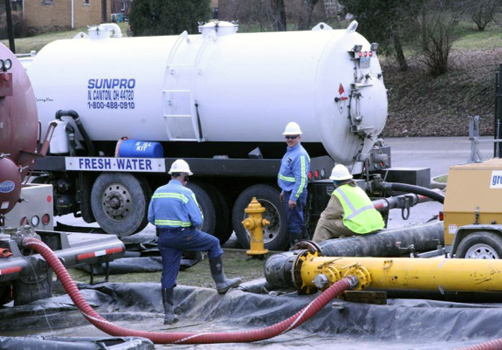
Yet another reason why we should take water into account in
any development plan:
fracking for shale gas
uses huge amounts of water, competing with everything else,
maybe even using more than power plants and cities.

Delaware Riverkeeper and Protecting Our Waters wrote for Waterkeeper Alliance today,

The Water Footprint of Shale Gas Development
,


Recent studies examining potable water supplies on a global scale,
the current trends in American water consumption and the causes of
depletion of this essential resource are helping us to understand
that the footprint of shale gas development expands indefinitely
when measured in water….

Of the seven nations where the groundwater footprint is greatest,
the U.S. is one of the fastest speeding towards disaster. According


to Cynthia Barnett’s Blue Revolution, scientists say the 20th
century was the wettest in a thousand years and now drier times are
ahead.[3] This means that many of the management schemes we use
now—based on 20th C planning—need to be changed to avoid
catastrophe. So the 410 billion gallons of water America uses every
day will suck the nation dry if we don’t stop over-tapping nearly
every river and aquifer.

The biggest U.S. users are power plants and agriculture with private
Continue reading

Germany Added 543 MW of Solar Power Capacity in July

While we in Georgia were still pouring money down that nuclear pit near the
Savannah River, Germany has been getting on with real renewable energy.
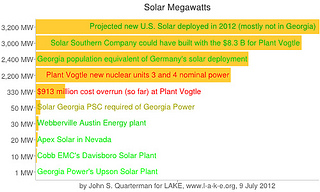
We could have deployed almost that much solar power with just the cost overruns
so far at Plant Vogtle.

Nicholas Brown wrote for Clean Technica 8 September 2012,

Germany Added 543 MW of Solar Power Capacity in July,


According to Matt McDermott of Treehugger: “[In] the first
half of 2012 Germany has installed just over 4.37 gigawatts of
grid-tied solar power. Remarkably just about 1.8 GW of that happened
in June alone (perhaps even more remarkable, this isn’t even a
record amount for one month in Germany).”

The amount of solar power capacity added in June was much more than
July’s, but July’s was still impressive. July’s addition brings
Germany’s total installed capacity for the first half of 2012 to
4,900 MW (4.9 GW).

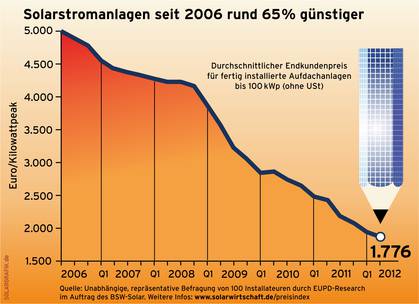
This impressive solar installation rate had a lot to do with Germany’s
famous Feed-in Tariffs (FIT), but it also had a lot to do with
Moore’s Law, illustrated by that graph of cost per kilowatt rapidly
going down.


543 MW?
That’s more than the 330 MW of solar
the $913 million cost overrun at Plant Vogtle in the
first half of 2012 could have bought.
1800 MW in June and 543 MW in July?
That’s 2343 MW, which is more than the entire rated 2200 MW output of Plant Vogtle 3 and 4 put together, if they ever get built.
Sure, the sun doesn’t shine all the time, but in the years until the nukes ever
get built (if ever), how much solar could we deploy at the rate of one Vogtle unit equivalent a month?

Hey, maybe we should cancel Plant Vogtle and deploy solar instead!
Maybe Georgia Power and Southern Company will realize their big bet
has already gone bad.
Or maybe we should elect some Public Service Commissioners and legislators
who will get them to realize it.

-jsq


Change the Atomic Energy Act? How about change the Georgia Electric Territorial Act?

In reaction to

the NRC denying a nuclear permit for Calvert Cliffs,


some nuclear backers suggest

changing the
Atomic Energy Act of 1954 to permit majority foreign ownership
of nuclear reactors.

What will they suggest next?
Asking Iran to invest in U.S. nukes?

Steve Skutnik wrote for http://theenergycollective.com 5 September 2012,

A cost-free way to open up nuclear investment
,

If this seems entirely backward in a world of global production and
investment, that’s because it is. The current regulation is an


artifact of the Atomic Energy Act of 1954, which first authorized
private ownership of nuclear facilities. (Prior to this—per
the Atomic Energy Act of 1946, all nuclear technology was considered
a state secret, during the short time in which the U.S. enjoyed a
monopoly on the technology.)

Is there any real compelling reason for restrictions on foreign
ownership and investment in nuclear facilities to exist at a time
when the U.S. holding a monopoly on the technology has long since
passed? Issues of safety here of course are irrelevant—the
facilities would be licensed and regulated by the NRC, just as any
other nuclear facility is now. About the only salient objection is
the political one—i.e., the implications of a foreign entity
maintaining controlling ownership in key infrastructure. (Although
it’s hard to see anyone getting particularly upset about the
reverse—U.S. entities owning a controlling stake in
infrastructure in other nations.)

Yeah, sure, strict regulation
will deal with that, just like it prevents fracking from setting
drinking water on fire, or BP from poisoning the Gulf.
The new NRC head is

maybe well-meaning
,
but it’s the same NRC

that gave Vogtle 1 a clean bill just before it had to shut down

and the same NRC that’s ignoring

cancer in Shell Bluff.

Oh, by the way, the article gets to the main point eventually:

Continue reading

NRC rejects nuke permit for EDF in Maryland

French nuclear operator Électricité de France (EDF)


was denied a license last week for the proposed Calvert Cliffs

nuclear reactor in Maryland, because the
Atomic Energy Act of 1954 prohibits majority foreign ownership
of nuclear plants.
EDF now has 60 days to find a U.S. partner, or give up the project.
Who could the possible suitors be?
Hint: think southeast.

The handwriting was on the wall two years ago when
Constellation Energy pulled out of the project.
Jim Polson and Alan Katz wrote for Bloomberg 10 October 2010,

Constellation Drops Nuclear Plant, Denting EDF’s U.S. Plans
,

Constellation Energy Group Inc. pulled out of negotiations on a $7.5


billion loan guarantee to build a nuclear reactor in Maryland with
Electricite de France SA, potentially damaging the French utility’s
U.S. expansion plans and the companies’ partnership.

The cost of the U.S. government loan guarantee that the companies’
joint venture, UniStar Nuclear Energy, would need to build the
Calvert Cliffs 3 reactor is too high and creates too much risk for
Constellation, the Baltimore-based utility said in a statement
yesterday. The statement said the next step is up to EDF. Enlarge
image U.S. Deputy Energy Secretary Daniel Poneman

In a letter Oct. 8 to Daniel Poneman, deputy secretary of the U.S.
Department of Energy, Constellation said it received a government
estimate that the venture would have to pay about $880 million to
the U.S. Treasury for the loan guarantee, “dramatically out of
line with both our own independent assessments and of what the
figure should reasonably be.”

Constellation’s decision may make it more likely that the U.S.
utility will exercise a put option forcing EDF to buy as much as $2
billion of Constellation’s non-nuclear power plants, said Ingo
Becker, head of utilities sector research at Kepler Capital Markets.

“EDF very clearly said if they exercise the put, this thing is
over,” Becker said. “Constellation may have just turned
around the calendar and pulled out of the new build before
exercising the put, anticipating EDF’s reaction.”

In a letter Oct. 8 to Daniel Poneman, deputy secretary of the U.S.
Department of Energy, Constellation said it received a government
estimate that the venture would have to pay about $880 million to
the U.S. Treasury for the loan guarantee, “dramatically out of
line with both our own independent assessments and of what the
figure should reasonably be.”

Meanwhile, Southern Company

is still trying to reduce what it has to pay for its
$8.3 billion federal loan guarantee
.

Back in Maryland, the news got worse for the nuke last year.
EDF

asked for the state’s help
,
but didn’t get the answer it wanted.
Scott Dance wrote for Baltimore Business Journal 16 December 2011,

EDF: Constellation-Exelon settlement hurts Maryland nuclear industry
,

Continue reading

New NRC head says agency is standing up for public health and safety

Sounds to me like the NRC is not telling its new chief everything.
For example, what about

Vogtle unit 1 shutting down right after it passed
an NRC review?

What about

cancer in Shell Bluff, Georgia,
near the reactors?


Mike M. Ahlers wrote for CNN 14 August 2012,

New NRC chair vouches for agency’s independence, states goals

Allison Macfarlane said Tuesday she has confidence in the agency and
its independence from the nation’s 104 commercial nuclear power
plants.

“I have some strong initial impressions of the agency, and one is
that I’ve been very impressed with the staff and their dedication to
safety, and their willingness to stand up to industry when they
believe a situation is not safe,” Macfarlane said in a wide-ranging
discussion with reporters.


“So I’m actually quite assured that the agency is completing its
mission of protecting public health and safety,” she said. “They
take safety issues very seriously. They take their role as
regulators very seriously and the public should be assure that they
have the public’s best interests in mind.”


Macfarlane said she hopes to build public confidence in the agency
by improving communication, increasing transparency and making NRC
documents understandable. “Some of them are rather opaque,” she
allowed.

She has said some slightly more impressive things back before
she was appointed.

Continue reading

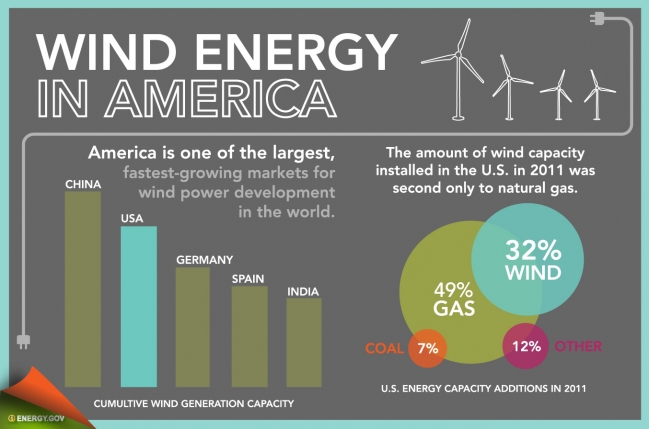
Wind second only to natural gas in 2011 added capacity

Looks like Southern Company (SO) bet on the wrong horse.

David Danielson wrote for DoE 14 August 2012,

A Banner Year for the U.S. Wind Industry
,

The report finds total U.S. wind power capacity grew to 47,000
megawatts by the end of 2011 and has since grown to 50,000
megawatts, enough to power 12 million homes annually — as many
homes as in the entire state of California. And as wind energy
capacity has grown, more and more wind turbines and components like
towers, blades, gears, and generators are “Made in
America.” Nearly 70 percent of all of the equipment installed
at U.S. wind farms last year came from domestic manufacturers,
doubling from 35 percent in 2005.


Why should SO worry? Wind only came in second in added capacity.
Because of this:

In addition to strong gains in domestic wind manufacturing and
capacity, the report finds that as wind technology improves, costs
are coming down. Technological innovations are helping make longer
and lighter wind turbine blades, while improving turbine performance
and increasing the efficiency of power generation. At the same time,
wind project capital and maintenance costs have continued to
decline.

And wind doesn't even have Moore's Law going for it as much as solar does,
plus solar is usable in more areas than wind.
Add wind and solar and why do we need much natural gas?
(Or any coal or nuclear?)

-jsq

Where would Georgia Solar Utilities Inc. get enough land for 80 MW solar generation?


Plant Branch in Georgia

Where will
Georgia Solar Utilities Inc.
get

the 2,200 acres it says it needs to build 80 MW of solar generation?

Well, it’s supposed to be “adjacent to Georgia Power Co’s coal-burning Plant Branch near Milledgeville, Ga.”, so let’s look there.


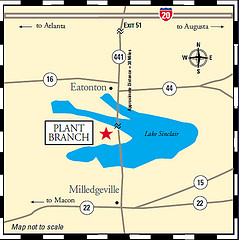
Plant Branch Location Map

A

brochure on Plant Branch by Georgia Power

(undated, but last date mentioned is 1998, so I’m guessing 1999)
says:

Located on 1,900 acres on Lake Sinclair in Putnam County between
Eatonton and Milledgeville, Plant Branch was the first
million-plus-kilowatt electric generating station to operate on the
Georgia Power system. It is named for Harllee Branch Jr., former
chairman of the board of Southern Company and president of Georgia
Power. Construction on the plant began in 1961, and by the summer of
1969,

Coal pouring onto pile

four units were in operation. The 1,539,000 kilowatts
generated by Plant Branch provides enough electrical power for
342,000 households.

And now Plant Branch will be among the first to close coal-generating
units.
According to
Melissa Stiers for GPB News 12 July 2011,

Georgia Power Closing Three Plants
,

Two coal fired units at Plant Branch in Milledgeville will close in
2013. That’s a result of federal regulation tightening air pollution
controls. The company has said it’s too costly to upgrade those
units.


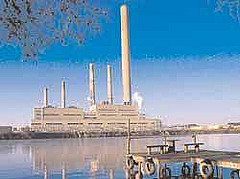
Plant Branch across Lake Sinclair

As we know, Georgia Power’s parent The Southern Company

claimed it was incompetent to deal with the new EPA regulations

even though it had already announced the Plant Branch closures (amounting to about 770 MW),
and later SO announced

4,000 MW of coal plant closures.

While the various news stories keep saying Plant Branch is in Milledgeville,
actually, it’s on the other side of Lake Sinclair, closer to Eatonville,

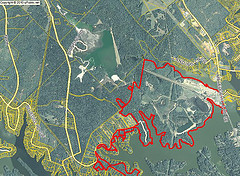
Plant Branch site in Putnam County qpublic map

and in Putnam County.
A quick glance at the

Putnam County Tax Assessor database maps

shows that the land parcel containing Plant Branch
is 913.87 acres, much of which isn’t actually used by the plant.
And Georgia Power owns a total of more than 3,000 acres adjacent
to that site.
So I’m guessing the 2,200 acres figure is simply around 3,100 total
Georgia Power acres minus 913 acres for the present Plant Branch site.

Estimates for land needed for a megawatt of solar power generation range

Continue reading

Company to build 90 MW solar and become a utility

What to do if you can’t interest Georgia Power in building solar?
Do it yourself, and do enough so you can be a utility yourself.
That’s the loophole in the 1973

Electric Territorial Act

that FPL and JEA use to burn coal at Plant Scherer in Georgia and export the power to Florida.
Now Georgia Solar Utilities Inc. is using the loophole for a better purpose:
building almost twice as much solar generation
as Georgia Power’s meager 50 MW.


Georgia Solar Utilities

Dave Williams wrote for the Atlanta Business Chronicle yesterday

New Georgia utility pitches solar plant:
A new utility is planning to build a $320 million solar power plant on 2,200 acres adjacent to Georgia Power Co’s coal-burning Plant Branch near Milledgeville, Ga.

Georgia Solar Utilities Inc. initially approached Georgia Power, a
unit of Southern Co. (NYSE: SO), with a proposal to build the plant
and sell it to Georgia Power through a power-purchasing agreement.

Georgia Power is retiring two coal-fired units at Plant Branch, part
of a move to reduce the Atlanta-based utility’s reliance on coal.

But when Georgia Power officials declined to take part in the
project last May, Georgia Solar Utilities executives decided to
build the plant on their own and operate it as a new utility
independent of Georgia Power.

Once cost prohibitive, solar energy has become competitive with
fossil fuels because of the rising costs of coal and tighter
government regulation of coal emissions, said Robert Green, founder
of Georgia Solar Utilities.

“When you don’t have to buy coal or worry about environmental
hangovers, it overwhelms the costs of fossil fuels, Green said
Thursday after presenting the proposal to the Georgia Public Service
Commission’s Energy Committee.

Some say the PSC can’t approve such a utility because of that 1973 law.
I suspect that if they don’t approve this proposal, the next one
will be even harder to turn down, and the next one,
as they become even more competitive.

How competitive?

Continue reading

Nuclear plant shut for two weeks in Connecticut due to heat

Ever heard of solar panels or windmills shutting down due to heat?
Me, neither.
Nuclear plants, yes, such as Millstone unit 2 in Connecticut,
closed for two weeks.

AP wrote today,

Conn. nuclear plant unit reopens with cooler water

Connecticut's nuclear power plant has returned to full service


nearly two weeks after one of its two units was forced to shut down
because seawater used to cool it down was too warm.


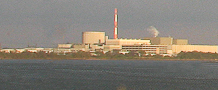
Millstone Power Station
spokesman Ken Holt said Monday that Unit 2
returned to 100 percent power Saturday. It shuttered Aug. 12 after
record heat in July contributed to overheated water from Long Island
Sound.

Water is used to cool key components of the plant and is discharged
back into the sound. The water's temperature was averaging 1.7
degrees above the 75-degree limit.

The temperature has since dropped to 72 degrees, Holt said.

"The water temperature cooled sufficiently to support operations and
that, combined with the weather forecast, has given us the
confidence to restart," he said.

Wait, wasn't the whole point of big distributed baseload power plants
supposed to be reliable dependable power?

Millstone provides half of all power in Connecticut and 12 percent
in New England.

Some scientists believe the partial Millstone shutdown was the first
involving a nuclear plant pulling water from an open body of water.
A few nuclear plants that draw water from inland sources have
powered down because of excessively warm water.

Time to think again!
Distributed solar and wind power doesn't have this problem,
and a smart grid can get their power where it's needed.

-jsq

PSC rubberstamps Vogtle costs; next day Fitch affirms Southern Company ratings

Need any more proof that Southern Company’s nuclear boondoggle
only works with Georgia Power customer and taxpayer subsidy?
PSC rubberstamps one day and Fitch affirms ratings the next day.
Maybe we should elect Public Service Commissioners who will
serve the public.

Georgia Power PR 21 August 2012,

Georgia PSC approves Vogtle construction costs


The Georgia Public Service Commission (PSC) today in a 5-0 vote
approved Georgia Power’s spending on Plant Vogtle units 3 and 4 for
the period including July 1, 2011 through Dec. 31, 2011.

The next day, Fitch PR 23 August 2012,

Fitch Affirms Ratings for Southern Company and Subsidiaries
,

Continue reading