Tag Archives: Economy

SO’s plan to make the Southeast a net exporter of the energy from solar and wind? –John S. Quarterman @ SO 2013-05-22

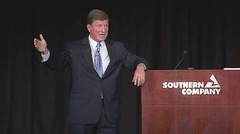
SO CEO Tom Fanning didn’t budge from nuclear and coal,
but he did announce a tiger team to get on top of
distributed solar and wind through a smart grid,
headed by SO’s COO,
at the

22 May 2013 Southern Company Stockholder Meeting
.


Next question --Tom Fanning

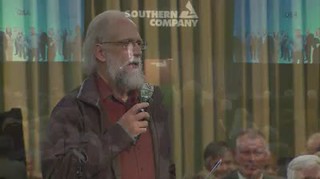
Mr. John S. Quarterman from Lowndes County, Georgia, and he holds
220 shares of Southern Company.

TF: Hello, John. Good to see you again this year.


jsq with SO fade

jsq: Hi. I’ve come to compliment Tom Fanning and Paul Bowers. Last
year, Tom Fanning was so persuasive I ran out and bought $10,000
worth of stock.

TF: Bless you.
[Applause]

However,
apparently because of

SO’s admission a few minutes before in that same meeting

that it was going to have to eat Kemper Coal cost overruns,
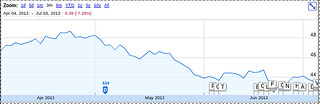


SO stock tanked that same day
,
causing my stock to stop out,
and Standard & Poor’s downgraded SO the following day
because of Kemper Coal, noting that if the same thing happened
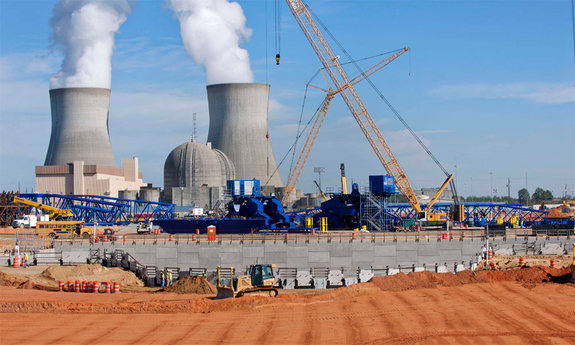
with SO’s nuclear project at Plant Vogtle, S&P’s would probably Continue reading
Re-evaluate Plant Vogtle and move to wind and solar power –Courtney Hanson @ GA PSC 2013-06-18

Re-evaluate Plant Vogtle, especially its water use,
and move to efficiency, wind, and solar power instead,
said


Courtney Hanson of
Georgia Women’s Action for New Directions (GA WAND)
at

the Georgia Public Service Commission meeting Tuesday 18 June 2013
.

She reminded GA PSC Plant Vogtle 3 and 4 are late and over budget, and then:

I want to add my voice to the chorus of folks here who are concerned
about water issues.


We know that Vogtle 3 and 4 will require an additional withdrawal
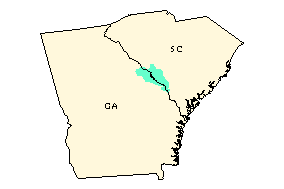
of as much as 74 million gallons a day from the Savannah River and
most of that water will not be returned.
We know that the central Savannah River
area where Vogtle is located is already
very prone to droughts
and the plant has been close to shutting down several times
due to drought conditions.


Georgia is also already struggling to supply enough water
for our homes, businesses, industries, and farms.

In addition, the Savannah River is Continue reading

It is not enough to add a little solar and wind on top of fossil and fission fuels –a German @ GA PSC 2013-06-18

A German national residing in Georgia
asked for a serious effort on energy efficiency and conservation
while switching to real renewable energy sources instead of
fossil fuels and nuclear,
at

the Georgia Public Service Commission meeting Tuesday 18 June 2013
.

She said increasing fires and floods were part of climate change,
and we need to do something about it.


I always hear this phrase “growing energy demand” as if it’s something,
some matter of fact.
A growing economy means growing energy demand, and that means
consequently growing waste, growing pollution, growing inequity,
and so on.
Any thinking person should notice that we need to find a way out.
For anyone concerned about our future, business as usual is
no longer acceptable.
We need drastic changes in our energy supply.
We need to use less.


Only a month earlier, Tom Fanning, CEO of Georgia Power’s
parent company Southern Company

reemphasized yet again that

To us, growing the economy is how we’re going to make profit.

Yet GA PSC could do something about that antique attitude,
as this speaker pointed out: Continue reading

More solar, less nuke cost overruns –Glenn Carroll @ GA PSC 2013-06-18

Glenn Carroll of Nuclear Watch South asked GA PSC
to raise the 2 MW solar cap and to get Georgia Power
to build solar in Georgia rather than in distant states,
plus efficiency and conservation,
at

the Georgia Public Service Commission meeting Tuesday 18 June 2013
.

She
said
they’d gotten a lot of national attention on Plant Vogtle,
which was having a legendary bad year, in procurement,
costs, etc.
She praised Sierra Club, Georgia Watch,
and Southern Alliance for Clean Energy (SACE)
for intervening in Georgia Power’s IRP.


The world has changed really really fast and Georgia Power
is being isolated.
It is protected financially of course because of the small business
and residential customers that are covering all of the risks that
they are taking.
We want solar power here, not Arizona and New Mexico.

She recommended conservation and efficiency programs at
Port Angeles, presumably

the one in Washington State
.

Here’s

the video:

Continue reading

Increased investment in demand-side reduction –a homebuilder @ GA PSC 2013-06-18

Paul[?] Matthews said he’s been green since before it was cool,
first in an earlier Georgia Power program (EarthCraft), and now in EarthCents.
He thinks the program is good, with both environmental and
economic benefits, but he asked for it to be extended to become
a model for the south,
at

the Georgia Public Service Commission meeting Tuesday 18 June 2013
.


He spoke about his company’s investment in sustainable
efficiency and conservation, and asked GA PSC and Georgia Power
to also do more.

A much more efficient way and cost-effective of reducing power is by
reducing energy used. We’re not only looking at tripling the savings
over the next ten years, but we’re also looking at job growth….

…a sustainable and long-term growth approach.

Let’s make the rebates and also the tax credits so they’re a model
for Georgia and also for the south.

Here’s

the video:

Continue reading

EarthCents has taken a lot of power bill mystery away –a contractor @ GA PSC 2013-06-18

A contractor who does homeowner education as part of Georgia Power’s
Earth Cents program praised that program
at

the Georgia Public Service Commission meeting Tuesday 18 June 2013
.


He said homeowners tend to complain about power bills:

And this Earth Cents program has, in my experience, taken a lot of that
mystery away.
The homeowners that I touch and I deal with come away with an understanding
that leaves them less concerned about the rate hikes that I’m sure
keep you guys up at night when it comes to a vote and more concerned
about where the money is actually going.

I’m guessing he means homeowners are more concerned about what
Georgia Power is using to generate the power.


Earth Cents, according to Southern Company
:

Introduced in 2008, EarthCents energy efficiency programs help our
customers save energy and money while reducing greenhouse gases.
EarthCents comprises a set of standing and new programs—and
educational efforts—to reduce residential and commercial
electricity consumption.

Here’s

the video:

Continue reading

Very restrictive definition of energy efficiency by Georgia Power and SO

Beware that when

Southern Company claims it’s doing a lot about energy efficiency

it is, but SO is using it’s own definition that is much more
restrictive than it could be.


SACE wrote 26 February 2013,

Southern Company: Squirreling the Energy Efficiency Debate

Southern Company has a solid track record of squirreling the
definition of energy efficiency to avoid debate. And Southern
Company has good reason to avoid the debate: Its utilities
consistently advocate what is considered by national experts to be
the “most restrictive” approach to designing energy
efficiency programs.

Just how restrictive, you ask? Continue reading

Does SO have a business model for energy conservation? –Dan Everett @ SO 2013-05-22

SO has done a lot about energy efficiency, but can it do more,
and how will it profit by doing so?
Prof. Dan Everett asked this
at the

22 May 2013 Southern Company Stockholder Meeting
.


Prof. Dan Everett speaking

I have Mr. Dan Everett from Athens, Georgia, and he holds 11 shares of
Southern Company.

TF: Talked to Dan earlier today. Dan is a professor at the University of
Georgia, right?

DE: Right.


Dan Everett striding to the microphone

He’s
Daniel M. Everett,
Assistant Professor of Computer Science
, UGA Athens.
The SO Annual Stockholders Meeting apparently doesn’t get many professors.

TF: Fantastic. Well, welcome.

DE: Oh, thank you very much. And as a guy who has some professional
interest in this stuff, I totally applaud the research that y’all
are doing on energy technologies and renewable
energies and efficiency technologies because it does take a while to
deploy those.

My specific question is about energy conservation.
I’ve noticed Continue reading

Portland’s Clean Economy of Place

Ironically,
Portland is the prime example in both

Amy Liu’s slides
and
the book


The Metropolitan Revolution:
How Cities and Metros Are Fixing Our Broken Politics and Fragile Economy

by Jennifer Bradley and Bruce Katz.

Here’s Bruce Katz in the Guardian 23 April 2012,

Urbanization and Inventing a Clean Economy of Place
,


Portland, Oregon, is also internationally renowned for its
commitment to sustainable development. The Portland metropolis has
an expansive public transit system and an urban growth boundary to
control development at the urban periphery. The city boasts a

green investment fund

to provide grants for residential and commercial building projects.

Now the city is striving, like Copenhagen, to reap the economic
rewards of sustainable development through business formation, firm
expansion, job growth and private investment. In February, Portland
released its first regional export plan to double exports over five
years by building on the region’s distinctive economic and physical
attributes. A critical pillar of this strategy involves increasing
the export orientation of firms in the burgeoning clean technology
sector to serve growing markets in Asia, Latin America and
elsewhere.

Hm, a clean economy of place; there’s an idea.
Here’s one of Portland’s green investments:

12W (Indigo) Project Report
, Continue reading

Lowndes County takes no responsibility for the pipeline –Bill Slaughter @ LCC 2013-06-25


You’re on your own if that pipeline company wants your property;
the county government chooses to stay completely out of it,
so said Lowndes County Chairman Bill Slaughter
at

the 25 June Regular Session of the Lowndes County Commission
.


He read a prepared statement about a proposed natural gas pipeline.
Why the county couldn’t put it on their
website as a press release is mysterious.
I’ve added the links:

Lowndes County has been
contacted by representatives of

McKenna, Long, Aldridge law firm

of Atlanta
regarding a proposed project expected to impact property owners
of Lowndes County.


Spectra Energy Company
and its subsidiary,

Sabal Trail Transmissions LLC
anticipates construction
of a 465 mile interstate natural gas pipeline from Anniston, Alabama
extending through Georgia and coming through Lowndes County,
terminating in Orlando, Florida.

This project is for the benefit of and is the responsibility of
Florida Power and Light.
Lowndes County has been Continue reading