Category Archives: Nuclear

Former Japanese PM Koizumi calls for zero nukes

Current PM Shinzo Abe was his chosen successor, and now
Junichiro Koizumi (prime minister 2001-2006) calls on Abe
to end nukes in Japan. Why?
“A large majority of the population now
understands that nuclear energy is the most expensive form of power
generation.”
For sure here in Georgia,

with Georgia Power charging through the nose for power customers aren’t
even receiving

while

trying to hike the price of solar power, too
.
Let’s end Plant Vogtle and get on with renewable solar inland and wind off the coast.

Wolf Richter wrote for Zerohedge 4 October 2013,

The End Of Nuclear Energy In Japan?


And on August 26, his words made it into the Mainichi Shimbun. If he
were an active politician, he’d want “to convince lawmakers to
move in the direction of zero nuclear plants,” he said. Now
would be the ideal time to move that direction. All 50 nuclear
reactors were off line. All opposition parties favored zero nuclear
power. It could be done “as long as the prime minister made
the decision” — putting the onus squarely on his former
protégé. And nuclear politics in Japan haven’t been the same
since.

The next blast came on September 24 at a forum in Tokyo. He talked
about his trip to Finland in August. The purpose was to inspect the
Onkalo spent-fuel repository. He was accompanied by Continue reading

Jellyfish 1 Nuke 0


One of the world’s largest nuclear reactors was shut down Sunday by jellyfish.
Not a tsunami, not an earthquake, not a blizzard, not even hot water: jellyfish.
And it’s not the first time or the first reactor.
Tell me again how reliable centralized baseload power is?

AP reported yesterday,

Jellyfish force nuclear plant shutdown in Sweden:
Tonnes of jellyfish clog pipes that bring in cool water to the plant’s turbines


Operators of the Oskarshamn nuclear plant in southeastern Sweden had
to scramble reactor number three on Sunday after tonnes of jellyfish
clogged the pipes that bring in cool water to the plant’s turbines.

By Tuesday, the pipes had been cleaned of the jellyfish and
engineers were preparing to restart the reactor, which at 1,400
megawatts of output is the largest boiling-water reactor in the
world, said Anders Osterberg, a spokesman for OKG, the plant
operator.

All three Continue reading

Which first to get more solar: fight big money or new technology?

In Georgia we’re still below 1% electric power generation from solar,
and we can get to 20-30% with no new technology whatever.


Georgia Power’s nuke overruns are

already causing a reaction of still more distributed solar
.
Yet even that good news gets the usual reaction:
“This is necessary but not sufficient: a breakthrough in energy storage technology is required.”
Which just ain’t so;
distributed rooftop solar alone is plenty to move Georgia way ahead.
That’s why

Edison Electric Institute calls distributed solar

a massively disruptive influence on the utilities’
century-old cozy baseload model.
What’s holding solar back is those same big utilities, who understandably
don’t want to change their long-time cash cow.
But they’re going to change, and pretty quickly.

People unfamiliar with the sunny south (which is most of the world
south of, oh, Germany), still say things like this: Continue reading

Nuke overruns already causing distributed solar in south Georgia

People are tired of

irresponsible trash government
at the state level
colluding with monopoly utilities to hold Georgia back in distributed
solar power, and some of us are doing something about it;
you can, too.


Jigar Shah
wrote for SaportReport 15 September 2013

Solar more viable as Georgia’s new nuclear power plants face overruns
,

I am seeing Georgia’s nuclear financial woes starting to prompt a
boon for distributed energy including solar, wind, biomass,
geothermal, low-impact hydro, high efficiency cogeneration, and
other sources of electricity.

Biomass?

Let’s not go back to that carbon-polluting forest-destroying factory-exploding waste of time and resources
.
Solar, wind, efficiency, and conservation are the main events, with solar increasingly leading the pack.
And those nuke cost overruns are already driving solar up even faster: Continue reading

Japan or south Georgia?

How is our local landfill like Fukushima?
No, not radiation: nobody seems to be responsible.

Colin P. A. Jones wrote for The Japan Times 16 September 2013,

Fukushima and the right to responsible government
,


Rather, the means of holding a member responsible for bad judgments
are internalized as part of the rules and discipline governing the
hierarchy to which they belong, with mechanisms for outsiders to
assert responsibility — to assert rights — being
minimized and neutralized whenever possible.

Sure, it’s not exactly the same.
Our local governments live in fear they’ll get sued (or so they claim),
and even sheriffs and judges occasionally get convicted around here.
But it’s quite difficult to get local elected officials to take their responsibility to the
people as seriously as “we’ve invested too much in that to stop now”
where “we” means the local government or more frequently a developer.

And privatizing the landfills and

now trash collection
is not that
dissimilar to the Japanese government keeping TEPCO afloat so they
have an unaccountable scapegoat for Fukushima.
Locally, nobody seems to even know, much less care, that the landfill
is Continue reading

Plant Scherer country’s dirtiest again!


Southern Company #1 and #2!
We get most of our electricity from #1 coal Plant Scherer
near Macon, and 1/4 of its power goes to Florida, dirtying our air.
SO says it’s worst only because it’s one of the biggest.
But it still emits more greenhouse gases than any other power plant
in the country.
#2 is only about twice as far away, and it’s also Southern Company.

Kate Sheppard wrote for Huffpost 10 September 2013,

Biggest Polluters In U.S. Ranked By Greenhouse Gas Emissions In New Report
,

The top five individual plants were:

  1. Georgia Power Company’s Plant Scherer

  2. Alabama Power Company’s James H. Miller Jr. Plant

  3. Luminant Generation Company’s Martin Lake Plant in Texas

  4. Union Electric Company’s Labadie Plant in Missouri

  5. NRG Texas Power’s W.A. Parish Plant

These power plants, said Julian Boggs, Environment America’s global warming program director, “are the elephant in the room when it comes to global warming.”

The report,

America’s Dirtiest Power Plants
,
by Environment America,
says (page 5) Plant Scherer alone produces 0.4% of all U.S. CO2 emissions
and 0.1% of all the world’s. Plant Miller emits almost as much, so that’s 0.8% of U.S. and 0.2% of world CO2
emissions from just the top 2 Southern Company coal plants.

How about we insist Georgia Power and Southern Company get on with solar
power inland and wind off the coast to replace all those coal plants and
the water-sucking nukes, too?

-jsq

GA PSC abdicates cost oversight for new nukes at Plant Vogtle

Finish it and then send we the taxpayers and ratepayers a bill?
What kind of deal is that?
So Southern Company already
dodged a Fitch downgrade by delaying
a decision, and now GA PSC wants to put it off for years more.
That also delays solar deployment in Georgia, putting us still farther behind.

Ray Henry wrote for AP yesterday,

Ga. approves deal on nuclear plant costs
,


A debate over the rising cost of building a nuclear power plant in
Georgia will be delayed for years under an agreement approved
Tuesday by Georgia’s utility regulators.

The elected members of Georgia’s Public Service Commission
unanimously approved a deal that will put off a decision on whether
Georgia Power can raise its budget for building two more nuclear
reactors at Plant Vogtle (VOH’-gohl) until the first of those
reactors is finished. An independent state monitor has estimated the
first reactor will be finished in January 2018 at the earliest.

Regulators will continue monitoring company spending but will not
make a decision on raising the bottom line budget figure.

So GA PSC will keep watching costs run over budget but will do nothing
about it.

Oh, wait, it’s actually worse: Continue reading

Trust the radiation-lying document-forging nuclear industry to build new nukes?

TEPCO

that lied about deadly levels of radiation at Fukushima


is part of the industry

Southern Company CEO Tom Fanning brags about

as producing

“nuclear power as a clean, safe, affordable solution for this
world’s energy future”.

SO and Georgia Power are building two new nukes at Plant Vogtle on the
Savannah River, including

parts by Korea’s document-forging Doosan
.
Forging as in lying, as in what the Korean press is now calling

the Korean nuclear mafia
of power companies, vendors, and testers.
Stateside
U.S. NRC
is refusing to supply Congress with safety documents
.
And when I asked NRC if they were going to take account of Doosan
in their

webinar about foreign ownership of U.S. nuclear reactors

NRC staff told me Vogtle was an unbuilt reactor and they were only dealing
with existing power reactors.
Which is very strange, considering their Commission Direction
explicitly refers to unbuilt and not-even-permitted Calvert Cliffs 3
in its subject.


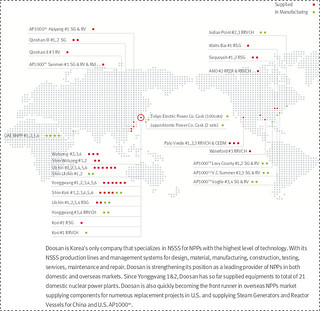
And considering Doosan’s online map of its customers includes
not only six not built yet,

Vogtle 3,4, Summer 2,3
,
Duke Energy’s Levy County 1,2 (since

cancelled
),
but also nine operating nuclear power reactors,
Entergy’s

Waterford 3
(west of New Orleans; remember the dark Super Bowl?),
TVA’s

Sequoyah 1
and 2 near Chattanooga and

Watts Bar 1
near Knoxville
(all
within 500 miles of here
) plus
Entergy’s
Indian Point 2
and 3 near New York City and
Arizona Public Service’s

Palo Verde 1,2,3
near Phoenix, Arizona.
With Vogtle 2 and 3, that’s fifteen reactors in the U.S.
supplied by document-forging Doosan.
OK, 13 now that

Levy County 1 and 2
won’t be built.

How about we say the same soon about Vogtle 3 and 4?
That they won’t be built?
Probably Georgia Power CEO Paul Bowers could say that.
GA PSC, Georgia legislature, or SO CEO Tom Fanning could say that.
We’re listening.

-jsq

TEPCO lied about Fukushima radiation: it’s 18 times worse

Officer, I wasn’t speeding, I pegged my speedometer at 50,
nevermind all those people I ran over!
Like TEPCO using radiation detectors that maxed out much lower than
the actual levels.
Is this an industry we want building new nukes in Georgia?

Mike Adams wrote for NaturalNews.com 1 September 2013,

TEPCO admits deliberately using radiation detectors that give deceptively low readings; radiation leaks far worse than reported
,


We also know from news reports in 2011 that TEPCO ran around the
Fukushima facility turning off the radiation detectors to prevent
alarms from going off. Radiation? What radiation?

And now we find out the company has been deliberately using
radiation detectors that max out at just 100 mSv.

That’s right, as
BBC reported 1 September 2013
, Continue reading

Japanese government forced to take over Fukushima nuclear crisis

This is not the type of “crisis” or “leak” that ends quickly even with the Japanese government now taking over from TEPCO:
radioactive water has been seeping into groundwater and the Pacific
Ocean for two years, many of those tanks
holding radioactive water,

built with rubber seams only meant to last five years
,
are leaking,
and the containment wall next to the ocean is making groundwater rise behind it,

spreading into the aquifer
and spilling over it into the ocean,
with

every tuna caught off California bearing radioactive signatures from Fukushima
.
The radioactive uranium cores are somewhere in

or under

their containment buildings, with no known way to extract them,
still requiring cooling water poured over them for some unknown number of years,
and continuing to be radioactive for thousands of years.
Remember, the Fukushima reactors are the same GE Mark I model as Plant Hatch
on the Altamaha River.

Why are we building more nuclear reactors in Georgia
when

ten U.S. nukes have been cancelled or will never be built in the past year
?

Google already installed on time and on budget

almost as much solar and wind as both new Plant Vogtle
nukes would produce and for less than what has already been spent on them,
plus solar panels and wind farms don’t leak radioactivity.


Photograph by Kyodo/Reuters


Latest Radioactive Leak at Fukushima: How Is It Different?
by Patrick J. Kiger
for National Geographic 21 August 2013,

The water from the leaking tank is so heavily contaminated with
strontium-90, cesium-137, and other radioactive substances that a
person standing less than two feet away would receive, in an hour’s
time, a radiation dose equivalent to five times the acceptable
exposure for nuclear workers, Reuters reported. Within ten hours,
the exposed person would develop radiation sickness, with symptoms
such as nausea and a drop in white blood cells.

Mari Yamaguchi wrote for AP 28 August 2013,

Fukushima Leak Upgraded To Level 3 Severity
, Continue reading