Category Archives: Incarceration

Jailing Too Many People Costs Too Much

John Schmitt, Kris Warner, and Sarika Gupta write about The High Budgetary Cost of Incarceration:
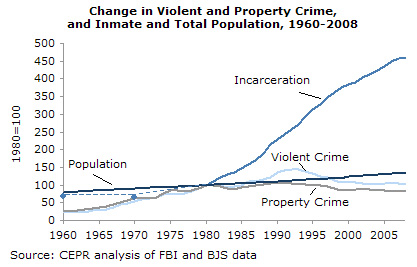
The United States currently incarcerates a higher share of its population than any other country in the world. We calculate that a reduction in incarceration rates just to the level we had in 1993 (which was already high by historical standards) would lower correctional expenditures by $16.9 billion per year, with the large majority of these savings accruing to financially squeezed state and local governments. As a group, state governments could save $7.6 billion, while local governments could save $7.2 billion.

These cost savings could be realized through a reduction by one-half in the incarceration rate of exclusively non-violent offenders, who now make up over 60 percent of the prison and jail population.

A review of the extensive research on incarceration and crime suggests that these savings could be achieved without any appreciable deterioration in public safety.

There’s a 19 page PDF report published by the Center for Economic and Policy Research, but that one graph pretty much spells it out: incarceration went up abruptly starting in the early 1980s and continued up, while crime did not. What we have here is a very expensive policy mistake.

And where does most of the cost come from? Continue reading

Cost of Incarceration in Lowndes County

I don’t know what we pay in local or state taxes to lock people up in Lowndes County, Georgia, although probably it’s in line with the high cost of incarceration in Georgia. I do know there are a lot of indirect costs, including this one:
Prisoners have to be released from prison or the county jail into the same community, and can’t get a job because they’re ex-cons, and often not even an apartment. Result? Homeless ex-cons turning to crime.
Female ex-cons in Lowndes County have some places they can turn to for housing. Male ex-cons have only the Salvation Army, and they have to leave there every morning early. In Atlanta they’ve examined their situation and determined that housing is the most central issue.

Which would we rather do? Pay as much per year to send them back to jail as it would cost to send them to college? Or find a way to provide housing for them?

How about helping ex-prisoners learn job-hunting skills and job-holding skills? Employment is the best preventative for crime. There are local organizations ready to work on that, such as CHANCE: Changing Homes and Neighborhoods, Challenging Everyone.

Local tax dollars need to be spent in a way that benefits the entire community, and not just a few. Maybe we can afford to do something about getting ex-prisoners a place to live and jobs so they stay out of crime and improve the local economy. Actually, can we afford not to do that to reduce incarceration expenditures?

Cost of Incarceration in Georgia

Carrie Teegardin and Bill Rankin
write in the AJC about A billion-dollar burden or justice? AJC investigation: Georgia leads nation in criminal punishment:
Georgia taxpayers spend $1 billion a year locking up so many criminal offenders that the state has the fourth-highest incarceration rate in the nation. When it comes to overall criminal punishment, no state outdoes Georgia.
They note that scare tactics made that happen.
But today, many public figures with strong anti-crime credentials are asking if that expenditure is smart, or even if it’s making Georgians safer. The debate about crime and punishment, once clearly divided along party lines, is now a debate in which conservatives often lead the charge for change.
Continue reading

Drug War Goals Not Met

Geoffrey Alderman writes in the Guardian about What next – penalising students for taking caffeine?
For the past 90 years this debate has been dominated by the professional purveyors of moral panic in our society – a toxic combination of politicians, pressmen, prelates and policemen, aided and abetted by ill-informed parents, who have sought to pre-empt any serious discussion of “psychoactive” substances.
That’s in the U.K.

Meanwhile, AP IMPACT: US drug war has met none of its goals: Continue reading

Biomass Air Quality Hearing Set

This appears to be the date and location for the Georgia EPD air quality hearing for the Wiregrass Biomass plant proposed for Valdosta:
6:30 PM, 27 April 2010
Multipurpose Room
Valdosta City Hall Annex
300 North Lee Street
Valdosta, Georgia
We’ve been waiting on this date for a while. EPD is going to send a press release to the VDT a few weeks in advance and post it on its own website, www.georgiaair.org. Assuming, of course, that the date and place don’t change again.

Why should you care? This plant proposes to burn sewage sludge, which can release numerous hazardous chemicals into the air. Here is Seth’s letter to the editor of the VDT of 21 Feb 2010: Continue reading

Prison population decline due to recession

FacingSouth reports on TURNING THE LOCK-EM-UP TIDE: State prison populations decline for first time since 1972:
Locking people up in jails and prisons is expensive. State officials know this all too well: In a country that puts more people behind bars than any other — the U.S. has less than 5% of the world’s population, but 25% of its prisoners — over 91% of the incarcerated are under state or local supervision.

The lock-’em-up approach to criminal justice that took off in the 1980s and ’90s may have helped a few political careers, but it has crushed state budgets: By 2008, states were spending over $50 billion a year on incarceration.

What else can you do?

But as Facing South has been reporting (see here and here), the Great Recession helped change that, pushing states to explore less expensive (and often more effective) options like alternative sentences for non-violent offenders and streamlining probation and parole.

Today, the Pew Center has released a report showing the shift in approach is bearing fruit: For the first time in 38 years, state prison populations are in decline.

Georgia, on the other hand, increased its prison population by 1.6%. Maybe instead of making massive cuts in education, Georgia could do something about the prison problem.

CHANCE: Changing Homes and Neighborhoods, Challenging Everyone

Many people have talked about the recidivism problem, but here’s a group trying to do something about it. Helping people right out of jail to learn how to get a job, convincing employers to hire them, mentoring them longterm with life coaches, lawyers, and accountants, and with some helping them start their own businesses and employ others. Jimmy Boyd is the principal organizer, and Steve Johnson is the outreach coordinator. They have some more people already signed up in a core team, and are looking for additional people, not to mention grants.

CHANCE had an organizational meeting 7 Jan 2010 at Floyd Rose’s Serenity Church. Here’s a playlist.


Videos by Gretchen Quarterman for LAKE.

Help give some people a needed push? Take responsibility and help solve a problem what will reduce crime by increasing employment? Here’s a chance to do that.

Prison Population on Decline in U.S.

The Associated Press reported 20 Dec 2009 that U.S. prison population headed for first decline in decades. Why?
…the economic crisis forced states to reconsider who they put behind bars and how long they keep them there, said Kim English, research director for the Colorado Division of Criminal Justice.

In Texas, parole rates were once among the lowest in the nation, with as few as 15% of inmates being granted release as recently as five years ago. Now, the parole rate is more than 30% after Texas began identifying low-risk candidates for parole.

In Mississippi, a truth-in-sentencing law required drug offenders to serve 85% of their sentences. That’s been reduced to less than 25%.

California’s budget problems are expected to result in the release of 37,000 inmates in the next two years. The state also is under a federal court order to shed 40,000 inmates because its prisons are so overcrowded that they are no longer constitutional, Austin said.

Some states even try not to lock up as many people in the first place:

States also are looking at ways to keep people from ever entering prison. A nationwide system of drug courts takes first-time felony offenders caught with less than a gram of illegal drugs and sets up a monitoring team to help with case management and therapy.

Studies have touted significant savings with drug courts, saying they cost 10% to 30% less than it costs to send someone to prison.

“I don’t think they work — I know so,” said Judge John Creuzot, a state district judge in Dallas.

Maybe Georgia could stop locking up so many people for drug and other minor offenses, not keep them in as long, and do something to integrate them back into the community instead of locking them up again.

How to Reduce Recidivism

Sometimes Atlanta has data which can be applied to the rest of Georgia. An Emory University press release of 26 Mar 2009 says Study Focuses on Barriers to Successful Prisoner Re-Entry Into Atlanta Communities:
Gaining employment was hindered by multiple obstacles: In addition to low levels of education and work experience, and the reluctance of employers to hire someone who has served time in prison, they also lacked the personal networks to help them identify and secure jobs. Those findings echoed the experiences of government and community-based reentry service providers.

However, “housing was identified as the most central issue and need people faced immediately upon their return or move to Atlanta,” said Owens. “For those released from prison without obtaining a guaranteed bed at a transitional house or shelter, and possessing only their $25 in ‘gate money,’ finding a place to stay that was secure, decent and accessible was often impossible.”

So it’s a difficult problem, but the first step is obvious.

And there’s a basic reason for doing something:

“In many ways, the success or recidivism of former inmates has a tremendous impact on the communities where they settle, but given the stigma attached, it hasn’t exactly been a cause championed by many. But, positive reentry is a necessity, not an option, when it comes to public safety, preserving families and the development and stability of neighborhoods,” said assistant professor of political science Michael Leo Owens, coauthor of the study “Prisoner Reentry in Atlanta: Understanding the Challenges of Transition from Prison to Community.” View the prisoner reentry study (PDF).
Helping prisoners re-enter the community reduces crime and increases employment, so it would seem like something everyone would want.

Prisoner Re-Entry

Prisoners have to be released from prison or the county jail into the same community, and can’t get a job because they’re ex-cons, and often not even an apartment. Result? Homeless ex-cons turning to crime. A New York Times editorial suggests Smart Answers to Recidivism:
Faced with soaring prison costs, states are finally focusing on policies that would help former prisoners stay out of jail after they are released. Some legislatures are reshaping laws that land parolees back inside for technical violations that should be dealt with on the outside. More than a dozen cities and counties have taken steps that make it easier for qualified ex-offenders to land government jobs, except in education and law enforcement and other sensitive areas from which people with convictions are normally barred by law.

Still, the nation as a whole needs to do much more about laws that marginalize former offenders — and often drive them back to jail — by denying them voting rights, parental rights, drivers licenses and access to public housing, welfare and food stamps, even in cases where they have led blameless lives after prison.

The specific example they consider is New Jersey, but Texas has also led in throwing people into jail and now is starting to try to do something about ex-prisoners once they get out. Paying as much per prisoner as would cost to send them to college, in a time of chronic budget shortfalls, is not very attractive. Georgia could also make changes to reduce recidivism, and reduce its prison population.