Tag Archives: Elections

Wall Street’s next big thing: privatizing public education

What’s really behind the charter school amendment referendum? Corporate greed.

Jeff Faux wrote for AlterNet 15 October 2012, Education Profiteering: Wall Street’s Next Big Thing? Wall Street’s involvement in the charter school movement is presented as an act of philanthropy, but it’s really about greed. He reviews some of the evidence that charter schools don’t improve education, especially when forced on states. Then he gets into why so much money is flowing into charter schools anyway.

Education privatization would not, per se, create a net new stimulus Wall Street greed for the economy. But by diverting large existing flows of money from the public to the private sector it would create new profit-making ventures that could be capitalized and transformed into stocks, derivatives and leveraged securities. The pot has been sweetened by a 39 percent federal tax credit for financing charter school construction that can double an investor’s return in seven years. The prospect of new speculative opportunities could well recharge the animal spirits upon which Wall Street depends.
Some “liberal” privatization promoters claim that charter schools should not be considered private. But that’s an argument the management companies that run the schools only use when they are asking for more government funding. At the same time they argue in courts and to legislatures that as private enterprises they should not be subject to government audits, labor laws and other restrictions.

These companies rent, buy, and sell buildings; make contracts for consulting, accounting and legal services, food concessions, and transportation; and pay their managers far more than public school principals earn. In cases where city governments have given land to charter schools, for profit real estate companies have ended up owning the subsidized land and buildings. In states where charter schools are required to be nonprofit, profit-making companies can still set them up and then organize a board of neighborhood residents who will give them the right to manage the school with little or no interference.

In 2008 Dennis Bakke, CEO of Imagine Schools, a private company that managed 71 schools in eleven states, sent an email to the firm’s senior staff. It reminded his managers not to give school boards the “misconception” that they were “responsible for making decisions about budget matters, school policies, hiring of the principal, and dozens of other matters.” The memo suggested that the community board members be required to sign undated letters of resignation. “It is our school, our money, and our risk,” he wrote, “not theirs.”

Yet in Georgia it’s our tax money they want to use to fund those “public” private charter schools. That’s the “large existing flows of money” they want to divert into their profiteering pockets. No wonder ALEC is so big into charter schools! And look who else:

Continue reading

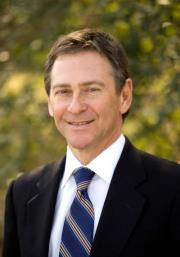
GA PSC questionnaire answers: Steve Oppenheimer

Steve Oppenheimer The Georgia Sierra Club sent a questionnaire to all candidates for Georgia Public Service Commission. None of the incumbents answered. The two challengers did. Here’s the one from Steve Oppenheimer for District 3. -jsq

  1. As a Candidate for Public Service Commission, what is your campaign strategy for achieving 50% +1 of the votes cast?

    [I’m omitting the answers to this question. -jsq]

  2. How should the Public Service Commission consider and weight the impacts to community health (asthma, cancer rates, etc.) and on Georgia’s environmental (water quantity, air quality etc.) when making decisions about a utility’s generation portfolio?

    The PSC has a major role shaping energy policy for Georgia. I would like to schedule PSC hearings on the relationship of power production and our air, water, morbidity and mortality and our general quality of life. My professional background in dentistry & health care provides a keen understanding of the relationship of power generation and health. Dr David Satcher, former US Surgeon General and Executive Director Satcher Health Leadership Institute at Morehouse University has become a friend and part of my professional network during the campaign. I would like to see PSC convene hearings on the topic. Georgians for a Healthy Future, a relatively new, broad based, organization would provide another forum for discussion of these issues. Membership in Georgians for a Healthy Future includes Georgia Legislators on both sides of the aisle. The PSC must be a leader on these issues—as the legislature as a body will likely not be progressive on these issues.

Continue reading

See Gretchen Quarterman on the radio

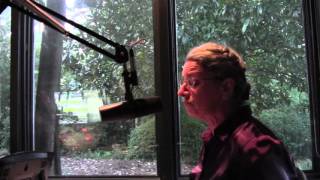
Gretchen Quarterman on Chris Beckham's radio show 11 October 2012 “I think people would be more interested in government if they could see it going on,” said Gretchen Quarterman, candidate for Chairman of the Lowndes County Commission, on the Chris Beckham drive-time radio show 11 October 2012, 105.9, WVGA. Here’s video of that interview, followed by some excerpts.

A few excerpts:

Our county government does a lot of stuff really great… but one of the things they don’t do very well don’t advertise themselves; not very transparent; they don’t say what a great job they’re doing; so I thought we could improve in that area.

The County Commission a couple of years ago had two different studies commissioned about growth and planning, and one of them was… Sprawl to ruin, by Prof. Dorfman growth close to existing services. The county already has an urban service area, like how far the water line goes, how far the sewer line goes. And that growth should be infilled, and not expand outside of that area, because that saves resources in terms of how far you have to send the sheriff, how far the school bus has to go. And they also gave an average house price, what it costs in terms of property taxes to support the services that are sent to them, to a development. So I would say close in to existing services is the way to go.

We need to actively seek out manufacturing jobs,

Continue reading

Score high on ALEC policy, score low on education


According to ALEC’s own website, states that score high on ALEC’s education policies score low on education. Remember, ALEC is behind the Georgia charter school amendment on the November ballot. If you didn’t believe Stanford Credo’s study that showed adding a charter school authorizer, as that amendment would do, reduces academic learning, how about ALEC’s own data?

Bill Simon write for The Political Vine today, Charter Schools and ALEC: The Facts ALEC Doesn’t Want You To Know,

If you take the state performance rankings and match them up to each state’s education policy rankings, you come-up with an entirely different picture of how little (if any at all) a state’s degree of conservative education “policy” translates into actual education performance.

I did this ( PDF copy available here) and this is what the 2012 Top 10 states in Performance looks like, and their corresponding Policy ranks:

2012 Performance/Policy Rank

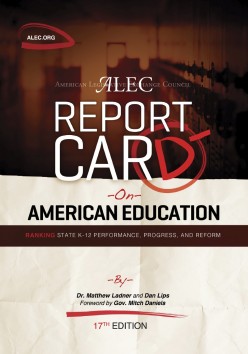
ALEC's 17th Report Card on American Education
  1. Massachusetts / B-
  2. Vermont / D+
  3. New Jersey / B-
  4. Colorado / B
  5. Pennsylvania / C+
  6. Rhode Island / C
  7. North Carolina / C
  8. Kansas / C-
  9. New Hampshire / C+
  10. New York / C-

The numbers are ALEC’s performance rankings, and the letters are ALEC’s policy grades.

Continue reading

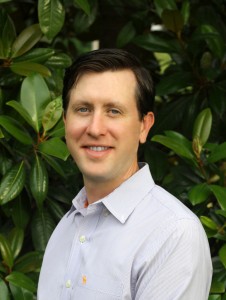
GA PSC questionnaire: David Staples

David Staples The Georgia Sierra Club sent a questionnaire to all candidates for Georgia Public Service Commission. None of the incumbents answered. The two challengers did. Here’s the one from David A. Staples for District 5. -jsq

  1. As a Candidate for Public Service Commission, what is your campaign strategy for achieving 50% +1 of the votes cast?

    [I’m omitting the answers to this question. -jsq]

  2. How should the Public Service Commission consider and weight the impacts to community health (asthma, cancer rates, etc.) and on Georgia’s environmental (water quantity, air quality etc.) when making decisions about a utility’s generation portfolio?

    Impacts to community health and the environment have to be considered very carefully. I know there are a number of different ways of viewing the situation but the explanation I’ve found that works best with Republicans in trying to get their support is that it comes down to a private property matter. The right to swing ones fist ends at the other person’s nose. Does anyone have the right to pollute the air that I breathe or the water that I drink?

    If I buy a piece of property for instance along the Savannah River or Ogeechee River, does someone upstream from me have the right to pollute the water that then flows onto my land, carrying those pollutants with it?

    Absolutely not.

Continue reading

Adding another charter school authorizer reduces academic learning —Karen Noll

Received today on Georgia charter schools do no better than traditional public schools. -jsq

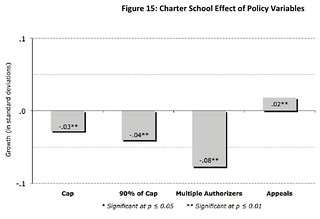
The Stanford study, Multiple Choice: Charter school performance in 16 states (p. 4), also found that multiple authorizers:

Figure 15: Charter School Effect of Policy Variables

States that empower multiple entities to act as charter school authorizers realize significantly lower growth in academic learning in their students, on the order of -.08 standard deviations.

Currently we have the local boards of education that authorize charter schools at a very high rate, 94%. If the charter is not approved by the local board then they can appeal to the Dept of Ed. For approval. So, by adding another authorizer in the form of the UNCONSTITUTIONAL charter school commission you simply reduce the academic learning of the students! This is not about education this amendment is about the money earned by some to keep power! Our constitution states that we have an obligation to provide free quality education to all Georgians. We have no obligation to line the pockets of the rich with our tax dollars!

-Karen Noll

Charter school amendment: taxation without representation —Karen Noll @ LCC 2012-10-09

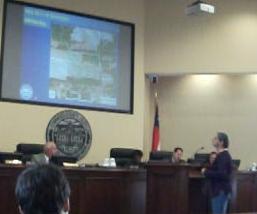
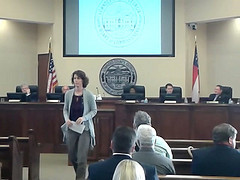
Karen Noll spoke to the Lowndes County Commission Tuesday about the charter school amendment, saying it would implement taxation without representation Karen Noll @ LCC 2012-10-09 and would take more tax dollars from our public schools to give twice as much money to special charter school students.

When you’re talking about my kids in the schools and you’re going to take their money and ship it to somebody else’s family and then there’s no accountability, that’s just unacceptable.

Here’s the video.

-jsq

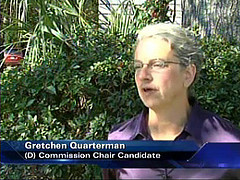
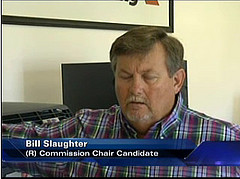
WCTV on LCC Chair Candidates

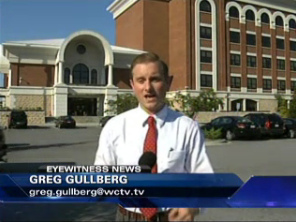
Greg Gullberg at the Lowndes County Palace Greg Gullberg wrote for WCTV today, Lowndes County Commission Chair Candidates Polar Opposites,

The Chairman of a County Commission can have great impact on the lives of residents. And in one local county, the candidates couldn’t be more different.

She wants to make it easier to see what the Commission is doing; he worries ordinances make it too difficult for business.

Gretchen Quarterman for Lowndes County Chairwoman Bill Slaughter for Lowndes County Chairman

Gretchen Quarterman speaking to the Lowndes County Commission WCTV using LAKE video Here’s the WCTV video, which appears to start with outtakes from LAKE videos of Commission meetings. LAKE videos that were taken by… Gretchen Quarterman. The one of her speaking to the Commission? Camera on a tripod.

-jsq

Georgia charter schools do no better than traditional public schools

Let's look at Georgia's non-unionized public schools. So far as I know, Georgia does not have teachers' unions. But there's still no reason to believe charter schools in Georgia would be any more magic than in Chicago.

According to CREDO at Stanford University, which has done CREDO at Stanford University state-by-state charter school studies, they find CHARTER SCHOOLS IN GEORGIA PERFORM SIGNIFICANTLY BELOW THEIR TRADITIONAL PUBLIC SCHOOL PEERS IN MATH: No Difference Found in Reading Performance. That's their press release. Here's the detailed study.

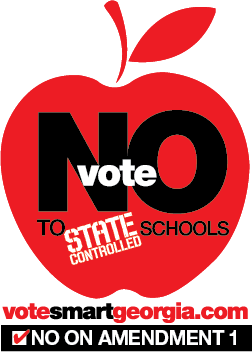
So if someone has a charter school idea that they think will perform Vote No on Amendment 1 better than public schools, they can talk to their local school board about that, and maybe that local board will agree. There's no need to authorize an unelected Atlanta board to force that charter school on us.

Vote No on the charter school amendment in November.

-jsq

Chicago charter schools do no better than unionized public schools

The Georgia “charter school” amendment isn’t really about charter schools (which any school district in Georgia can already approve, and many have): it’s about giving an unelected committee in Atlanta power to force us to pay extra local taxes to fund charter schools we don’t want. However, since the pushers of that amendment say it’s about charter schools, it’s worth reviewing that charter schools actually on average perform no better or even worse than traditional public schools. Let’s look at what the pushers hate most, unionized public schools in Chicago. and then let’s look at Georgia’s non-unionized public schools.

Ben Joravsky wrote for chichagoreader.com 3 October 2012, Today’s lesson: charters do not outperform unionized schools: Confronting the anti-teachers’ union myth with, you know, facts

But as I was saying, the foes of the teachers’ union declare that we should pay close attention to the all-important standardized test scores. So let’s take a look.

Chicago Public Schools There are 541 elementary schools in Chicago. Based on the composite ISAT scores for 2011—the last full set available—none of the top ten are charters. None of the top 20, 30, or 40 either.

In fact, you’ve got to go to 41 to find a charter. Take a bow, CICS Irving Park!

Most of the 49 charters on the list are clustered near the great middle, alongside most of their unionized neighborhood schools.

The top scorers are public schools with unionized teachers who are members of the Chicago Teachers Union.

UNO is a charter school operator. Joravsky compares one of its schools side-by-side with a unionized public school.

Continue reading