
The
failed EDF nuke project at Calvert Cliffs in Maryland
makes it clearer why Southern Company (SO) was the first company
to get a nuclear permit in 30 years:
it was the only one big enough and monopolistic enough to pull it off.
Even then it’s such a
bet-the-farm risk
that even
“great, big company”
SO only dared
to deploy its
“great big huge scale“ equipment
with the regulatory capture triple-whammy
of
a stealth tax on Georgia Power bills,
PSC approval of cost overruns,
and
an $8.33 billion federal loan guarantee:
-
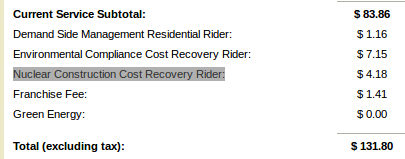
a legislated
stealth tax in the form of
a rate hike on Georgia Power customers for
power they won’t get for years if ever.
If you’re a Georgia Power customer,
look on your bill for Nuclear Construct Cost Recovery Rider.
You’ll find it adds about 5% on top of your Current Service Subtotal.
Georgia is one of only a handful of states where such a
Construction Work in Progress (CWIP) charge is legal
thanks to our regulatory-captured legislature.
Doubling down on bad energy bets,
Southern Company is also
trying to use CWIP to build a coal plant in Mississippi. -
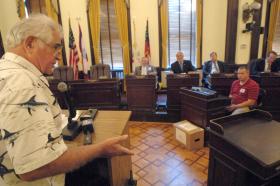
A captive Public Service Commission that
rubber-stamps costs for Plant Vogtle.
In case there was any doubt as to the PSC’s role in legitimizing those new nukes,
the very next day Fitch reaffirmed Southern Company’s bond ratings.Southern Company’s regulated utility subsidiaries derive predictable
cash flows from low-risk utility businesses, enjoy relatively
favorable regulatory framework in their service territories, and
exhibit limited commodity price risks due to the ability to recover
fuel and purchased power through separate cost trackers.Translation: Georgia Power customers subsidize SO’s bonds
and SO shareholders’ stock dividends.
The PSC also approved
cost overruns being
passed on to Georgia Power customers,
and those nukes are already over
$400 or $900 million, depending on who you ask.
What do you expect when
4 out of 5 Public Service Commissioners
apparently took 70% of their campaign contributions from utilities
they regulate or their employees or their law firms,
and the fifth commissioner took about 20% from such sources?
Hm, there’s an election going on right now! -
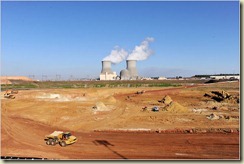
An
$8.33 billion federal loan guarantee.
Even that’s not good enough for SO and Georgia Power: SO is
asking for less down payment.
And what if even one of that three-legged regulatory capture stool’s legs
went away?
If we elect new Public Service Commissioners and legislators this year,
one or both of the Georgia legs could get revoked.
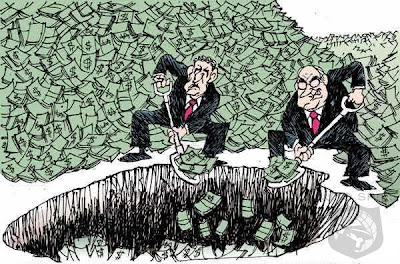
And if we lobby Congress and the federal government, maybe that
federal loan guarantee, which apparently has never been finalized,
might never get finalized.
Then we could stop
pouring money down that rathole on the Savannah River
and get on with
efficiency,
wind power,
and
solar power,
both
utility scale,
such as
GaSU’s 90MW proposal,
and
distributed rooftop,
such as
Austin Energy pioneered way back in 2003.
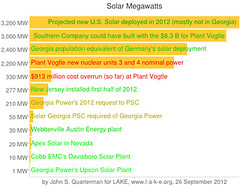
If
Cobb EMC can switch from coal to solar,
Georgia Power and Southern Company can switch from nuclear to
efficiency, wind, and solar.
Georgia Power’s
additional 210 MW solar
is a move in the right direction, but still a baby step.
We’ll know SO and Georgia Power are serious about
when they stop
getting in the way of changing the 1973 Georgia Territorial Electric Service Act
catching up with the rest of country and the world
that currently only permits you to sell power you generate to your
one and only
electric utility at whatever rate that utility has set.
We need to change that law so in Georgia like in most states we can
have a real energy market.
Kick one of the legs out from under that three-legged
regulatory capture stool and the nuke boondoggle will collapse,
leaving SO and Georgia Power no excuse.
Then the clean energy sun can rise on Georgia.
Vote.
-jsq
PS 2012-10-02 10PM: Here’s
a list of the legislators who voted for CWIP.
Consider voting for their opponents.
The two Public Service Commission candidates challenging the incumbents are:
-
Steve Oppenheimer, who visited Lowndes County yesterday, -
and
David Staples.

You don’t even have to wait for November. If you’re a Georgia Power customer,
you can
pay your CWIP payment in a separate check,
with a comment saying you’d rather have renewable energy.
Even if you’re not, you can write to Georgia Power, or Southern Company,
or the GA PSC.
Here are
some contacts.
Pingback: Fossil fuels get five times the subsidies of renewable solar and wind | On the LAKE front