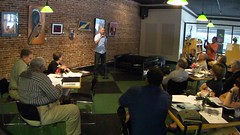
Speakers pro and con school unification assembled up front
to talk about procedures, and a listener took exception to that.
Dr. Lee Allen said the important thing was “the simple idea of what we want to do”
and then talked about the 1960s and what he didn’t want to hear about that.
He never did say what he wanted to do now.
We have complaints that some people couldn’t understand
what Dr. Mark George was saying in
the previous post of his remarks at Monday’s Lowndes County Democratic Party meeting,
so here’s another version from a different camera.
Feedback, please.
He said the Chamber of Commerce said schools were not its issue.
Dr. George pointed out that it was the Chamber and the
real estate industry that largely produced the current situation
by funelling people to the county schools.
He said the unification project started with a request from
the Industrial Authority, who said it didn’t look good when
potential industry saw there was a black school system and
a white school system.
(The timing of this is interesting, because it comes after
Brad Lofton was hired as VLCIA Executive Director,
and other people formerly associated with VLCIA say they
were never asked by any potential industry how many school
systems we have.)
Dr. George discussed many other interesting points, such as CUEE’s
terminology drift from consolidation to integration to unification.
Dr. Mark George pointed out that school consolidation didn’t solve
some problems last time:
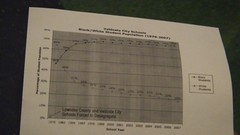
In 2011 our schools were more segregated racially than they were in 1968.
He questioned why people should believe that consolidation, even if called
unification, would solve those same problems this time.
Continuing the
debate between proponents and opponents of unification of the
Valdosta and Lowndes County School Systems, organized by
Gretchen Quarterman, chair of the
The Lowndes County Democratic Party (LCDP).
Here, speaking against, is Dr. Mark George.
I’m on the CUEE board because
I believe a unified school system can better serve children
of our community, and particularly children in the city of Valdosta.
Gretchen Quarterman, chair of the
The Lowndes County Democratic Party (LCDP),
organized a debate between proponents and opponents of unification of the
Valdosta and Lowndes County School Systems.
Here, speaking for, is Dr. George Bennett, on the board of
Community Unification for Educational Excellence (CUEE).
In the first video, Dr. Bennett talks about his history with the Valdosta schools.
Here’s
Part 1 of 3:
That was
Ashley Paulk, Chairman of the Lowndes County Commission (LCC),
talking at the Lowndes County Democratic Party (LCDP) monthly meeting
about T-SPLOST.
Gretchen Quarterman, Chair of the Lowndes County Democratic Party (LCDP),
thanks
Corey Hull of VLMPO and says the next speaker will give us
some inside knowledge about T-SPLOST.
Ashley Paulk, Chairman of the Lowndes County Commission (LCC)
is not a fan of T-SPLOST.
He says:
Y’all know I’m on the executive committee, so I guess I should be a salesman.
But I’m sorry.
Y’all know me pretty well, I’ve got to really be
not just a little bit correct,
but it’s got to be good for the people.
I think what disturbs me,
is when you’ve got to put something in the law that’s a stick,
carrot and stick,
you don’t do what I’ve said you’re going to get punished.
Public meetings will be held in August and September before the
regional transportation roundtable meets before
October 15th; that’s what their deadline is to vote….
The referendum will be in the summer of 2012 … July or August 2012….
Corey Hull of VLMPO explains that next they go to GDOT and then back.
On April 13th we have to turn those projects in to the Georgia
Department of Transportation.
…
On June 1st or thereabouts, the executive committee that
Chairman Paulk is on is gonna receive the unconstrained project list.
It won’t be … constrained to the amount of money the economists
say we will receive.
…
It is that executive committee’s responsibility
to go through and select projects and select the projects off
that we can afford for the region.
If the regional transportation roundtable does not agree on a list
to present to the voters by October 15th of 2011,
then each jurisdiction in this region must match their
Local Maintenance and Improvement Grant … at a rate of 50%.
That’s
Local Maintenance and Improvement Grant Program (LMIG).
So if they get $100,000 from LMIG they’ll have to match that with $50,000.
This will affect smaller communities the most, since they use the
most LMIG funds proportionally.
And the most likely way to raise the funds to match is to raise property taxes.
So what if there is a list on the ballot but the voters vote it down?
The 75% pot of T-SPLOST funds is what the project lists recently
submitted by Lowndes County
and the City of Valdosta are about,
according to
Corey Hull, continuing his presentation on T-SPLOST at the Lowndes County
Democratic Party (LCDP) meeting.
Those are projects of regional significance
that the local jurisdictions want the voters to actually
vote on that project.
The other 25% goes to local jurisdictions, like this: