So what is Georgia Power afraid of
that made their CEO Paul Bowers double down on old-style baseload?
Competition, that’s what!
What could be more scary in the power-monopoly state of the
1973 Territorial Electric Service Act?

On one side, Georgia Power faces
GaSU and its 80 or 90 MW solar plant proposal.
Walter C. Jones wrote for OnlineAthens 24 September 2012,
Proposed solar company could stir up Georgia’s utility structure,
A proposal from a start-up business promises to lower electricity
rates by rebating profits to customers if given a chance to compete
as Georgia Power Co.’s “mirror image.”
To proceed with its long-range plan of developing 2 gigawatts of
solar power, the start-up, Georgia Solar Utilities Inc., wants to
start by building an 80-megawatt “solar farm” near
Milledgeville as soon as it gets a green light from the Georgia
Public Service Commission. GaSU filed its request last week, and as
of Monday, it’s still too fresh for public evaluation.So radical is the proposal that spokespersons for Georgia Power and
the Georgia Solar Energy Association said they still were evaluating
it and could not comment.Groups that normally advocate for customers also are staying quiet.
GaSU executives recognize such a big change won’t come easily.
“There are obstacles. There’s no question there are obstacles,
but you have to look at the rewards,” GaSU President Robert E.
Green said at a Capitol news conference. “We don’t know what
it’s going to take, but we are prepared to go through legislative
action if necessary.”

One reaction to GaSU’s PSC request was foretold in the same article:
Commissioner Chuck Eaton issued a news release saying he had been
working with Georgia Power on a proposal for expanded solar that
meets his requirement of not boosting customers’ rates. The giant
utility is expected to release details soon.
And two days later,
Georgia Power announced a PSC proposal to swap its former 210 MW of biomass
for the same amount of solar power.
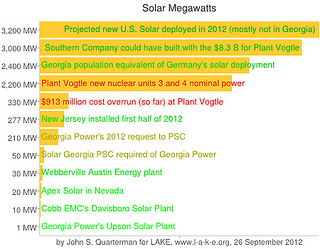
Which is a drop in the bucket, considering tiny New Jersey already installed
277 MW of solar in the first half of 2012.
And remember this feature of Georgia Power’s proposal:
Georgia Power’s plan is to buy no more than 20 megawatts from any
one supplier and to purchase 10 megawatts of so-called distributed
power in new contracts each of the next three years from homeowners
or property owners looking to make a little money from their roof
space.
Hm, 20 MW is a lot less than GaSU’s 80 or 90 MW proposal.
Convenient, huh?
And if that wasn’t enough, a week later
Georgia Power’s Bowers doubled down on old-style baseload
for the next fifty years.
The timing of these two Georgia Power announcements could be coincidence,
I suppose.
But I think more likely Georgia Power is running scared of GaSU.
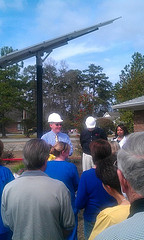
Meanwhile, remember Dr. Sidney Smith is chipping away at the other
end of the price size spectrum with
Lower Rates for Customers LLC,
which is
installing solar panels in customers parking lots, selling them
the power, and daring Georgia Power to sue,
while
deploying solar meters to enable a commodity market in solar power.
A solar market through which I could sell the excess of my
15 KW of rooftop solar,
getting far more for it than the 4.5 cents Colquitt EMC currently pays me.
Colquitt EMC could take a percentage for transport and get bragging rights,
so everybody would profit.
This is the same thing on rooftop scale that GaSU proposed for its 90MW
solar farm, as Walter C. Jones pointed out:
GaSU could build its solar farm without action by the state
legislature or the PSC, and existing federal law would require
Georgia Power to buy its electricity. But it would only pay GaSU an
amount equal to what it could buy electricity from its cheapest
wholesale supplier.
The start-up wants instead to sell its electricity directly to
retail customers who would be billed by Georgia Power or the other
existing utilities, similar to how natural gas is marketed here.
GaSU would pay the utilities for the use of their wires in the
electric grid and any profits would be shared with customers like a
cooperative.
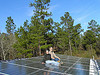
You could profit too: such a market would enable private financing for
solar such as you can already get in Tennessee, California, Oregon, New Jersey,
or many other states.
But not yet in Georgia, because of the
1973 Electric Territorial Act.
That’s right, Georgia Power is scared of you, because if you can generate
your own power, you might buy less from them, and they might not be able to
milk big baseload plants like they do now.
Nevermind that if they got out in front on this change that’s going
to happen sooner or later they could actually profit more than now
(more on that later).
Georgia Power is afraid of you, and Dr. Smith, and GaSU.
GaSU has
an online petition to the state of Georgia,
posted by Shane Owl-Greason.
For more information,
GaSU’s facebook page
has occasional updates, and is at least more informative than their
website,
which doesn’t even list Robert E. Green or Shane Owl-Greason
or anybody else as executives or otherwise associated with the company.
I wonder if a company that wants to change the bedrock Georgia monopoly law, the
1973 Electric Territorial Act,
might not get more public support if they
were a bit more transparent, instead of more opaque than Georgia Power.

Eventually, GaSU and Dr. Smith, or others like them, will win.
Georgia Power and its parent the Southern Company (SO) could
go ahead and lead now, or they can keep stonewalling and dragging
Georgia still farther behind New Jersey and most other states.
We have an opportunity right now in this election to replace
two GA PSC members and multiple legislators,
or at least to give them such a fright as recently caused
Snapping Shoals EMC to ditch coal.
Snapping Shoals probably remembered
Cobb EMC waiting until a majority of its board was replaced
before it switched from coal to solar for new plants.
How long will Georgia Power and SO wait?
The
solar train is leaving the station,
and it’s time for Georgia to get on board.
If you’re tired of SO playing us all for rubes and
shovelling money into that nuclear pit on the Savannah River
instead of getting on with solar and wind,
you can get out and early vote this month or on election day November 6th.
-jsq