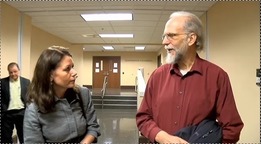
“I ask you and FERC to stop Sabal
Trail from telling newspapers things that Spectra
Energy’s own corporate documents refute, and to start
paying attention to multiple requests by county commissions
and other affected parties.”
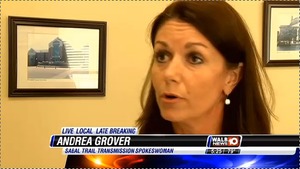
Back in December, Spectra’s Andrea Grover and Brian Fahrenthold were
“not familiar” with Spectra’s lengthy safety rap sheet (see above picture).
Yesterday’s VDT had
Sabal Trail: Eminent domain accusation ‘hard to believe’
by Joe Adgie. Meanwhile, the Moultrie Observer has picked up
the VDT story.
Maybe some newspapers will also publish better information
than what trained pipeline PR people seem not to remember or believe, despite
copious evidence of the actual facts.
Filed with FERC
19 November 2014 accession Number: 20141119-5232. The attachments are in the PDF, and they’re all in the links in the HTML version below. -jsq
John S.
Quarterman
3338 Country Club Road #L336
Valdosta, GA 31605
19 November 2014VIA ELECTRONIC FILING
Ms. Kimberly Bose
Federal Energy Regulatory Commission
888 First Street NE
Washington, DC 20426Re: Southeast
Market Pipelines Project,
Sabal Trail Transmission, LLC Docket No PFl4-1-000Dear Ms. Bose,
I ask you and FERC to stop Sabal
Trail from telling newspapers things that Spectra
Energy’s own corporate documents refute, and to start
paying attention to multiple requests by county commissions
and other affected parties.According to "Sabal Trail:
Eminent domain accusation ‘hard to
believe’" by Joe Adgie in the Valdosta Times
today, 19 November 2014,‘Andrea
Grover, director of stakeholder outreach for Sabal Trail,
said allegations from homeowners that surveyors threatened
eminent domain on their properties was “hard to
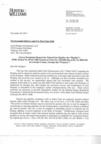
believe.”’Please find attached
a two-page
letter of 26 November 2013 from Hunton & Williams LLP of
Atlanta, representing Sabal Trail, threatening Larry Rodgers
with use of Georgia eminent domain law for a pipeline
survey. Many other landowners received similar letters.Does Sabal Trail really not know
what its own attorneys are sending to landowners? If Ms.
Grover does not know, perhaps you could get Vice President
of Stakeholder Outreach Susan Waller or Spectra Energy CEO
Greg Ebel to find out what their attorneys are doing.Similarly, you may want to ask
them about this statement in the same newspaper article:‘Grover
said that Sabal Trail only works on properties that they are
allowed to work on.‘“We
are only on those properties that we have permission to be
there, or have agreements in place to be there,”
Grover said. “These are things that we instill in our
workforce.”’
Why then, was Sabal Trail
sued for criminal trespass in Leesburg, Georgia 10 July 2014
by a
landowner in Mitchell County, Georgia? I saw Ms. Grover
leading the Sabal Trail team in the courtroom in
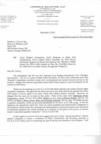
Leesburg.Meanwhile, please also find
attached
a two-page response of 4 December 2014 to Sabal
Trail’s law firm from Larry Rodgers’ attorney,
Bill Langdale, spelling out that Georgia eminent domain law
does not apply to a pipeline that is of no benefit to
Georgia.In the same newspaper article,
Ms. Grover admitted there are no agreements in place now for
use of Sabal Trail gas in Georgia:‘Grover
also said that those living along the pipeline’s route
will be able to get natural gas.‘“The
community can benefit from taking natural gas for their
community use when the pipelines are put in service,”
Grover said. “We would put the local communities and
municipalities in contact with our business development
group and they can look for locations that are best for gas
to come off, what the structure would look like, and timing
and all of that, and work to get some agreements in
place.”’So there are no such agreements
in place now. Which, according to attorney Bill Langdale
(and the judge in Leesburg), means Georgia eminent domain
does not apply. Yet Sabal Trail’s law firm sent
landowners letters threatening Georgia eminent domain.Also in the newspaper article
there is an erroneous assertion about easements:‘Grover
said that once the pipeline was constructed and the land on
the easement was replaced, landowners could do whatever they
wanted with the land, including farming of the
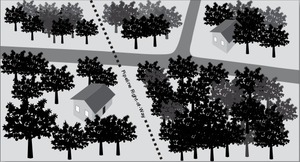
land.’Yet landowners cannot grow trees
on pipeline rights of way, for example. Please see
"Spectra Energy’s Encroachment Policy" in
Spectra Energy’s own Public Official brochure,
http://www.spectraenergy.com/content/documents/Brochures/Public_Official.pdf
‘Spectra
Energy investigates encroachment by non-company individuals
in the pipeline right-of-way. These include activities that
have been reported by the encroaching party to the state one
call service by calling 811, and those activities that are
discovered by the company through aerial and/or ground
patrol that have not been reported by calling 811.
Right-of-Way encroachments include installation of such
things as:
• Buildings/Mobile Homes • Fences • Utility
Lines
• Pipelines • Roads • Trees’Why is Sabal Trail telling a
newspaper something its own brochure for public officials
contradicts?Finally, Sabal Trail’s
proposed three-foot top cover is inadequate:‘For
safety reasons, the Federal Energy Regulatory Committee
requires three feet of cover for the pipeline, and Grover
said that they would negotiate with landowners for different
allowances, such as if they needed the pipeline to run
deeper than the minimum 36 inch allowance.’
See my
submittal 20141117-5040
about the incident just this month in Berrien County,
Georgia where a ditch puller broke a SONAT pipeline.See the
submittal 20141113-5199
by Southern Natural Gas about Sabal Trail’s inadequate
plans for boring under existing pipelines, as well as far
too many pipeline crossings.And please find attached
Resolution Number 2014-R-6 of the Colquitt County, Georgia,
Board of Commissioners dated 4 March 2014 and filed with
FERC as submission 20140310-5098 of 10 March 2014, which
reads in part:‘NOW,
THEREFORE BE IT RESOLVED, that the Colquitt County Board of
Commissioners adamantly urge that Sahal Trail Natural Gas
Pipeline should make every effort to ensure that the Sabal
Trail Natural Gas Pipeline is buried with a minimum of five
(5) feet of top cover when traversing agricultural
properties to include pasture land, cultivated lands,
surface drains, diversions, waterways, open ditches and
streams.’
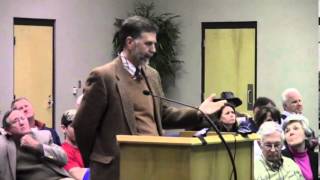
Here is
a video of Colquitt
County Attorney Lester Castelow informing FERC and Sabal
Trail of that resolution at the 5 March 2014 FERC Scoping
Meeting in Moultrie, Georgia. He said he had already emailed
that resolution to FERC. You can see Sabal Trail’s
Andrea Grover sitting in the audience listening, and
FERC’s John Peconom sitting at the front table.
Sabal Trail Methane Pipeline
Scoping Meeting, Federal Energy Regulatory Commission (FERC)
Moultrie, Colquitt County, Georgia, 5 March 2014.
Videos by John S. Quarterman for Lowndes Area Knowledge Exchange.Castelow warned about top cover
on dirt roads, explicitly mentioning ditches. Where is any
acknowledgement by Sabal Trail of this issue, very recently
demonstrated by the ditch-digger SONAT pipeline break in
Berrien County, Georgia?Brooks County, Georgia,
passed the same resolution in April 2014; see "Brooks urges
deep-dug pipeline," by Matthew Woody, Valdosta Daily
Times, 20 April 2014. Yet seven months later the Valdosta
Daily Times says Sabal Trail told it FERC still is not
requiring any more than three feet top cover.
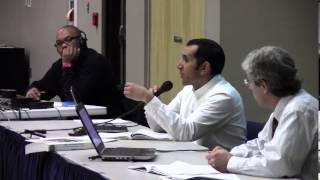
Here is
a video of FERC’s
John Peconom saying at the 5 March 2014 Moultrie FERC
Scoping Meeting that in other states FERC has required more
than three feet top cover:
Sabal Trail Methane Pipeline
Scoping Meeting, Federal Energy Regulatory Commission (FERC)
Moultrie, Colquitt County, Georgia, 5 March 2014.
Videos by John S. Quarterman for Lowndes Area Knowledge Exchange.Plenty of evidence has been
presented to FERC that at least five feet of top cover
should be part of any pipeline plan in Georgia.This letter and all three
attachments are integral parts of this filing, and I request
FERC post all of them on its ecomment system so all
subscribers to docket PF14-1 and the general public can see
them. The three attachments, once again, are:• two-page letter of 26
November 2013 from Hunton & Williams LLP• two-page response of 4
December 2014 from Bill Langdale• one-page Resolution
Number 2014-R-6 of 4 March 2014 by Colquitt County
CommissionI ask FERC to get Sabal Trail to
come up to speed on what their own attorneys are doing, to
remember what is actually happening on the ground in
Georgia, and to stop telling newspapers things that are
simply not true.I ask FERC to remind Sabal Trail
of all the previous requests for more than three feet of top
cover, and I ask FERC to require at least five feet of top
cover as part of any Sabal Trail pipeline plans.And once again I urge FERC to
deny any permit for Sabal Trail’s proposed
environmentally damaging and hazardous pipeline, which would
take significant rights from landowners, and for which no
need has ever been demonstrated.Sincerely,
John S.
Quarterman
229-242-0102
jsqferc@quarterman.orgCc: Joe Adgie,
joe.adgie@gaflnews.com, Reporter, Valdosta Daily Times
Cc: Jim Zachary, zacharyjim@gmail.com, Editor, Valdosta
Daily Times
Pingback: MGAG didn’t contact local governments before agreeing with Sabal Trail | SpectraBusters
Pingback: My Thanksgiving prize was an eminent domain threat from Sabal Trail –Sandra Jones to FERC | SpectraBusters