There are historical reasons for why we lock up so many people,
some going back a century or more, and some starting in 1980 and 2001.
Knowing what they are (and what they are not)
lets us see what we can do to end the epidemic of
incarceration that is damaging education and agriculture in Georgia.
Adam Gopnik wrote for the New Yorker dated 30 January 2012,
The Caging of America:
Why do we lock up so many people?
More than half of all black men without a high-school diploma go
to prison at some time in their lives. Mass incarceration on a scale
almost unexampled in human history is a fundamental fact of our country
today—perhaps the fundamental fact, as slavery was the
fundamental
fact of 1850. In truth, there are
more black men in the grip of the
criminal-justice system—in prison, on probation, or on
parole—than were in slavery then.


In Georgia,
1 in 13 of all adults is in jail, prison, probation,
or parole: highest in the country (1 in 31 nationwide).
Georgia is only number 4 in adults in prison, but we’re continuing
to lock more people up, so we may get to number 1 on that, too.
Over all, there are now more people under
“correctional supervision” in America—more than
six million—than
were in the Gulag Archipelago under Stalin at its height. That city of
the confined and the controlled, Lockuptown, is now the second largest
in the United States.The accelerating rate of incarceration over the past few decades is just
as startling as the number of people jailed: in 1980, there were about
two hundred and twenty people incarcerated for every hundred thousand
Americans; by 2010, the number had more than tripled, to seven hundred
and thirty-one. No other country even approaches that. In the past two
decades, the money that states spend on prisons has risen at six times
the rate of spending on higher education.

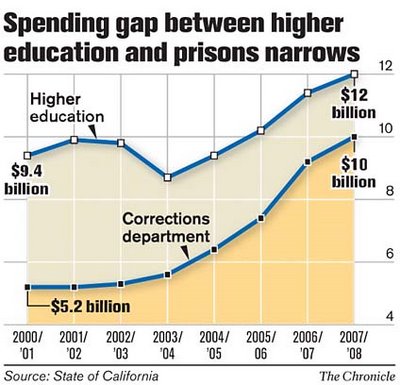
And we can’t afford that, especially not when we’re cutting school budgets.
That graph of education vs. incarceration spending is for California.
Somebody should do a similar graph for Georgia.
The article does get into why we lock up so many people:
How did we get here? How is it that our civilization, which rejects
hanging and flogging and disembowelling, came to believe that caging
vast numbers of people for decades is an acceptably humane sanction?
There’s a fairly large recent scholarly literature on the history
and sociology of crime and punishment, and it tends to trace the
American zeal for punishment back to the nineteenth century,
apportioning blame in two directions. There’s an essentially
Northern explanation, focussing on the inheritance of the notorious
Eastern State Penitentiary, in Philadelphia, and its
“reformist” tradition; and a Southern explanation, which
sees the prison system as essentially a slave plantation continued
by other means. Robert Perkinson, the author of the Southern
revisionist tract “Texas Tough: The Rise of America’s Prison
Empire,” traces two ancestral lines, “from the North,
the birthplace of rehabilitative penology, to the South, the
fountainhead of subjugationist discipline.” In other words,
there’s the scientific taste for reducing men to numbers and the
slave owners’ urge to reduce blacks to brutes.

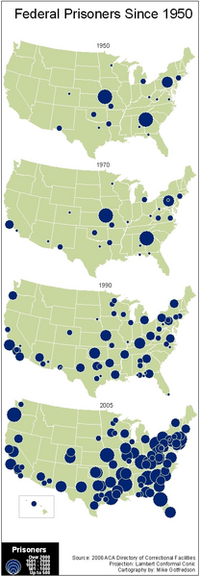
There may be two original sources of U.S. incarceration, but it looks like the
south has won the race to lock up people.
According to Desiree Evans in Facing South 5 March 2009,
Doing time in the South,
By 2008, the top five states with the highest adult incarceration rates were in the South: Louisiana leads the way, with one out of every 55 residents behind bars. Mississippi, Georgia, Texas, and Alabama finish off the top five.

While both deep-historical explanations are correct as far as they go, they don’t explain the sudden jump upwards starting in 1980.
What happened then?
The article effectively debunks a popular but wrong speculation:
One fact stands out. While the rest of the country, over the same
twenty-year period, saw the growth in incarceration that led to our
current astonishing numbers, New York, despite the Rockefeller drug
laws, saw a marked decrease in its number of inmates. “New
York City, in the midst of a dramatic reduction in crime, is locking
up a much smaller number of people, and particularly of young
people, than it was at the height of the crime wave,” Zimring
observes. Whatever happened to make street crime fall, it had
nothing to do with putting more men in prison.
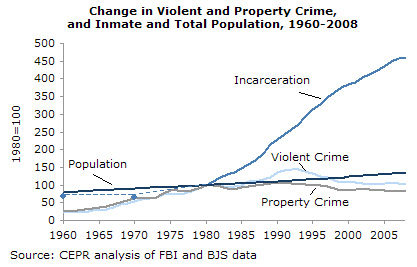
That’s right: the national epidemic of incarceration has nothing
to do with the crime rate.
Nationally, incarceration has gone way up since 1980 while crime has not.
By locking up more people, Georgia has not made us safer than
New York City.
So what did happen in 1980?
The War on Drugs.
Nixon started it, but Reagan accellerated it, and politicians ever since
have competed to be tough not just on crime (as the New Yorker article
describes), but on drugs.
The New Yorker article doesn’t say much about
the war on drugs as a cause of incarceration,
even though it quotes, as we have,
CCA’s 2010 report to the SEC:
The demand for our facilities and services could be adversely
affected by the relaxation of enforcement efforts, leniency in
conviction or parole standards and sentencing practices or through
the decriminalization of certain activities that are currently
proscribed by our criminal laws — for instance, any changes
with respect to drugs and controlled substances or illegal
immigration could affect the number of persons arrested, convicted,
and sentenced, thereby potentially reducing demand for correctional
facilities to house them.


The New Yorker misses the link to anti-immigration laws, even though
CCA itself puts drugs and immigration in the same sentence.
Betty Liu of Bloomberg tied CCA’s ten-fold stock price increase
since 2001 directly to anti-immigration laws.
So sure, the U.S. incarceration system probably started with the
two old causes the New Yorker cites.
But those aren’t the causes of the boom in imprisonment since 1980.
The causes of that are the war on drugs and the post 9/11 crackdown
on illegal immigration, the latter pushed by ALEC and its prison corporation
partners such as CCA.
So the main way to end the epidemic in incarceration in America is to
end the failed war on drugs.
The New Yorker does get to that at the end:
Ending sentencing
for drug misdemeanors, decriminalizing marijuana, leaving judges
free to use common sense (and, where possible, getting judges who
are judges rather than politicians)—many small acts are
possible that will help end the epidemic of imprisonment as they
helped end the plague of crime.

Except ending the war on drugs is not a small act: it’s the main act.
While we’re at it,
repeal the bogus anti-immigration laws such as Georgia’s HB 87
that are really excuses to lock more people up for private prison profit.

We can’t afford to let incarceration further
damage Georgia’s biggest industry: agriculture.
In an even larger sense, this is all a symptom of
private corporation money lobbying government.
Where did we get all these state “anti-immigration” laws?
ALEC, the American Legislative Exchange, promoted them in 22 states.
We need to stop that.
We need a
U.S. Constitutional Amendment for Separation of Corporation and State.
Dealing with the root causes will take time.

Meanwhile, CCA also admitted to the SEC that
local community opposition
could affect its ability to site a prison.
We don’t need
a private prison in Lowndes County, Georgia.
Spend those tax dollars on rehabilitation and education instead.
Follow
this link
to petition the Industrial Authority to reject CCA’s private prison in Lowndes County.
-jsq
The Fedgod isn’t going to change it’s tune, it’s act locally or nothing. If enough people resist they can’t jail you all. As Alex Jones says, “resistance is victory.”
Tom Paine said it a lot earlier:
“The strength and power of despotism
consists wholly in the fear of resistance.”
-jsq