Category Archives: CWIP

Barnes and Richardson against Georgia Power’s CWIP

Two former big-time politicos join the fight against CWIP.

Melissa Roberts wrote for CBS Atlanta yesterday, Unlikely duo challenges Ga. utility over rates,

The unlikely duo of ex-Democratic Gov. Roy Barnes and former Republican House Speaker Glenn Richardson are heading to court to challenge Georgia Power over a surcharge they say has cost ratepayers as much as $100 million.

They're going after Construction Work in Progress (CWIP)!

Jim Galloway in the AJC yesterday noted the irony,

The gentleman knows of what he speaks, and that is only one of the ironies here. The legislation that has allowed Georgia Power, for the last 15 months, to charge ratepayers for financial costs associated with the construction of two new nuclear power plants, was passed in 2009 during Richardson’s final session as the second- most powerful man in the Capitol.

Maybe he can help undo the harm he helped do. Ditto Roy Barnes, who got coal-plant-building Cobb EMC former head Dwight Brown off on a technicality.

Melissa Roberts wrote:

The lawsuit contends the utility is charging sales tax on the finance surcharge and the franchise tax paid to cities. Richardson said in a phone interview he and Barnes are two "Davids against the Goliath."
Add those two Davids to the two Davids of Savannah, Drs. Sidney Smith and Pat Godbey and their Lower Rates for Customers LLC. Add a few more thousand Davids around the state paying their CWIP in separate checks with objections.

New Hampshire banned CWIP and their nuke-building utility went bankrupt. Missouri banned CWIP. Iowa is working on banning CWIP. Georgia can ban CWIP, too. Watch out Goliath!

-jsq


Missouri has defeated CWIP: so can Georgia

A veteran of the original No Nukes movement calls Plant Vogtle
and CWIP like he sees it.

Harvey Wasserman wrote Friday for EcoWatch,

Nuclear Power’s Green Mountain Grassroots Demise
,

The accelerating revolution in renewables has allowed solar, wind


and other green sources to outstrip atomic reactors in cost, time to
build, ecological impact and safety. As billions pour into
Solartopian sources, private investment in atomic energy has all but
disappeared—except where there are massive taxpayer subsidies.

Even that’s not enough. In 2011, President Obama handed $8.33
billion in federal loan guarantees to the builders of two reactors
at Georgia’s Vogtle. But Peach State ratepayers are already being
soaked for billions more in pre-payments, and the cost of the
project is soaring. A parallel financial disaster looms at the
Robinson site in neighboring South Carolina. Though the industry
assumes these four reactors will eventually be finished, economic
realities may say otherwise.

Cost estimates for new nukes have been soaring even before
construction begins. Even with federal money, the builders still
demand that state ratepayers foot the bill as the process proceeds,
meaning consumers are on the hook for multiple billions even if the
reactors never open. Pitched battles over this Construction Work in
Progress scam have already been won by consumers in Missouri and are
being fought in Iowa and elsewhere. As the years of building drag
on, costs will escalate while renewables continue to become cheaper.
Sooner or later, construction is likely to stop, as it did at
numerous projects in the 1970s and 1980s which were never finished.

We can end CWIP in Georgia.
It will benefit Georgia Power and the EMCs as well as all the rest of us
when we stop wasting tax and customer dollars on boondoggles like Plant Vogtle
or biomass or private prisons and get on with clean, profitable, job-creating
renewable energy in Georgia: wind off the coast and sun inland.

-jsq

Separate CWIP payments to Georgia Power —WACE call for action

We don’t have to wait for

the Georgia legislature to ban Construction Work in Progress (CWIP)

for Georgia Power’s new nukes at Plant Vogtle.
WACE has put out a clever call for action about CWIP,

Go Solar, Not Nuclear!

Here’s an

excerpt:


  • Use two checks each time you pay your bill. One check covers the amount
    you are forced to pay for “Nuclear Construction Cost Recovery”
    (write “for solar construction” in the memo line). The other check
    covers the remaining amount of your actual electricity costs.

  • Include a note in the letter with your checks voicing your opposition
    to nuclear power and ask Georgia Power to invest your funds in solar
    energy instead. This note could read:

    • I oppose nuclear power because of its dangers to our health and our
      environment. (See the nuclear accidents at Fukushima, Chernobyl, and
      Three Mile Island)

    • I oppose the construction surcharge for nuclear power plants because
      they are too expensive and waste billions of our tax dollars. (Plant
      Vogtle was originally estimated to cost $660 million. Eventually, only
      2 of its proposed 4 reactors were built, costing more than $8 billion,
      and resulting in huge rate hikes for Georgia residents.)

    • I ask that GA Power invest my money and any collected surcharges in
      solar instead.

The

PDF of the call

includes these addresses:

Tim Echols, Chairman

Georgia Public Service Commission

244 Washington Street SW

Atlanta, GA 30334

1-800-282-5813
W. Paul Bowers, CEO

Georgia Power Company

241 Ralph McGill Boulevard NE

Atlanta, GA 30308

1-888-660-5890

And don’t forget Georgia Power’s parent company The Southern Company’s
CEO, Thomas Fanning,
said a year ago he’s

“bullish”
on solar.
Let’s see some solar action from The Southern Company and Georgia Power!

Here are
some more contacts.

You don’t even have to be a Georgia Power customer to write to these people.
Most of them are elected or appointed officials who are supposed to represent you,
the taxpayers.

-jsq

Why CWIP is a bad idea

Iowa is rejecting CWIP, and Georgia can, too.
Here’s why.

Herman K. Trabish wrote for Green Tech Media 22 February 2012,

The Nuclear Industry’s Answer to Its Marketplace Woes:
Construction Work in Progress (CWIP) financing shifts the risks of nuclear energy to utility ratepayers,

A sign of the nuclear industry’s difficult situation in the
aftermath of Fukushima is a proposal before the Iowa legislature

“Construction Work in Progress was intended to circumvent the
core consumer protection of the regulatory decision-making
process,”

that would allow utility MidAmerican Energy Holdings, a subsidiary
of Warren Buffett’s Berkshire Hathaway, to build a new nuclear
facility in the state using Construction Work in Progress (CWIP)
financing (also called advanced cost recovery).

“Investment in nuclear power is the antithesis of the kind of


investments you would want to make under the current uncertain
conditions,” explained nuclear industry authority Mark Cooper,
a senior fellow for economic analysis at Vermont Law School’s
Institute for Energy and the Environment. “They cannot raise
the capital to build these plants in normal markets under the normal
regulatory structures.”

CWIP would allow the utility to raise the money necessary to build a
nuclear power plant by billing ratepayers in advance of and during
construction.

“Construction Work in Progress was intended to circumvent the


core consumer protection of the regulatory decision-making
process,” Cooper explained. “It exposes ratepayers to
all the risk.” The nuclear industry’s answer to its
post-Fukushima challenges, he said, “is to simply rip out the
heart of consumer protection and turn the logic of capital markets
on their head.”

And the Iowa Utilities Board staff agreed with Cooper and recommended against CWIP.

His message to policymakers is simple, Cooper said. “This is
an investment you would not make with your own money. Therefore, you
should not make it with the ratepayers’ money.”

Meanwhile, in Georgia:

Continue reading

How to ban CWIP in Georgia

A one-paragraph law can do it; that’s all it took in New Hampshire
to ban

Construction Work in Progress (CWIP)


after

Three Mile Island.

OK, plus a state Supreme Court ruling, but that would be easier in Georgia
since the New Hampshire Supreme Court already set a precedent of upholding
the NH law.
After Fukushima,

Georgia could ban CWIP
and end the new Plant Vogtle construction.
The we could

get on with building solar
.

Here’s the text of the NH law, taken from

the NH Supreme Court ruling:

“378:30-a Public Utility Rate Base; Exclusions. Public utility rates or
charges shall not in any manner be based on the cost of construction
work in progress. At no time shall any rates or charges be based upon
any costs associated with construction work if said construction work is
not completed. All costs of construction work in progress, including,
but not limited to, any costs associated with constructing, owning,
maintaining or financing construction work in progress, shall not be
included in a utility’s rate base nor be allowed as an expense for rate
making purposes until, and not before, said construction project is
actually providing service to consumers.”

Simple enough.
The

Georgia legislature
could do it.
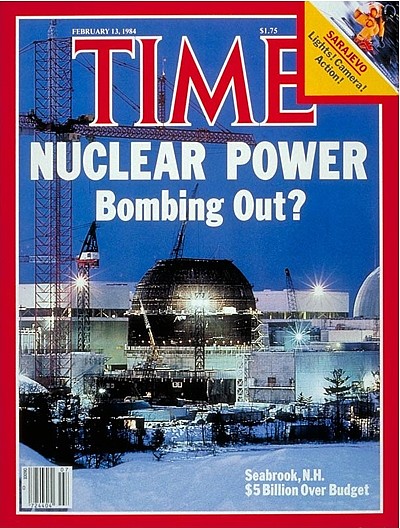
Knowing the NH CWIP ban caused PSNH

to go bankrupt on costs for the Seabrook nuclear plant
,
Georgia Power might back off on Plant Vogtle rather than have such a law passed.

-jsq

What we can learn from no nukes and solartopia of 30 years ago

Why were only 12% of the projected 1000 nuclear plants built in the U.S. by
the year 2000?
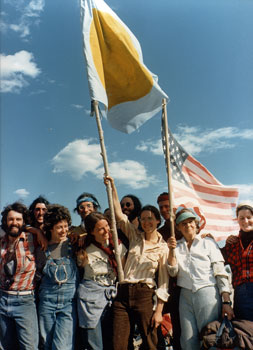
Because of the no nukes movement started in Seabrook, New Hampshire
in 1977.
And because New Hampshire banned CWIP.
Here in Georgia in 2012 we can cut to the chase and do what they
did that worked.

Harvey Wasserman wrote for The Free Press 13 May 2007,

How creative mass non-violence beat a nuke and launched the global green power movement
,

Thirty years ago this month, in the small seacoast town of Seabrook,
New Hampshire, a force of mass non-violent green advocacy collided


with the nuke establishment.

A definitive victory over corporate power was won. And the global
grassroots “No Nukes” movement emerged as one of the most important
and effective in human history.

It still writes the bottom line on atomic energy and global warming.
All today’s green energy battles can be dated to May, 13, 1977, when
550 Clamshell Alliance protestors walked victoriously free after
thirteen days of media-saturated imprisonment. Not a single US
reactor ordered since that day has been completed.

How effective?

Richard Nixon had pledged to build 1000 nukes in the US by the year
2000. But the industry peaked at less than 120. Today, just over a
hundred operate. No US reactor ordered since 1974 has been
completed. The Seabrook demonstrations—which extended to
civil disobedience actions on Wall Street—were key to keeping
nearly 880 US reactors unbuilt.

The only new nukes ordered since then are the ones Georgia Power
wants to build at Plant Vogtle on the Savannah River, for which

Georgia Power customers are already getting billed Construction
Work in Progress (CWIP).

Thirty years later, some things haven’t changed:

Continue reading

How and why did New Hampshire ban CWIP?

After years of protests and the Three Mile Island nuclear accident
in Pennsylvania,
the New Hampshire legislature passed a law that denied
the Public Service Company of New Hampshire (PSNH)

Construction Work in Progress (CWIP)
charges
before the Seabrook nuclear plant


provided electricity to its customers.
One of two planned Seabrook reactors did finally go into service in 1990,
more than a decade late and far over budget.
Meanwhile,
the New Hampshire Supreme Court ruled the anti-CWIP law was constitutional,
and PSNH went bankrupt in 1988:

the first
investor-owned utility since the Great Depression to declare
bankruptcy.

Seabrook was the last nuclear reactor built in the United States.
Until now.
In Georgia.
Which has CWIP.
Maybe we should
change that.

Here’s an excerpt from

a corporate history of

Public Service Company of New Hampshire (PSNH):

By January 1972 PSNH had decided not only to build a nuclear plant
at Seabrook but also to have it consist of two 1,150-megawatt units,
to be completed in 1979. PSNH was to own 50 percent of the $1.3 billion
project and share the remaining investment with other New
England utilities. In January 1974 the New Hampshire Site Evaluation
Committee, the Public Utilities Commission (PUC) and other
regulatory bodies had issued the basic permits, but interveners in
the case succeeded in having the New Hampshire Supreme Court
overturn these permits. After repeated appeals and rehearings PSNH
received its construction permit in July 1976—and experienced
its first protest at the planned site.

There followed a decade of other protests at the site, inside
regulatory chambers, and in New Hampshire and Washington courtrooms.
The 1979 accident at the Three Mile Island nuclear-power plant in
Pennsylvania—to name but one event that triggered concern

Continue reading

Can Georgia ban Construction Work in Progress (CWIP)?

Georgia Power

charges its customers
Construction Work in Progress (CWIP)
for the nuclear plants
it is constructing at Plant Vogtle on the Savannah River.
This while
claiming a solar energy commodity market would raise rates for its customers.

If nuclear is so great, why does it need to be pre-funded by customers?
Can Georgia ban CWIP?
Other states have.

This interesting

survey by Wisconsin
, courtesy of


National Association of Regulatory Utility Commissioners (NARUC)
,
says Illinois, Montana, New Hampshire, Ohio, and Oregon
ban CWIP (except in certain cases for some of those states)
and North Carolina and Washington in practice do not use it.

Appended below is the first question from the survey and the answers.
The entire survey is
on the LAKE website.

Here’s
who in the Georgia state government
you can contact about CWIP.

-jsq


CURRENT RETURN ON CWIP

VERSUS AFUDC [Allowance for Funds Used During Construction]

REGULATORY SURVEY RESULTS

March 2006

The Wisconsin
Commission is relooking at its current practice for allowing a
current return on construction work in progress (CWIP). We
would appreciate it if you or someone else from your agency could
respond to the following questions.

Continue reading

Georgia Power peddling old disinformation about solar power

On the same day as SB 401
revived as SB 459
gets a hearing in a better committee,


Georgia Power trots out the same old tired disinformation it’s been peddling
for years.
As if we didn’t already know that almost all solar installations in Georgia
are installed by certified solar installers.
Or that pretty much every inverter these days comes with built-in
automatic cutoff if the grid goes down to which installers add
air-gap cutoff knife switches plus breakers.
And as if Georgia Power didn’t know

it and EMCs could charge a percentage on electricity arbitraged
across their networks,

which gapower could use to finance any needed grid improvements, while
retaining a hefty profit for doing not much of anything else.
Meanwhile, those of us who chose to participate in solar electricity arbitrage
would get lower rates for customers.
We do know all that,
but maybe your state senator doesn’t, so maybe you should call your
senator today and tell them you want to be able to buy and sell solar
power without having to get it from the utility monopoly.

Greg Roberts, Vice President of Pricing and Planning for Georgia Power
in Atlanta, wrote for the Savannah Morning News today,

The solar sleight of hand
.
I’ll only quote part of his concluding paragraph.

Georgia Power is involved in many efforts to expand the use solar energy

Usually dragged along behind reluctantly,

Continue reading

Stop Georgia Power from stopping you from affording solar

Why can’t you do this?


Say you own a coffee shop. You’d like to install solar panels on
your roof but can’t afford them. A company offers to install and
lease you the equipment, provided you sign a long-term contract. The
company will sell you energy at a cheaper rate than you already pay
Georgia Power. No longer would you be so susceptible to spikes in
electricity prices. Nor would your money be helping to support
burning coal or nuclear power.

Georgia law says you can’t do that.

That’s why

SB 401 is in the Georgia Senate
.
It’s

a common-sense measure that would put people to work, create a new
sector in Georgia’s economy, and promote clean energy. In addition,
the legislation would help shield people from increases in
electricity rates, which, according to the U.S. Department of
Energy, have risen nearly 50 percent over the last seven years.

Why would Georgia Power not like that?

Continue reading