In most states, financing solar energy is largely a matter of learning
all the local ropes.
In Georgia, there’s a bigger problem.
Michael Mendelsohn
wrote for RMI 5 December 2012,
How Do We Lower Solar Installation Costs and Open the Market to Securitized Portfolios: Standardize and Harmonize,
Soft costs can be pretty tough. The cost of solar installations can
be generally separated into “hard” costs — representing
primary components such as modules, racking, inverters — and
soft costs including legal, permitting, and financing. While the
former group — particularly modules — have dropped
dramatically over the last several years, the latter have not.
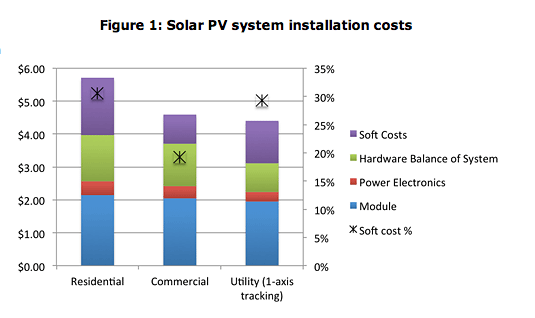
According to a recent NREL analysis, these costs represent roughly
30% of both residential and utility installations (slightly less for
commercial-host systems). See Figure 1.
In fact, soft costs are so critical to the overall success of solar
adoption, their reduction is a primary focus of the Department of
Energy’s SunShot Initiative to make solar energy cost-competitive.
In order to reduce the cost of financing, NREL recently completed
and continues to work on various efforts to tap public capital
markets and enable other vehicles that securitize project
portfolios.
We’ll come back to tapping public capital markets and the like,
because that’s the key to what
Georgia Solar Utilities (GaSU) is trying to do.
But there’s a special problem in Georgia, buried in the next paragraph:
Doing so requires standardized contracts, interconnection
agreements, and other relevant documentation so these projects can
be easily aggregated with a consistent set of risk factors.
Unfortunately, a myriad of unique state renewable portfolio
standards (RPS), interconnection protocols, and/or permitting
processes prevent the possibility of solar projects becoming
routine.
We don’t have an RPS in Georgia.
Why?
Because
ALEC’s “our state legislators”
keep propping up Georgia Power’s interpretation of
the 1973 Territorial Electric Service Act.
What do Georgia Power and its parent the Southern Company want to do instead?
SO CEO Thomas A. Fanning has spelled that out in several different formats:
nuclear, “21st century coal”, natural gas, renewables, and efficiency.
When does he want renewables (solar and wind)?
“probably very late in this decade or beyond that, we still are gonna
get by far the lion’s share of electricity from central stations.”
You can see him say that on video, along with what he called Georgia’s
franchise law “that we need to protect.”
Protect so SO and Georgia Power can continue to wallow in their

three-legged nuclear regulatory-capture stool
of a stealth tax on Georgia Power bills, PSC approval of cost overruns,
and an $8.33 billion federal loan guarantee.
You know, you don’t need a federal loan guarantee to float bonds for solar
energy, because soalr is not a bet-the-farm risk like nuclear!
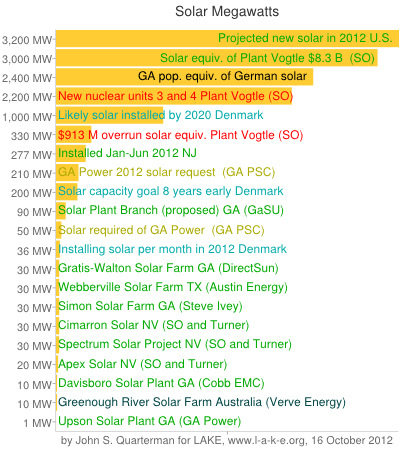
Solar gets installed on budget and often ahead of schedule, like in Denmark, way to the north of us!
SO’s backwards priorities are why the SO states of Georgia and Alabama
and Mississippi and northern Florida and some surrounding states
don’t have Renewable Portfolio Standards.
SO and Georgia Power’s nuclear buggywhip priorities are why
tiny Denmark is way ahead of Southern Company, not just in Georgia,
but even including SO’s southwestern solar farms.
And to change that, we need to find a way around that Territorial Act
to get financing for solar energy.
Assuming 75% of the installed cost of residential solar project are
sold into the securitization pool and a 5-kW average system size, a
$100 million fund can source roughly 4,700 systems. To put that in
perspective, that’s roughly the entire number of “pipeline” projects
under development in New Jersey [3], the second most active state in
the country (which likely includes some projects of much larger
size). In effect, residential-only projects from less active states
could benefit from standard contracts, evaluation practices, and
other protocols to enable access to public capital markets. [4]
75% was the rebate Austin Energy started providing for rooftop
(home and business) solar installations after AE’s

sudden flip to solar in 2003.
They ran the numbers and found they could get as much energy as a coal
plant that way, for the same investment.
Hm, what if GaSU (or somebody) tapped capital markets and provided
solar installation rebates across Georgia?
That way the jobs (planning, delivery, installation, studying) would
be distributed across Georgia, as would the delivered energy and the
directly lowered bills.
If GaSU wrapped that in along with their single-location
solar plant,
GaSU could help all of us at the same time.
Or somebody else could.
-jsq