
From Eisenhower’s Atoms for Peace and Matsutaro Shoriki founding
the Japanese nuclear industry
to Shinzo Abe’s international nuclear salesmanship,
nuclear power has always been a whitewash for nuclear weapons,
with “peaceful” nukes
a boondoggle for big corps subsidized by taxpayers and ratepayers.
Yet the sun is rising around the world, on Japan as well as on the U.S.
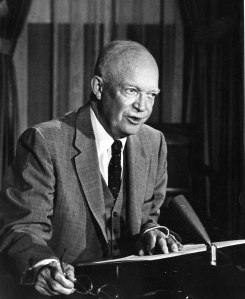
U.S. President Dwight Eisenhower kicked it off with his
“Atoms for Peace”
speech at the UN, 8 December 1953,
The Atomic Energy Agency could be made responsible for the
impounding, storage, and protection of the contributed fissionable
and other materials. The ingenuity of our scientists will provide
special safe conditions under which such a bank of fissionable
material can be made essentially immune to surprise seizure.The more important responsibility of this Atomic Energy Agency would
be to devise methods whereby this fissionable material would be
allocated to serve the peaceful pursuits of mankind. Experts would
be mobilized to apply atomic energy to the needs of agriculture,
medicine, and other peaceful activities. A special purpose would be
to provide abundant electrical energy in the power-starved areas of
the world. Thus the contributing powers would be dedicating some of
their strength to serve the needs rather than the fears of mankind….Against the dark background of the atomic bomb, the United States
does not wish merely to present strength, but also the desire and
the hope for peace.

And “Atoms for Peace” was part of an organized government PR campaign
(“Operation Candor”)
about Soviet nuclear weapons; see
http://www.eisenhower.archives.gov/research/online_documents/atoms_for_peace.html”>Dwight D. Eisenhower Presidential Library for sources.
Operation Candor was replaced by Operation Soothing Syrup (I am not making this up),
according to newspaper columnist (and leak publisher)
Stewart Alsop,
in his column of 23 November 1957.
Alsop wanted more candor, mostly because he wanted more nuclear weapons
to counter the Soviet Union’s nukes and missiles, yet his conclusion is
just relevant now as then:
It might make life simpler for high officials such as Mr. Cutler
if the American people were obedient sheep who
unquesiontingly obeyed the orders of daddy Governement.
But the United States is not the Soviet Union.
It is, instead, a society in which the Government
derives its authority from the people.
And such society is instantly in deadly danger
if the essential facts on which to reach a
reasoned judgment are concealed by the Government
from the people.
Take that, Atomic Energy Commission successor NRC!
And don’t worry, it’s not just government in this boondoggle,
and wasn’t back then, either.
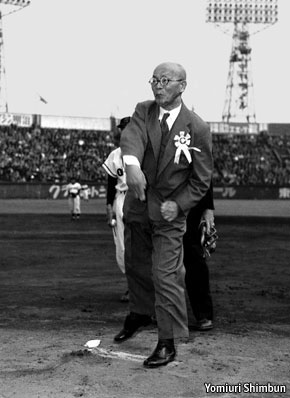
Meanwhile in Japan,
Matsutaro Shoriki, briefly jailed for war crimes during World War II),
was the head of the secret police
and then founded the newspaper Yomiuri Shimbun, and
set up the country’s first private television network.
According to the Economist 22 December 2012,
Matsutaro Shoriki,
Japan’s Citizen Kane:
A media mogul whose extraordinary life still shapes his country, for good and ill,
‘To cap it all, he was the “father of nuclear power”,
using his cabinet position and media clout to transform an
atom-bombed nation into one of the strongest advocates of atomic
energy. That legacy now smoulders amid the ruins of the Fukushima
Dai-ichi nuclear plant.’…But television was only the next stage in his journey. By 1954 Japan
was in the grip of anti-American hysteria. After the horrors of the
atomic bombings of Hiroshima and Nagasaki, American H-bomb testing
in the Pacific Marshall Islands blanketed 23 Japanese tuna fishermen
with radioactive ash. After one of the men affected died,
anti-nuclear passions soared. Shoriki, as well as America’s CIA, was
terrified at the thought that the Soviet Union and China might take
advantage of the uproar to displace American influence in Japan.He hit upon another remarkable plan, this time to use nuclear energy
as a tool of pro-American leverage. Yet another biographer claims
this was a CIA plot—an idea pooh-poohed by other scholars, who
believe that Shoriki exploited the Americans at least as much as
vice versa. Dwight Eisenhower had recently made his “Atoms for
Peace” speech, promoting the spread of nuclear energy to
counter the stigma of nuclear weapons. In December 1954 John Jay
Hopkins, president of General Dynamics, a pioneering nuclear
conglomerate, suggested an “Atomic Marshall Plan” for
Japan.Shoriki pressured Hopkins to travel to Tokyo to deliver the message
in person; at the first hint of assent, the Yomiuri splashed the
news on its front page. With all the hoopla that had heralded the
arrival of Babe Ruth more than 20 years earlier, the paper played up
the visit in May 1955. Shoriki used giant screens artfully erected
on street corners both to spread the pro-nuclear message and to
boost the fledgling NTV’s ratings.At the same time he and some of his pronuclear cronies in parliament
were pulling strings, with results that still resonate. He won a
Diet seat on a nuclear-energy platform, then helped form the Liberal
Democratic Party. It ruled Japan for almost all of the next 55 years
(and is now returning to power). In January 1956, as a cabinet
member of the first LDP government, he was appointed president of
Japan’s new Atomic Energy Commission. To the surprise and horror of
some of the scientists on the commission, his first announcement was
that Japan would have a reactor within five years. He never let
practicalities get in the way of a story.
The same Liberal Democratic Party of current Japanese Prime Minister
Shinzo Abe: Japan’s Nuclear Salesman-In-Chief,
as Sebastian Sarmiento-Saher called him in The Diplomat, 3 July 2013.
In order to promote Japan’s peaceful nuclear technology exports
abroad, Tokyo has recently reached out to a number of countries including
the United Arab Emirates (UAE), France, Turkey, India, and the Visegrad
Four (V4), which is composed of the Czech Republic, Hungary, Poland,
and Slovakia.In the UAE,
Mr. Abe and Prime Minister Sheikh Mohammed
bin Rashif al-Maktoum established a nuclear
cooperation agreement under which Japanese firms would supply
the UAE with components for the ongoing
construction of a nuclear power facility. Mr. Abe then signed a
deal with the Turkish government for a consortium of Japanese
and French companies to build a nuclear power plant and to then
supply it once it is completed. Back in Tokyo, Mr. Abe
hosted French President François Hollande last month, engaging a
would-be competitor in an agreement to cooperate in nuclear technology
exports.Further targeting emerging nuclear power
markets, Mr. Abe received Indian Prime Minister
Manmohan Singh in Tokyo last month, where the two accelerated
negotiations that, if successfully concluded,
will allow Japan to sell the second most-populous country
in the world the nuclear technology it needs to address its own energy
shortfalls. In Europe, Mr. Abe lobbied
vigorously on behalf of Japanese nuclear
power reactors and technology in Japan’s first
V4 summit – where he and his counterparts agreed
to cooperate in atomic energy development in Central EuropeAbe also traveled to Saudi Arabia to discuss nuclear
technology while protests in Brazil caused its President, Dilma
Rousseff, to postpone a trip to Tokyo where, like India,
she was set to accelerate nuclear cooperation with Japan to
build more atomic power reactors. Given Brazil’s growing energy
problems and the government’s plan to expand
nuclear power generation, it is likely that Brasilia and Tokyo
will have an agreement in the near future.


Now Japan may have come full circle, back to nuclear weapons,
as John Pate points out, with
Is Japan Developing a Nuclear Weapons Program?
Huge reprocessing plant could be used to stockpile plutonium for the future manufacture of nuclear weapons.
by Peter Symonds for Global Research 7 May 2013, sourcing from
Japan’s Nuclear Plan Unsettles U.S.
by Jay Solomon and Miho Inada
in WSJ 1 May 2013,
Japan is preparing to start up a massive nuclear-fuel reprocessing
plant over the objections of the Obama administration, which fears
the move may stoke a broader race for nuclear technologies and even
weapons in North Asia and the Middle East.The Rokkasho reprocessing facility, based in Japan’s northern Aomori
prefecture, is capable of producing nine tons of weapons-usable
plutonium annually, said Japanese officials and nuclear-industry
experts, enough to build as many as 2,000 bombs, although Japanese
officials say their program is civilian.

Yet Abe may not succeed in peddling nukes abroad and at home.
His predecessor and mentor, former Japanese PM Junichiro Koizumi,
is now
openly calling for no nukes.
And the
economics of solar power
may make the whole question moot, as Japan rapidly

expands its solar power production while its electric grid plays catch-up.
Even TEPCO, flailing so badly at containing the broken Fukushima nukes,
is deploying wind power offshore
and solar inland.
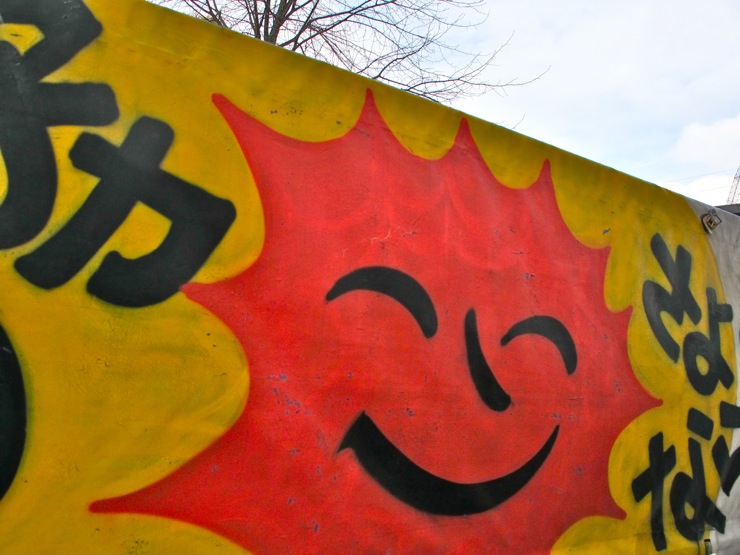
The sun is rising, on the east as well as the west.
-jsq
Pingback: Press freedom is not opposed to freedom –AP | On the LAKE front
Pingback: Nukes have always been a government sponsored b...