A long list of agricultural corporations wrote a letter
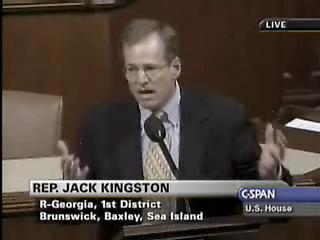
thanking Jack Kingson (R GA-01) for working to get the Monsanto rider
into the 2013 Ag. bill:
Again, we commend Subcommittee Chairman Kingston’s efforts and
urge the support of Section 733 in the Fiscal Year 2013 Agriculture,
Rural Development, Food and Drug Administration and Related Agencies
Appropriations Act.

This letter is on
Monsanto’s own website.
It contains not one word about public health or quality of food or preservation of farmers who do not choose to
poison people the Monsanto way.
The glyphosate mentioned in the letter is the principal ingredient in Roundup, and

research shows it causes DNA damage even when vastly diluted.
Monsanto’s glyphosate-resistant crops are genetically modified to include a gene which produces a poison that
other research indicates is toxic to humans.
These poisons are what the Monsanto rider makes harder to get out of fields.
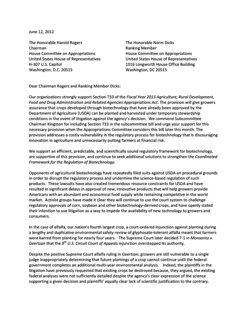
June 12, 2012
The Honorable Harold Rogers
Chairman
House Committee on Appropriations
United States House of Representatives
H‐307 U.S. Capitol
Washington, D.C. 20515The Honorable Norm Dicks
Ranking Member
House Committee on Appropriations
United States House of Representatives
1016 Longworth House Office Building
Washington, DC 20515
Dear Chairman Rogers and Ranking Member Dicks:
Our organizations strongly support Section 733 of the
Fiscal Year 2013 Agriculture, Rural Development, Food and Drug Administration and Related Agencies Appropriations Act.
The provision will give
growers assurance that crops developed through biotechnology that
have already been approved by the Department of Agriculture (USDA)
can be planted and harvested under temporary stewardship conditions
in the event of litigation against the agency’s decision. We commend
Subcommittee Chairman Kingston for including Section 733 in the
subcommittee bill and urge your support for this necessary provision
when the Appropriations Committee considers this bill later this
month. The provision addresses a costly vulnerability in the
regulatory process for biotechnology that is discouraging innovation
in agriculture and unnecessarily putting farmers at financial risk.We support an efficient, predictable, and scientifically sound
regulatory framework for biotechnology, are supportive of this
provision, and continue to seek additional solutions to strengthen
the
Coordinated Framework for the Regulation of Biotechnology.Opponents of agricultural biotechnology have repeatedly filed suits
against USDA on procedural grounds in order to disrupt the
regulatory process and undermine the science-based regulation of
such products. These lawsuits have also created tremendous resource
constraints for USDA and have resulted in significant delays in
approval of new, innovative products that will help growers provide
Americans with an abundant and economical food supply while
remaining competitive in the world market. Activist groups have made
it clear they will continue to use the court system to challenge
regulatory approvals of corn, soybean and other
biotechnology-derived crops, and have openly stated their intention
to use litigation as a way to impede the availability of new
technology to growers and consumers.In the case of alfalfa, our
nation’s fourth largest crop, a court-ordered injunction against
planting during a lengthy and duplicative environmental safety
review of glyphosate-tolerant alfalfa meant that farmers were barred
from planting for nearly four years. The Supreme Court later decided
7-1 in
Monsanto v. Geertson that the 9th U.S. Circuit Court of
Appeals injunction overstepped its authority.Despite the positive
Supreme Court alfalfa ruling in Geertson, growers are still
vulnerable to a single judge inappropriately determining that future
plantings of a crop cannot continue until the federal government
completes an additional multi-year environmental analysis. Indeed,
the plaintiffs in the litigation have previously requested that
existing crops be destroyed because, they argued, the existing
federal analyses were not sufficiently detailed despite the agency’s
clear expression of the science supporting a given decision and
plaintiffs’ equally clear lack of scientific justification to the
contrary.
The language in Section 733 maintains the ability of growers to
continue to grow previously de-regulated crops while giving the
Secretary of Agriculture the authority to impose immediate interim
measures if a judge rules that a “deregulation”
determination was not properly granted for a biotechnology-derived
crop. Such interim measures have previously been imposed by USDA for
glyphosate-tolerant sugarbeets in 2011, but even those interim
measures for sugarbeets are now being litigated. The language
ensures growers can continue planting and cultivating their crops
— with appropriate interim conditions — while disputes
about the sufficiency of federal analysis and paperwork continue.Section 733 provides certainty to growers with respect to their
planting decisions. If enacted, growers would be assured that the
crops they plant could continue to be grown, subject to appropriate
interim conditions, even after a judicial ruling against USDA.
Moreover, the language would apply only to products that have
already satisfactorily completed the U.S. regulatory review process
and does not remove or restrict anyone’s right to challenge USDA
once a determination of no plant pest risk has been made.The
inclusion of Section 733 is a positive step to ensure U.S. farmers
and our food chain are shielded from supply disruptions caused by
litigation over procedural issues unrelated to sound science or the
safety of biotech crops. This legislative solution ensures that
national agricultural policy is not being decided by the court
system while providing a level of certainty that is critical to
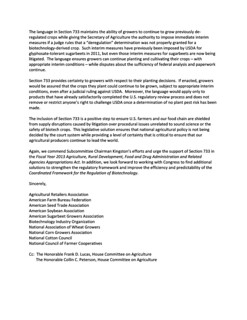
ensure that our agricultural producers continue to lead the world.Again, we commend Subcommittee Chairman Kingston’s efforts and urge
the support of Section 733 in the
Fiscal Year 2013 Agriculture,
Rural Development, Food and Drug Administration and Related Agencies
Appropriations Act. In addition, we look forward to working with
Congress to find additional solutions to strengthen the regulatory
framework and improve the efficiency and predictability of the
Coordinated Framework for the Regulation of Biotechnology.Sincerely,
Agricultural Retailers Association
American Farm Bureau Federation
American Seed Trade Association
American Soybean Association
American Sugarbeet Growers Association
Biotechnology Industry Organization
National Association of Wheat Growers
National Corn Growers Association
National Cotton Council
National Council of Farmer CooperativesCc: The Honorable Frank D. Lucas, House Committee on Agriculture
The Honorable Collin C. Peterson, House Committee on Agriculture
PS: Owed to Claudia Collier.
-jsq