Around here I hear local leaders say “we’ll never be Austin.”
Well, Austin may be letting San Antonio pass Austin as far as rooftop solar
and the jobs that generates.
It’s not a matter of size or pre-existing advantages.
It’s a matter of political will.
Do we have that will here?
TexasVox
wrote a white paper in February 2012,
Solar Austin: Rooftop Solar & Job Creation,
…the most direct route to attracting and encouraging the
development of clean energy industries is through the
the scale of future development will be orders of
magnitude greater than what has occurred to date.
mass deployment of local rooftop solar, which is probably why solar has
by far the most significant presence of any clean energy generation
technology in Austin.
But the paper’s point is that Austin is falling short.
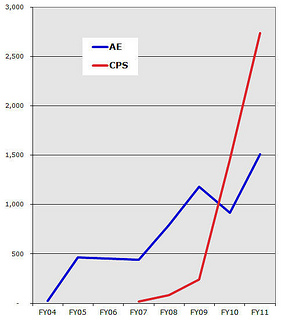
Look at the graph:
Austin seems to have settled for linear growth in solar power,
while San Antonio gets it about
compound growth.
As San Antonio Mayor Julian Castro
said in 2011, solar power is in
the nexus between sustainability and job creation.
Every now and then, perhaps once in a generation, there presents itself
a moment, an opportunity, for those cities that are willing to seize it,
to truly benefit the region for generations to come.
It’s great that
our Industrial Authority has gone solar.
That’s a good start.
But they can’t do it alone.
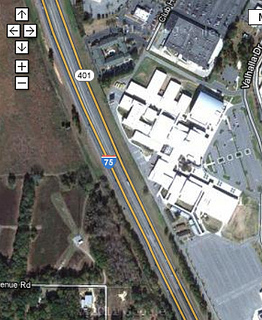
Where are the solar panels on the City Hall Parking lots, on the county palace,
on
Lowndes High School
or on
the conference center,
where all the world on I-75 can see them?
Where is our bond-financed solar rooftop rebate program
to create local jobs?
Back to the white paper:
Austin’s solar future: Turning hundreds of jobs into thousands
The success that has been achieved so far has come despite
significant technological obstacles which are quickly disappearing.
While rebates in 2004 started at $5.00/watt, this now exceeds the
total installed cost of most photovoltaic systems. As a result, the
per-watt rebate has been cut in half, meaning every utility dollar
invested goes twice as far. In the “clean energy capital of
the world” one would expect that such dramatic cost decreases
would be the harbinger of rapidly escalating deployment, but so far
this has not been the case for Austin.The chart at right comparing rooftop solar installations supported
by Austin Energy and San Antonio’s utility CPS tells two important
stories. The portion covering 2004 to 2008 tells the story of
Austin’s early success with pilot rooftop solar programs. The
portion since 2008 tells a very different story about how San
Antonio recognized that rooftop solar would soon break from its
niche and become a major energy resource and economic driver.Should Austin fail to make the same adjustments, it is unlikely that
the local solar industry could grow substantially in the near term.
This chart implies that the economic development benefits to those
cities that remain ahead of the curve will be far greater than what
Austin and other first-movers have experienced so far. The reason is
simple —
the scale of future development will be orders of
magnitude greater than what has occurred to date.
Even as an early
leader Austin has only deployed a few megawatts of rooftop solar,
whereas in the relatively near future we can anticipate hundreds or
even thousands of megawatts being deployed in those communities with
the right policies and conditions.
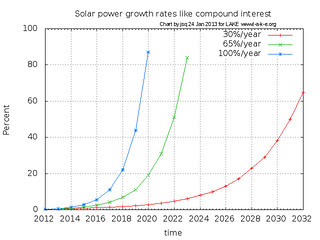
Do we want to be one of those “communities with the right policies and conditions”?
-jsq