Need any more proof that Southern Company’s nuclear boondoggle
only works with Georgia Power customer and taxpayer subsidy?
PSC rubberstamps one day and Fitch affirms ratings the next day.
Maybe we should elect Public Service Commissioners who will
serve the public.
Georgia Power PR 21 August 2012,
Georgia PSC approves Vogtle construction costs
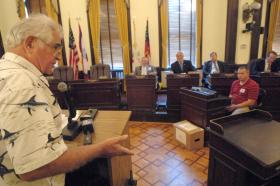
The Georgia Public Service Commission (PSC) today in a 5-0 vote
approved Georgia Power’s spending on Plant Vogtle units 3 and 4 for
the period including July 1, 2011 through Dec. 31, 2011.
The next day, Fitch PR 23 August 2012,
Fitch Affirms Ratings for Southern Company and Subsidiaries,
Fitch Ratings has affirmed the Issuer Default Rating (IDR) and
security ratings for Southern Company. In addition, Fitch has
affirmed the IDRs and debt ratings of Southern Company’s
subsidiaries, Alabama Power Company (Alabama Power), Georgia Power
Company (Georgia Power), Gulf Power Company (Gulf Power),
Mississippi Power Company (Mississippi Power) and Southern Power
Company (Southern Power). The Rating Outlook for all of the
subsidiaries is Stable except for Mississippi Power, which remains
Negative. Approximately $22 billion of long-term debt is affected by
these rating actions. A complete list of rating actions is provided
at the end of this release.Southern Company
Southern Company’s ratings recognize the financial support that the
company gets from its operating subsidiaries in the form of
dividends for the payment of corporate expenses, debt-service,
dividends to common stockholders, and for other business matters.
Southern Company provides equity funding to its subsidiaries for
their long-term growth while optimizing their capital mix. Southern
Company’s regulated utility subsidiaries derive predictable cash
flows from low-risk utility businesses, enjoy relatively favorable
regulatory framework in their service territories, and exhibit
limited commodity price risks due to the ability to recover fuel and
purchased power through separate cost trackers.


Southern Company’s subsidiaries, including its biggest one, Georgia Power,
“derive predictable cash
flows from low-risk utility businesses, enjoy relatively favorable
regulatory framework in their service territories….”
Yep, the Georgia PSC is a favorable regulatory framework all right.
Such regulatory capture is why Georgia Power enjoys a “low-risk utlity business”.
Wouldn’t you like to have all your risks underwritten by GA PSC
(and the Georgia legislature, and federal loan guarantees)?
Oh, sorry: you’re not a state-sponsored monopoly, and Georgia Power is.
Georgia Power’s PR doesn’t mention cost overruns; for them, see
GA PSC’s PR of the same day,
“For this reporting period, Georgia Power is not seeking any
changes to the schedule or certified budget amount of $6.113
billion,”said Commissioner Tim Echols.”If and when they
do bring changes in future periods, I’ll scrutinize it
closely.”In this Report, the Company acknowledges potential cost increases
associated with certain design changes made by the Consortium during
the Design Control Document review process. However, the Company
continues to state that the project is more favorable for customers
than originally anticipated at the time of the Certification given
the impact of cost savings from the Department of Energy’s Loan
Guarantee, Production Tax Credits and the Construction Work in
Progress in rate base. The Company will file its Seventh Semi-annual
Vogtle Construction Monitoring Report on August 31, 2012 for the
period ending June 30, 2012.

So Georgia Power hasn’t yet asked the PSC to approve its
$425 million (and climbing) cost overruns.
I wonder what Fitch’s plan is for when that happens 6-12 months from now?
Echols is the best of the utility-sponsored Public Service Commissioners,
in that while the rest
apparently took 70+% of their campaign contributions from people or companies
potentially affected by PSC decisions,
nearly one in five dollars in Echols’ contributions came from people or
companies whose business is affected by PSC decisions, the review found.
Hey, what if we elect some commissioners not beholden to the power utilities?
-jsq