A Japanese feed-in tariff apparently provoked an explosion of solar power,
making Japan head up towards China and Germany in installed solar power.
Where is the U.S.?
Where is Georgia, with much more sun than Japan?
Maybe there is something more to learn from Fukushima after all, SO CEO Tom Fanning.
Michael Fitzpatrick wrote for Fortune 13 June 2013,
Japan: The world’s new star in solar power; China and Germany have new competition at the top,
PV cell production and shipment (GWp) in Japan: Total (orange), Export (green), and Domestic (blue)
しばともAccording to a report by energy analyst IHS on Japan’s energy mix,
Japan’s solar installations jumped by “a stunning 270% (in
gigawatts) in the first quarter of 2013.” That means by the end of
2013 there will be enough new solar panels equal to the capacity of
seven nuclear reactors. Such massive growth will allow Japan to
surpass Germany and become the world’s largest photovoltaics (PV)
market in terms of revenue this year.


How did this happen?
Chico Harlan wrote for Washington Post 4 June 2013,
In Japan, new policy spurs solar power boom,
Across Japan, technology firms and private investors are racing to
install devices that until recently they had little interest in:
solar panels. Massive solar parks are popping up by the dozen, and
companies are mounting panels atop warehouse and factory rooftops as
part of a rapid buildup that one developer likened to an
“explosion.”The boom is striking in part because of how simply it was sparked
— by a little-noted government policy, implemented nearly a
year ago, that suddenly guaranteed generous payments to anybody
selling renewable energy, including solar power.Because of that policy, known as a feed-in tariff, Japan has become
one of the world’s fastest-growing users of solar energy, investors
and analysts say, a shift that comes as this resource-poor country
tries to find clean and homegrown alternatives to nuclear power.
This year alone, Japan is forecast to install solar panels with the
capacity of five to seven modern nuclear reactors.
The wapo article then makes a false claim that solar and wind cost more
(this ignores no cost of fuel, no cost of meltdowns, etc.).
Back to the Fortune article:
Until recently less than 1 percent of Japan’s electrical power
output came from renewables. But following the catastrophe of
Fukushima and the power blackouts that followed, Japan has seen an
explosion in investment in alternatives. Solar, in particular, in
this averagely photon-blessed country, has seen a seismic rise of
late and is this year poised to become the world’s largest solar
market in volume after China.According to a report by energy analyst IHS on Japan’s energy mix,
Japan’s solar installations jumped by “a stunning 270 percent
(in gigawatts) in the first quarter of 2013.” That means by
the end of 2013 there will be enough new solar panels equal to the
capacity of seven nuclear reactors. Such massive growth will allow
Japan to surpass Germany and become the world’s largest
photovoltaics (PV) market in terms of revenue this year.“Japan is forecast to install $20 billion worth of PV systems
in 2013, up 82 percent from $11 billion in 2012,” IHS said.
“In contrast, the global market is set for tepid 4 percent
growth. The strong revenue performance for Japan this year is partly
driven by the high solar prices in the country.” Germany still
leads with the total number of units and capacity, however, with its
32,192 megawatts. Japan is now closer to the US’s 8,069 megawatts at
7,429 megawatts, according to London-based BNEF.Solar energy in Japan has come to dominate thanks to government
incentives now offered to the producers of renewables and rules
which require public power utilities to buy alternative power at
above-market rates. A deal forged by the last government desperate
to wean Japan from its addiction to oil and nuclear power led to the
implementation of a very generous feed-in tariff (FIT) for renewable
power generators.
In Georgia, how about we start by
capping cost overruns for Georgia Power and Southern Company’s Plant Vogtle nuke boondoggle and
fixing that antiquated 1973 Territorial Electric Service Act to
facilitate solar power financing and resale through the grid.
Investors saw it coming says Hisashi Hoshi of the Institute of
Energy Economics. “Despite a shortage of available land in
Japan, many corporations who had unused land have rushed in. They
can now exploit those plots, once earmarked for expansion that never
came, to make money by building solar panels and selling on that
energy to the utility companies at a good profit.”
Hm, how about all those unused industrial parks we’ve got around here?
A 26.5 gigawatt solar power plant in western Japan, enough to power
9,000 households, opened last month, typically built on an unused
factory site. Even mothballed golf courses from the ’80s bubble
years are being pressed into productive service, says Hoshi.
Hey, the Country Club could get into the act!
And this is what we need in south Georgia:
“How long the boom in solar can last in Japan is hard to tell,
but as land runs out, there will be slowdown,” says Hoshi.
“Of course there are still the rooftops to exploit as mobile
carrier Softbank is doing. It’s renting rooftops for solar — a
very smart and interesting business model. Perhaps, unlike previous
attempts to deregulate Japan’s electric utility industry, this
should be a success.”
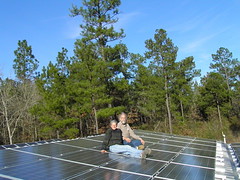
Rooftop solar for power, profit, and jobs!
-jsq