City of Valdosta PR today 5 December 2014,
Valdosta Named “Smart Energy Municipality of the Year”,
The City of Valdosta was named “Smart Energy Municipality of
the Year” by the
Technology Association of Georgia (TAG) on
Dec. 4, at an awards banquet held at the Georgia Tech Wardlaw
Building in Atlanta, Ga. The event recognized successful
individuals, businesses and municipalities who have shown dynamic
leadership over the past year in Georgia’s large and growing Smart
Energy sector.Sixty nominations were received collectively in the three
categories. In the municipality category, which includes cities,
counties and state government agencies, the City of Valdosta was one
of two finalists and the overall recipient of the award ” the
other finalist was the Georgia Department of Corrections.“We are extremely honored
to have been selected for this award,” said City Manager Larry Hanson. “The City of Valdosta has consistently sought out energy-saving initiatives that demonstrate stewardship of our natural resources. We are a strong supporter of smart energy technology, and we consistently pursue efficiencies to optimize our operations. Utilizing cost-effective investments and creative conservation measures, our goal to reduce our energy consumption needs by 10 percent will soon be a reality.”
Hanson accepted the award on behalf of the city and presented Valdosta’s most recently implemented energy-efficient and demand-management strategies, which include:
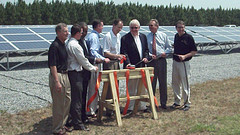
In partnership with the Valdosta-Lowndes County Development Authority, a 20-year lease was negotiated with Sterling Energy Assets and Hannah Solar, LLC, in 2011, to develop a 0.35 megawatt solar array on open city property located near its Mud Creek Wastewater Treatment Plant. The project represented a $1,750,000 capital investment by Sterling Energy Assets and Hannah Solar in equipment and construction. Electricity generated at the site is purchased by the Georgia Power Company under a 20-year purchase agreement.
In 2013, again in partnership with the Valdosta- Lowndes County Development Authority, the city was approached by companies specializing in the development of renewable/ sustainable energy projects proposing to develop and operate a solar photovoltaic facility in response to the Georgia Power Company Advanced Solar Initiative (GPASI), approved by the Georgia Public Service Commission. After review of proposals submitted by each company, Hannah Solar was again selected to construct and operate another solar array facility on remaining available land near the Mud Creek facility. A 20- to 30-year lease was granted on this property with Hannah Solar to produce up to 2.0 megawatts of solar energy for sale to the Georgia Power Company. The project represents a $2,500,000 capital investment by Hannah Solar in equipment and construction.- As is often the case, innovation is ahead of regulation. Currently,
Georgia law does not allow direct sale of alternative energy to a
user, but the energy must be sold to a regulated utility, then
re-sold. Legislation is being considered to change and modernize
this process. The city’s goal is to one day soon convert these land
lease agreements to direct energy agreements (land use for energy)
so that the Mud Creek facility can be powered directly by the solar
energy created on its property.- At its newly modernized
Mud Creek Wastewater Treatment Plant, the
city installed energy efficient fine-pore diffused aeration systems.
This state-of-the-art process incorporates highly efficient turbo
blowers, which greatly reduces energy costs and increases treatment
efficiency. Along with numerous other plant improvements, such as
energy-efficient filtration processes, pump upgrades, and LED
lighting, the Mud Creek plant will provide energy-efficient
wastewater treatment for years to come. This facility also has a
state of the art power generation system for back-up power as well
as use during peak rate season and peak day usage.
Within its wastewater collection system, efforts are ongoing to
modernize and optimize
the city’s pump stations via its
comprehensive Lift Station Rehabilitation Program. Since 2011,
various contracts have been awarded to design and upgrade 12 of the
city’s 28 wastewater pump stations, with more stations on the
horizon. These improvements include the installation of
energy-efficient pumps and screening systems, LED lighting, and
state-of-the-art computerized monitoring systems. Stations not
scheduled for complete rehabilitation have been integrated into the
monitoring system and retrofitted with LED lighting and energy
efficient motors, where necessary.
Energy consumption and costs associated with inflow and infiltration
(I&I) into wastewater collection systems can be extreme. With
the environment and efficiency in mind, the city initiated a broad
manhole and sewer rehabilitation program to thwart I&I problems.
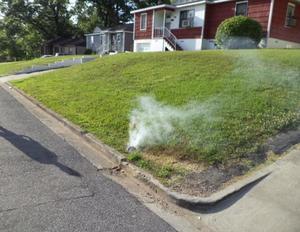
Through the use of
smoke testing and Closed Circuit Television
(CCTV) view of over 300 miles of sewer lines, the city is able to
significantly reduce I&I through a find-and-fix approach
”a process that is saving energy and chemical costs in
treatment and essentially creating new capacity at the plants to
avoid multi-million dollar expansions. With ongoing sewer line
improvements and a goal of rehabilitating a minimum of 30 sewer
manholes per year, the city is on track to significantly cut energy
costs related to I&I by 2018.- Over the years, Smart Energy processes have also been implemented
within the city’s water treatment and distribution system. In 1993,
the city built its Water Treatment Plant using Ozone as the primary
disinfectant ”the first plant of its kind in Georgia. When the
plant was expanded in 2003, the most modern technology was installed
so that the plant can be remotely operated if necessary
”including chemicals, deep wells, and plant processes. This
plant, named the 2013 Georgia Association of Water Professionals
Water Treatment Plant of the Year withdraws 3.3 billion gallons of
water a year from nine onsite wells located 300-400 feet into the
Floridan aquifer, then treats it and delivers it through over 300
miles of lines to over 20,000 customers. In addition, LED lighting
is being installed or retrofitted throughout the water system at
storage tanks, water well sites, and the water treatment plant. The
plant is equipped with its own stand-by generator, frequently
generating its own power on high-demand days in order to free up
power for other utility customers.
The City of Valdosta Engineering Department changed all traffic
signal bulbs to LED bulbs about 10 years ago, realizing substantial
cost savings in both power and life expectancy. Also, through a
pilot project with Georgia Power which begins in January 2015, the
city will be changing all of its street lights to LED lighting
”resulting in future power savings and tremendous
efficiencies. Valdosta will be one of the first five cities in
Georgia to make this change and the first in South Georgia.Although these improvements are a good start toward improving energy
efficiency, the city realizes that Smart Energy will not succeed
without an energy conservation mindset and culture. Understanding
this, city leadership routinely educates its management and staff on
the importance of energy efficiency and environmental awareness and
encourages other community organizations to do the same.“The City of Valdosta will continue to pursue and incorporate
Smart Energy processes in managing our public assets,” said
Mayor John Gayle. “We encourage other entities to implement
environmental sustainability and energy-efficient practices, as
well. In doing so, we can collectively and significantly impact jobs
and economic growth in our community and throughout South
Georgia.”For more information, visit
www.valdostacity.com.