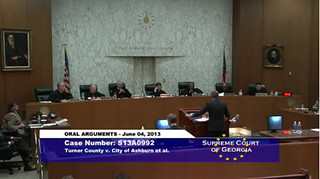
Here’s the Georgia Supreme Court’s own video of
S13A0992 Turner County v. City of Ashburn et al.
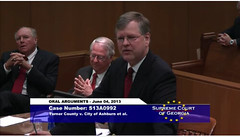
Tuesday, June 4, 2013.
It starts with the attorney for Turner County, Walter Elliott
(who is also Lowndes County Attorney)
apparently arguing that the courts shouldn’t intervene because
only legislative bodies should decide on taxes.
The judges didn’t seem to understand his argument.
One judge wondered how disputes would be settled then.
Elliott said the local elected bodies would decide or the tax
wouldn’t be levied.
Another judge pointed out that legislative bodies could delegate
administrative functions.
Later the same judge asked how to distinguish this case from
a child custody case as far as criteria and a court being
able to decide.
Elliott claimed that was a judicial function, but allocating
tax dollars was not.
The judges didn’t seem to be buying the city attorney’s argument later, either.
Funny how the Supreme Court of Georgia videos its sessions,
but the Lowndes County Commission does not.
Here’s
the subject of the case:
In this dispute between the governments of Turner County and three
cities over how Local Option Sales Tax (LOST) proceeds should be
distributed, the county is appealing a superior court ruling which
picked the cities’ plan for distribution over the county’s.
GA Supreme Court’s written summary of these arguments
(
Dave Miller, WALB, 3:48 PM EDT 4 June 2013):
ARGUMENTS: Attorneys for the county argue the superior court erred
in denying the motion to dismiss the case because the “2010
amendment violates the separation of powers clause of the Georgia
Constitution by conferring upon the judicial branch the legislative
function of determining the benefit of the tax.”The statute unconstitutionally “confers upon the judicial branch
‘the legislative discretion’ of allocating the proceeds of the tax
between (a) the county for the benefit of all county property
taxpayers and (b) the cities for the sole benefit of city property
taxpayers,” the county’s attorneys argue in briefs. The statute is
also unconstitutional because it: “empowers a city to cause a tax to
be imposed beyond the territorial jurisdiction of the city in
violation of the due process clauses” of the Constitution; “empowers
a city to require a county to levy a tax for county purposes in
contradiction of the board of commissioners’ exclusive jurisdiction
over the levying of taxes for county purposes;” and “limits the
power of the judiciary by restricting the decision of the assigned
judge to adopting the best and final offer of one of the parties.”Under the amended statute, neither the levy of the tax nor the
allocation requires the approval of the board of commissioners of
the county. Rather, the mayor and city council can cause the tax to
be levied, and the judge has the power and authority to allocate the
proceeds, the attorneys argue. They contend the judge erred by
adopting the cities’ best and final offer because he based his order
on a consultant’s report and failed to include mandatory findings of
fact in the order. And the judge was wrong to preclude the
presentation of evidence by witnesses, the attorneys argue, ordering
the submission of consultant reports and limiting the hearing to
argument by the parties’ attorneys.
Attorneys for the cities argue the trial judge made the correct
ruling in upholding the constitutionality of the statute. The 2010
amended statute made the judge the arbitrator but does not vest in
him the power to determine the distribution of the tax. “It
specifies that the parties, through negotiation, arbitration and
through their respective best and final offers, shall determine the
distribution of the tax, and the arbitrator has nothing to do with
that process,” they argue in briefs. “It is only where the parties
submit best and final offers which reflect their disagreement that a
judicial function comes into play.The arbitrator had before him what essentially were two offers, each
specifying how the proceeds were to be divided.” He then selected
the offer which he determined best satisfied the criteria laid out
in the statute. The county has misunderstood the nature of this tax,
the cities argue. “It is not a county tax,” their attorneys argue.
“It is a district tax, thus the power granted to the city is to
initiate a district tax, not to compel a county to implement tax for
county purposes which the county may thereafter not repeal.”Before the legislature amended the statute, if parties did not
agree, the tax lapsed. “It thus often developed that a party whose
need for the tax might be less than the other parties’ imposed its
will on the others by threatening to allow the tax to lapse, thus
compelling the other parties to give in so as to preserve a much
needed source of revenue,” the cities’ lawyers contend. “This was
the evil which the 2010 amendment sought to cure.” The county now
complains that this has violated “some right it somehow had to have
control over LOST,” the attorneys argue. “It seems to believe that
complete authority over taxation is vested in counties and that the
General Assembly cannot divest them of this authority.” They also
argue that the judge did provide findings of fact, as the statute
requires, by determining “that the best and final offer of the
plaintiffs the City of Ashburn, Georgia, the City of Rebecca,
Georgia, and the City of Sycamore, Georgia more closely comports
with the requirements and intent” of the amended statute than the
county’s offer.Finally, there is nothing in the record supporting the county’s
contention that the judge precluded the production of evidence or
limited the hearing to attorneys’ arguments. The county “made no
motions, obtained no orders of the arbitrator, and made no effort
whatsoever at the hearing to present witnesses or evidence,” the
cities’ lawyers contend.Attorneys for Appellant (County): Walter Elliott, James Elliott
Attorneys for Appellees (Cities): Franklin Coleman, III, R. Kelly
Raulerson, James Davis
-jsq