Yet another reason why we should take water into account in
any development plan:
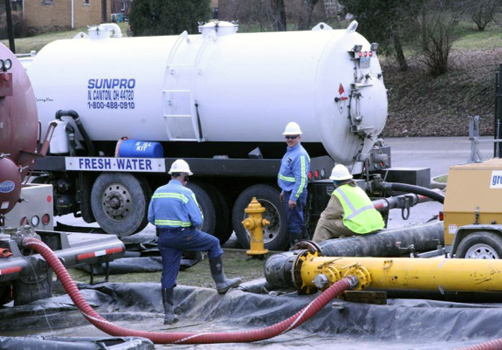
fracking for shale gas
uses huge amounts of water, competing with everything else,
maybe even using more than power plants and cities.
Delaware Riverkeeper and Protecting Our Waters wrote for Waterkeeper Alliance today,
The Water Footprint of Shale Gas Development,
Recent studies examining potable water supplies on a global scale,
the current trends in American water consumption and the causes of
depletion of this essential resource are helping us to understand
that the footprint of shale gas development expands indefinitely
when measured in water….Of the seven nations where the groundwater footprint is greatest,
the U.S. is one of the fastest speeding towards disaster. According
to Cynthia Barnett’s Blue Revolution, scientists say the 20th
century was the wettest in a thousand years and now drier times are
ahead.[3] This means that many of the management schemes we use
now—based on 20th C planning—need to be changed to avoid
catastrophe. So the 410 billion gallons of water America uses every
day will suck the nation dry if we don’t stop over-tapping nearly
every river and aquifer.The biggest U.S. users are power plants and agriculture with private
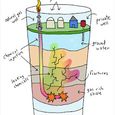
and public utilities next,
supplying the average 147 gallons per
person per day that Americans use (four times more than we each used
in 1950), far greater than the 33 gallons the Dutch use per capita
and the 5 gallons per day used by people in many impoverished
nations. Scientists say America’s High Plains and Floridan Aquifers,
both enormous and water-rich, are being used faster than they can
recharge—Florida can no longer fill its state’s drinking water
needs and Lake Mead behind the Hoover Dam on the Colorado River has
a 50-50 chance of going dry by 2021.[4]…
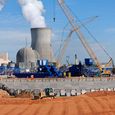
Remember,
Nuclear Plant Vogtle already uses more water
than agriculture for the middle Savannah River watershed,

and with the two new units will (if it doesn’t already)
use more water than the city of Savannah.
And
coal and biomass are almost as bad for water overuse.
The Floridan Aquifer is our aquifer,
the one
Ben Copeland reminded us Jacksonville and Tallahassee and Orlando also
drink from.
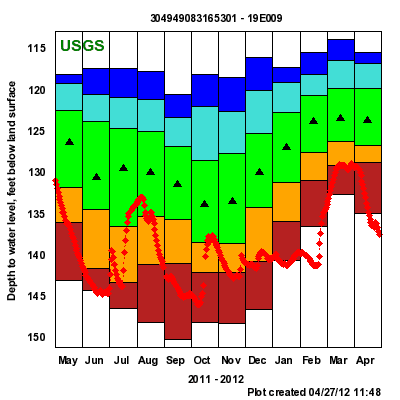
While
our groundwater has been at historically low levels
for most of the past year.
Water levels have finally recently risen back into average ranges
with the recent rains,
but what will happen if we keep using water like we are,
and add fracking to that?
Enter hydraulic fracturing for shale gas.
The water footprint for
shale gas is defined in two main ways—water consumed and water
polluted.

See
the article for the details, which ain’t pretty.
Worth thinking about the next time you see
energy experts making excuses for fracking.
We don’t need to be doing this, considering already when all costs,
including fuel, are taken into account,
solar, which needs no fuel, already beats natural gas on price.
-jsq
PS: Owed to Michael Noll.
Take note of recent developments in Europe in regard to fracking: http://www.huffingtonpost.com/2012/08/23/eu-green-energy-shale-gas-europe_n_1823901.html