
Sue the state? You’ll lose, because of sovereign immunity,
unless HB 59 passes.
Then you might be able to sue GA-DNR for circumventing permiting
in allowing construction on the Georgia Coast, or if it
should approve a compressor station in Albany, or if it
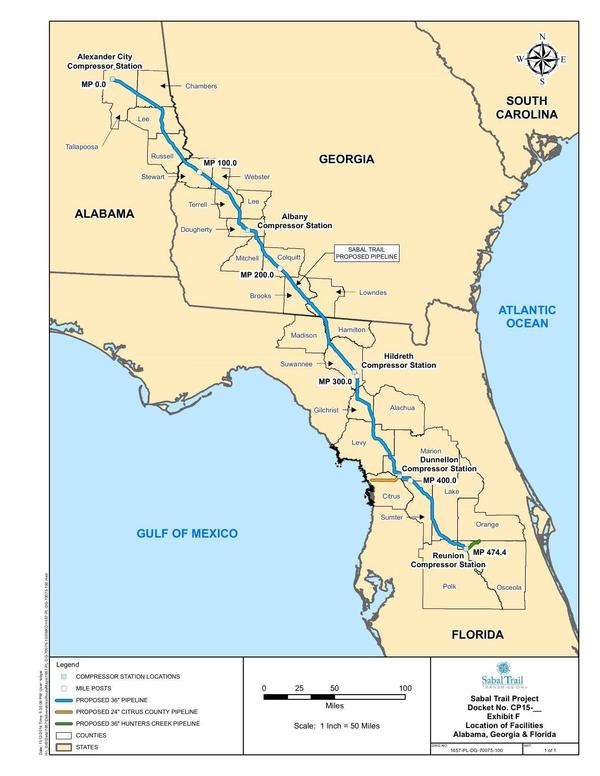
should issue any other permits for the Sabal Trail fracked methane pipeline.
State agencies such as the Department of Natural Resources (GA-DNR),

can use “letters of permission” to do things like make alterations to
Georgia’s coast, and anyone suing to stop it runs up against sovereign immunity
unless the issuing agency has expressly waived it.
Now that may change with
HB 59,
“State tort claims; waiver of sovereign immunity for declatory judgment or injunctive relief; provide”.
It has six co-sponsors, including
Jay Powell, District 171, Camilla, Mitchell County, GA.
Here’s the key part:
SECTION 1.
Chapter 21 of Title 50 of the Official Code of Georgia Annotated,
relating to waiver of sovereign immunity as to actions ex contractu
and state tort claims, is amended by adding a new article to read as
follows:“ARTICLE 3
50-21-50.
The defense of sovereign immunity is waived
as to any action brought in the courts of this
state by an aggrieved person seeking declaratory judgment or injunctive relief.”
What’s not to like?
Citizens and aggrieved organizations should be able to sue the state
for overreach.
But the UGA Regents and the state Attorney General’s office don’t think so.
Kathleen Baydala Joyner, Daily Report, 2 February 2015,
Georgia AG, Regents Say Bill Waives Too Much Sovereign Immunity,
Georgia’s attorney general and university system governing board
want to trim a bill that would waive the state’s sovereign immunity
in certain cases.During a hearing Monday morning at the Capitol, representatives from
the Law Department and the Board of Regents told lawmakers they
didn’t disagree with the intent of House Bill 59—to undo the
effects of a 2014 Georgia Supreme Court ruling that said sovereign
immunity blocked all lawsuits seeking injunctive relief from the
state.But they argued the bill, which says sovereign immunity would be
waived “as to any action brought in the courts of this state by an
aggrieved person seeking declaratory judgment or injunctive relief,”
was too broad.Waiving sovereign immunity as a defense for declaratory judgment
could lead to “everyday decisions of state government being overseen
by the courts,” said Nels Peterson, vice chancellor of legal affairs
for the University System of Georgia. To protect the separation of
powers, the waiver in the bill should be limited to only cases
seeking injunctive relief, Peterson said.Peterson also said the bill, as written, could be interpreted to
subject entities such as the Department of Corrections and public
schools to certain lawsuits challenging their authority. Under the
Administrative Procedures Act, those agencies are exempted from
suits challenging their rules in Superior Court if the rules violate
someone’s rights.“The giving up of these sorts of agencies to regular declaratory
judgment has the real potential for unforeseen consequences,” he
said.During a hearing Monday morning at the Capitol, representatives from
the Law Department and the Board of Regents told lawmakers they
didn’t disagree with the intent of House Bill 59—to undo the
effects of a 2014 Georgia Supreme Court ruling that said sovereign
immunity blocked all lawsuits seeking injunctive relief from the
state.But they argued the bill, which says sovereign immunity would be
waived “as to any action brought in the courts of this state by an
aggrieved person seeking declaratory judgment or injunctive relief,”
was too broad.Waiving sovereign immunity as a defense for declaratory judgment
could lead to “everyday decisions of state government being overseen
by the courts,” said Nels Peterson, vice chancellor of legal affairs
for the University System of Georgia. To protect the separation of
powers, the waiver in the bill should be limited to only cases
seeking injunctive relief, Peterson said.Peterson also said the bill, as written, could be interpreted to
subject entities such as the Department of Corrections and public
schools to certain lawsuits challenging their authority. Under the
Administrative Procedures Act, those agencies are exempted from
suits challenging their rules in Superior Court if the rules violate
someone’s rights.“The giving up of these sorts of agencies to regular declaratory
judgment has the real potential for unforeseen consequences,” he
said.

Pictured is Britt Grant, solicitor-general for the state department of law,
who the article says “said her office has many of the same concerns as the Board of Regents.”
OK, those are some legitimate concerns.
Peterson wants an aggrieved person defined according to standard federal
requirements, “injury in fact, causation and redressability” along
with some other constraints.
What about the parties who brought this bill?
(As usual, I added the links and images.)
House Judiciary Chairman
Wendell Willard, R-Sandy Springs, said he
introduced the bill in response to the high court’s ruling last
February in
Georgia Department of Natural Resources v. Center for
Sustainable Coast, 294 Ga. 593. In the decision, the Supreme Court
unanimously overruled its 1995 decision in
IBM v. Evans, 265 Ga. 215.In the IBM case, the court said the state Constitution allowed a
plaintiff to seek injunctive relief against the state or public
officials who acted outside the scope of their authority. In the
Sustainable Coast case, the court found the opposite, saying the
Constitution vested the power to waive sovereign immunity
exclusively with the Legislature.


The
Center for a Sustainable Coast
also lost another such case against GA-DNR last year,
756 S.E.2d 554 (2014),
326 Ga. App. 288
CENTER FOR A SUSTAINABLE COAST, INC. et al. v. GEORGIA DEPARTMENT OF NATURAL RESOURCES.
Court of Appeals of Georgia.
March 17, 2014.
The appeal started two years earlier,
734 S.E.2d 206 (2012),
CENTER FOR A SUSTAINABLE COAST, INC., et al. v. GEORGIA DEPARTMENT OF NATURAL RESOURCES.
Court of Appeals of Georgia.
November 13, 2012.
The complaint alleged that the CRD was violating the Shore
Protection Act (“the Act”) by issuing letters of permission for
construction activities that, under the Act, require a permit. OCGA
§ 12-5-230 et seq. Pursuant to OCGA § 12-5-237,(a) No person shall construct or erect any structure or construct,
erect, conduct, or engage in any shoreline engineering activity
or
engage in any land alteration which alters the natural topography or
vegetation of any area within the jurisdiction of this part, except
in accordance with the terms and conditions of a permit therefor
issued in accordance with this part. A permit may authorize the
construction or maintenance of the project proposed in an
application. After construction of a project pursuant to a permit,
the project may be maintained without a permit so long as it does
not further alter the natural topography or vegetation of the site
or increase the size or scope of the project.(b) No permit shall be required for a structure, shoreline
engineering activity, or land alteration which exists as of July 1,
1979, provided that a permit must be obtained for any modification
which will have a greater adverse effect on the sand-sharing system
or for any addition to or extension of such shoreline engineering
activity, structure, or land alteration; provided, further, that, if
any structure, shoreline engineering activity, or land alteration is
more than 80 percent destroyed by wind, water, or erosion as
determined by an appraisal of the fair market value by a real estate
appraiser certified pursuant to Chapter 39A of Title 43, a permit is
required for reconstruction.In order to obtain a permit, an applicant must comply with myriad
requirements, which includes providing the names and addresses of
all landowners whose property adjoins or abuts the parcel of land.
See, e.g., OCGA § 12-5-238. The permit is then submitted to a
Shore Protection Committee, which is comprised of the Commissioner
of the DNR and four others.2 OCGA §
12-5-235(a) & (b). The interested parties and adjoining landowners
are provided notice of the proposed action before any permit is
granted. See OCGA § 12-5-239(b). In determining whether to
grant the permit, the granting authority must consider whether the
proposed action is unreasonably harmful; whether completion of the
project will unreasonably interfere with conservation of marine life
or wildlife; and whether completion of the project will unreasonably
interfere with public access and enjoyment of public properties.
OCGA § 12-5-239(i).Although the Act does not contain any provision for circumventing
the permit process,3 [734 S.E.2d 208] the
CRD often issues letters of permission for certain requests without
requiring the applicant to formally seek a permit. Such letters of
permission have allowed petitioners to take actions ranging from the
rebuilding of houses and drainage systems, to the construction of a
film set. The Center sought injunctive relief and declaratory
judgment stating that the issuance of letters of permission were
ultra vires acts. The Center also asserted claims for equal
protection violations, due process violations, and attorney fees.

So it looks like GA-DNR by convention frequently circumvents state law
to issue permits without due process,
and the Center has objected in at least two court cases.
According to
the Association of County Commissioners of Georgia (ACCG),
nonetheless at least one other case, while citing one of the Center’s
losses, has successfully gotten around sovereign immunity:
City of Hapeville v. Grady Memorial Hospital Corporation
Georgia Court of Appeals
August 18, 2014; A14A0724This case involves the issues of sovereign immunity and the failure
to pay for medical services rendered to inmates in the custody of
city. A hospital sued the city seeking payment for treatment of four
prisoners transported by the city to the hospital. The Court of
Appeals found that the trial court correctly determined that
O.C.G.A. 42-5-2(a) waived sovereign immunity. Interestingly, the
Court works around the seeming limitation of the Center for a
Sustainable Coast case and states that express waiver words are not
necessarily required and that an express statutory waiver can occur
if a statute creates a right of action against the state which can
result in a money judgment and the state would otherwise have
enjoyed sovereign immunity. Otherwise, the legislative act would
have no meaning. The wording of the statute in this case meets this
test. Since municipal sovereign immunity is provided in O.C.G.A.
36-33-1, et seq., the court notes the waiver under O.C.G.A. 42-5-2
also includes municipalities because O.C.G.A. 42-5-2(b) covers
inmates to whom O.C.G.A. 42-4-1, et seq. applies, thereby including
inmates held by cities.
Apparently if you can find a statute that doesn’t expressly waive
sovereign immunity yet can be interpreted as creating a right of action
anyway, you can successfully sue.
The next obvious step is a bill to clarify the law.
Back to House Judiciary Chair Willard in the Daily Report:
Willard said the Legislature must act, as it did years ago when it
waived sovereign immunity in tort cases against state officers and
employees, because the high court laid out an alternative that would
be worse. He cited the Sustainable Coast opinion, written by Justice
Carol Hunstein, which stated, aggrieved citizens may “seek relief
against such [state] officers in their individual capacities.”“What I don’t want is for us to put individuals working on behalf of
the state in the position of being sued as a way to get around the
Constitution,” Willard said. “I don’t think we should have people
exposed in that manner.”
So that’s how to get the legislature to act:
get a court to say otherwise individual state employees might be liable….
When I discussed HB 59 with
David Kyler, Executive Director of the
Center for a Sustainable Coast, he expressed surprise that he
was named in a writeup about the bill, since he and the Center
had had nothing to do with drafting or submitting it.
Presumably it was this paywall article by Dave Williams
for Atlanta Business Journal 23 January 2015,
Legislation targets state’s immunity from lawsuits,
which includes:
“We want the courts to be able to entertain an action that says,
‘The state is doing something wrong to me and I want it stopped,’ ”
said Georgia Rep. Wendell Willard, R-Sandy Springs, the bill’s chief
sponsor.
Seems to me that would be a good thing if, for example,
GA-DNR should approve a permit for Sabal Trail’s Albany compressor station
despite the many reasons not to expressed by for example
Ted Turner’s Nonami Plantation
and Greenlaw,
not to mention the resolutions against Sabal Trail’s pipeline by
five Georgia counties and two cities, including the ones by
Dougherty County and Albany that explicitly say they don’t want
that compressor station.

It would be a good thing if any state agency approves a permit for
KinderMorgan’s Elba Island LNG Export project on the Georgia coast,
which quite possibly could, perhaps not coincidentally, get gas from Sabal Trail through
existing pipelines across Georgia.
Sabal Trail would go right by Auburn, AL, which you see marked on the KinderMorgan map below
as on pipelines right across to Elba Island LNG.

Seems to me the mere possibility of being sued might make a state
agency think twice before rubberstamping a pipeline or LNG export
terminal for corporations from some other state, such as Spectra Energy
of Houston, Texas and FPL of Juno Beach, Florida for the Sabal Trail
pipeline, or KinderMorgan of Elk Grove Village, Illinois for Elba Island LNG export.
-jsq