If the most populous country in the world can do it,
even the Sunshine State and the rest of the world can do it.
With no new nuclear,
depending heavily on on energy efficiency and conservation,
using China’s huge number of rooftops for solar power,
with almost as much wind power, plus a bit more hydropower,
China can go 80% renewable energy by 2050.
While reducing energy use per capita and increasing
GDP per capita.
So this path will not only improve Chinese quality of life
by getting rid of massive pollution by
reducing emissions 90% from
otherwise-projected levels; it will also give Chinese citizens
more money in their pockets.
China has no more sunshine than the U.S. or much of Canada does,
so there’s no reason the Canada, U.S., and pretty much every country can’t do this, too.

The WWF report,
China’s Future Generation: Assessing the Maximum Potential for Renewable Power Sources in China to 2050, by
William Chandler, Chen Shiping, Holly Gwin, Lin Ruosida, and Wang Yanjia,
February 2014,
does pencil in quite a bit of natural gas,
but carefully hedges that:
The High Renewables scenario assumes that the Chinese government’s
targets for gas expansion are not fully met and that gas remains
relatively expensive for some time before seeing significant growth
in China. This scenario limits gas to 17 percent of China’s
electricity mix by 2050, used only to satisfy power demand during
peaking episodes. If China sourced all of its gas domestically in
this scenario, the country would need to rely on unconventional gas
(i.e., shale gas and/or coal bed methane).Admittedly, including gas in this scenario should raise some
concern. While gas emits fewer carbon emissions than coal at the
point of combustion, uncertainty about fugitive methane emissions,
associated particularly with extraction and shipping of gas to
point-of-use, raises valid questions about the climate benefits of
gas, particularly in the short run.
Concern about fugitive emissions
has increased given that the UN Intergovernmental Panel on Climate
Change recently revised the potency level of methane showing that it
is 34 times higher than CO2 (on a 100-year time scale).viii
If
fugitive emissions are not sufficiently controlled, the climate
benefits would be cancelled out, making gas as environmentally
detrimental for the climate as coal, or even more so.
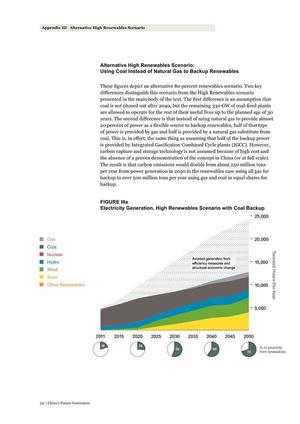
In other words, keeping some coal generation may be better than
using fracked methane.
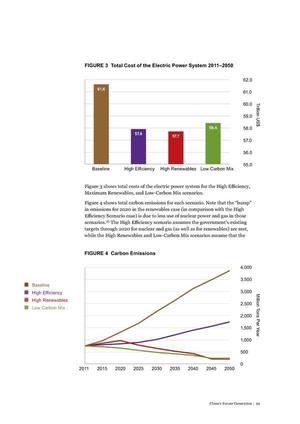
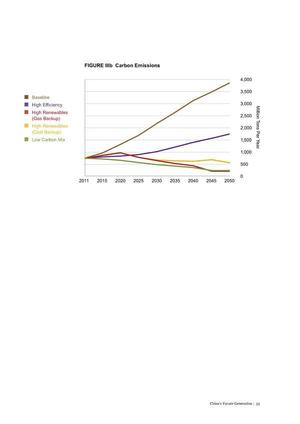
WWF’s scenario for that is shown in the graph above.
Even with coal, total emissions would still be around far less
than formerly projected and less than currently, because so much power generation would
be avoided through conservation and efficiency, and so much
would be generated by sun, wind, and water, as shown in the graph below.
Or, even better, develop energy storage.
2050 is 36 years from now.
That’s plenty of time to get on with
compressed air storage, or better batteries, or something else.
So even just using today’s known technology, China can
go 80% sun, wind, and water by 2050.
Which means the real Chinese future can be even better than that.
So can the real U.S. future if we stop letting utilities like FPL
keep wasting resources including our local land on boondoggles like
FPL’s proposed
Sabal Trail fracked methane pipeline
and instead insist they get on with sun, wind, and water power now.
Georgia Power is at least doing some solar power after many of us
insisted last year.
FPL can, too.
-jsq